
Translated material
Sanding clock in development biology
In the article by Leo Klein in the last issue of the TRV-hunger, the biogenetic law of Geckel was mentioned, according to which the ontogenesis repeats the phylogenesis, i.e. The embryo of the “higher” organism (for example, a person) becomes in the process of development similar to organisms, more primitive - - fish, amphibians, poultry, etc. Unfortunately, this law is not easy
I am incorrect, but also one of the dark spots in the history of evolutionary teaching; It is not without reason that creationists love him so much. Geckel, a skilled drawingman, depicted in his books not what he saw, but what he wanted to see based on the idea of the progress of the organic world. However, the same creationists forget to say that modern evolutionary biology has long abandoned this law.
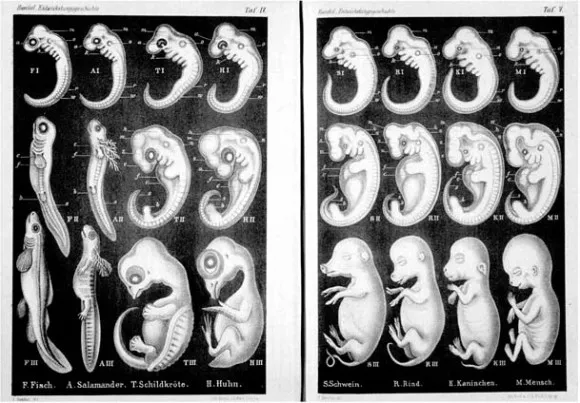
But in it the back of the Berian law, named after German (as, as, for example, the authors of Nature [1]) of the scientist, one of the founders of embryology, Karl Maksimovich von Baer, who was born in Esteland and lived most of his life in Russia, is preserved. In 1828, he drew attention to the fact that at a certain stage in the development of the embryos of all vertebrates they are very similar to each other, and in the course of development they have more and more special signs. This stage is called Philotypical, since at this time there are signs characteristic of the type of “vertebrates”, and it is not at all the earliest. In embryology, this phenomenon is called the "model of the hourglass" - wide at the edges and narrow in the middle.
But, as the history of Geckel shows, morphological similarities are a deceptive thing, it is difficult to strictly determine. But modern methods of molecular biology make it possible to evaluate the intensity of genes and compare it in different organisms. This was done by a group of scientists from the Dresden Institute of Molecular Biology and Genetics of the Society of Max Planck [2]. They measured the intensity of the work of genes in six types of fruit flies, evolutionarily located from each other at different distances- from the Drosophila melanogaster and D. Simulans very close to each other D. virilis (the evolutionary distance between them is approximately like between
DU person and mouse). Measurements were made on the embryo every two hours, after which the intensities obtained for different types were compared at each temporary cut. It turned out that, as the model of the hourglass predicts, interspecific differences in the early and later stages are significant than in the middle of embryonic development.
But you can go on a different path. By comparing the genomes of modern organisms, it is possible to determine the time of the occurrence of individual genes and, thus, attribute its evolutionary age to each gene: from the most ancient, available in almost all modern organisms, up to bacteria, to young, specific for narrow taxonomic groups. Then you can measure the average age of genes working at a particular stage of development. This was done by a group from another Max-Plankovsky Institute-the Institute of Evolutionary Biology in Plena [3]. Scientists have experimentally studied the work of genes in the Danio Rerio aquarium fish, one of the standard model organisms in the biology of development. Genes were measured at 60 points, from fertilized eggs to aging individuals. It turned out that ancient genes work relatively evenly throughout the development, while younger ones in the early or later stages. Similar results were obtained when analyzing the data available in the literature obtained by other authors for other purposes: on the same fruit flies, on mosquitoes and nematodes.
So, what turns out: young, specialized genes work mainly in the early and late stages of development, and, apparently, it is the differences in the work of these genes that cause interspecific differences - this natural conclusion, strictly speaking, must be confirmed by analysis of data, since it was not verified in any of the works, but it seems very believable. For the late stages of development, this is quite natural, because according to the law of the bera, it is then that specific features are established. For the early stages, the point, apparently, is that at this time the cell massif is going on and thin details are not very significant. At the same time -as embryologists have long been seen, the foundations of the body structure plan are laid in both vertebrates and insects in the middle stages of development. This requires thorough coordination of the work of all functional systems. Accordingly, the most ancient genes that form stable regulatory networks are involved.
Mikhail Gelfand
- B.PRUD'Homme, N.Gompel. Genomic Hourglass. Nature 468: 768-769 (2010).
- Atkalinka, ..., P.tomancak. Gene Expression Divergence Recapitulates The Developmental Hourglass Model. Nature 468: 811-814 (2010).
- T.Domazet-loso, D.Tautz. A Phyloge-Netically Based Transcriptome Age Index Mirrorors OntoGenetic Divergence Patterns. Nature468: 815-818 (2010).