
Translated material
Religious Code: for and against
In society
 Religious Code: for and against
September 12, 2012 Daily Journal
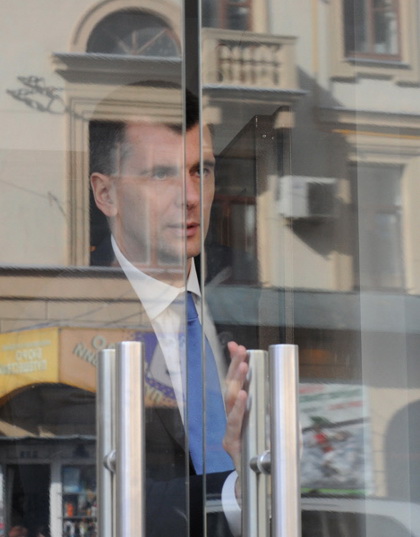 The businessman and leader of the Civil Platform party Mikhail Prokhorov proposed to develop a religious code to resolve relations of the church, state and society. Already too restless, in his opinion, recently in this field, constant conflicts have led to almost the split of society. It's time to somehow solve the problem.
“I call for the immediate beginning of a wide dialogue about the settlement of the relations of the Church (of course, referring to all churches and confession, religion as a whole), state and society. This can be done on the basis of the "Civil Platform" through the instruments of crowdsourcing and public discussion, ”Prokhorov writes in an article published today in Kommersant.
“The goal of such an initiative should be to develop the concept of the Code of Churches and Religions of the Russian Federation or the Religious Code - by analogy with the civil or family codes. Then lawyers will take up the case, who will turn the concept into a full -fledged legal document, ”Prokhorov suggests.
He promises that "parallel to the party" Civil Platform "will begin to form a real civil and political coalition that can achieve the adoption of this document by the Federal Assembly of the Russian Federation and gaining legal force."
According to the politician, in this way “a strong secular basis will be created for the full cooperation of the Russian state, Russian society, all Russian faiths in the incomplete construction of the updated and healed Russia.”
“I am ready by all means available to me to support the activities of this meeting and the implementation of its proposals. Now I do not see a more important task for myself. We need to choose the most effective strategy of future changes as soon as possible, ”the businessman and politician believes.
“Daily Journal” asked experts to express his attitude to the idea of Mikhail Prokhorov.
Alexander Verkhovsky, Director of the Information and Analytical Center "Owl":
Strange a little proposal ...
That is, to promote the party - normal, and in any other sense - the content is not visible.
Undoubtedly, the discussions around the Russian Orthodox Church are now overly confrontation, and yes, it would be worth hunting. And maybe to discuss some specific aspects of those relations in society that are somehow related to religion. Let it be difficult to imagine a calm discussion now, but striving for it is a good thing.
Only Prokhorov’s article does not even contain any hints of what to talk about, what questions the religious code should regulate. No, there is a hint about school. One. This involuntarily suspects that Prokhorov’s agenda is actually not.
If we distract from the author of the article and his political goals, then the question is, in fact, in another: those problems that exist in the field of implementation of Article 14 of our Constitution - do they need a separate legislative regulation or simply in clarifying and fulfilling existing norms? The answer is personally not obvious to me. But in order to get it, the discussion should be more subject.
Boris Falikov , Religious Vede:
It is difficult to disagree with Mikhail Prokhorov with the main idea of Mikhail Prokhorov. Yes, the secular character of the state protects the freedom of religion and is therefore beneficial to it. Moreover, it is beneficial not only for small faiths, but also the most important thing. In the West, this is understood not only liberal Protestants, but also quite conservative Catholics. Such an understanding is based on the division of secularism into “good” and “bad”, which is repeatedly spoke of the current Pope, who is difficult to suspect of liberalism.
The “good” secularism is the one that insists on the principle of separating the church from the state, that is, on the secular nature of the latter. And Prokhorov is completely surprised why this obvious thing has to remind him, a secular man. Is it really the same Russian Orthodox Church so that he does not see his strategic benefit in the separation from the state as a pully of independence and independence? Alas, he does not see. That is, representatives of the Russian Orthodox Church are on duty at duty (how, they are not against the Constitution), but this is nothing more than a rhetorical technique. Why doesn’t see, this is a separate question.
But it is precisely in the myopias of the Russian Orthodox Church that the recipe proposed by Prokhorov, namely, the creation of a certain “religious code”, is unlikely to be effective. I will explain why. This initiative is nominated on behalf of the secular public, which is not necessary to convince in such obvious things. But first, it is necessary that their evidence is recognized by the Russian Orthodox Church itself. Indeed, if the people that she consider to be her enemies will be engaged in help, the great benefit of this will not work. This will be perceived as another dig to the church foundation, and even insidiously disguised as help.
The problem is so that the Russian Orthodox Church itself realizes that in the long run will bring her good. If he realizes, then no codes will be needed. And he does not realize, then the codes will not help. Unfortunately, so far the symptoms of such awareness are not visible.
Marianna Shakhnovich , head of the philosophy of religion and religious studies of St. Petersburg State University:
I agree with Mikhail Dmitrievich that the situation in the relations of the church, society and the state has developed very complicated. We in many ways returned to the situation of a century ago, associated with the gap between the "state Orthodoxy" and the Christian faith. Long before the appearance of the Bolsheviks in Russia, trends arose that led to the tragic consequences for Orthodoxy and other religions, for the whole society, for the entire culture. This is a very important topic, and of course it needs to be discussed, and carefully and calmly. Representatives of religious associations and experts, primarily historians, should participate in discussions. Because ignorance of your own story in our time leads to errors that could have been avoided. And if such a site is organized for discussion, then I am ready to take part in it, albeit on the basis of a civilian platform or somehow differently.
As for the creation of a special religious code, then, in my opinion, this is a rather unusual idea. There was, of course, the Code of Napoleon. Now there will be a Code of Prokhorov?! It is beautiful from the point of view of political PR, but it seems to me that we must be guided by the principle of the Occam razor and not to multiply the entities. Firstly, we have a constitution, and it is not just a “frame”, as Prokhorov says, but the basic law of the country. And secondly, we have a law “On the freedom of conscience and on religious associations”, adopted in 1997, which, apparently, Mikhail Dmitrievich simply forgot. We can say that it is better or worse than the previous law of 1990, but it is. And it must be observed, just like a constitution. Its fourteenth article is absolutely accurate and concrete: 1. The Russian Federation is a secular state. No religion can be established as state or mandatory. 2. Religious associations are separated from the state and are equal before the law.
If these principles were always observed by everyone, then many problems could have been avoided.
Roman Linkin , Analyst of the Service "Wednesday", leading researcher at the Institute of Europe of the Russian Academy of Sciences:
The oligarch Prokhorov fell at the very point - the pain point of modern public life. The point here, first of all, is not even in religion, but in the fact that the government has ceased to be an impartial arbitrator, the state is losing the trust of the population and the intelligentsia.
Not only Prokhorov, but also many other cultural figures, economics and politicians suddenly opened their eyes not only on the polls, but also on the religious sphere. Everything that was previously accepted by default has now lost legitimacy and rationality.
As part of Prokhorov’s initiative, the problem of developing a concept (code) of state-confessional relations, their regulation and most importantly-the readiness of representatives of the authorities, parliamentarians and religious leaders to live according to these rules is posed. At the same time, it is desirable that the code does not repeat the foundations of the teachings of the Russian Orthodox Church about the dignity, freedom and rights of man, where it is not the law and civil values, but “morality and tradition” - the basis for adjusting the European concept of human rights. But some provisions of the social concept of the Russian Orthodox Church are quite appropriate in such a code - for example, about a possible disobedience to the authorities in case they put forward requirements incompatible with a Christian conscience.
From the Code of Prokhorov, a concordat can be obtained - an agreement between the state and religious associations, extremely important due to the fact that, as Prokhorov writes rightly, the provisions of the Constitution of the Russian Federation on the equality of all religions are not respected. As the law on civil service is not respected, where it is recorded that the official cannot use his position in the interests of any religion or ideology. And they don’t even read the law on freedom of conscience - few people know that it does not contain a very common phrase “traditional religions”.
Manipulations and castling in the political sphere led to civilian turbulence, and when the citizens rushed to the refuge in the form of religion and, in particular, Orthodoxy, it turned out that the ideas about the church were very different. Moreover, not all liberals, not to mention the fundamentalists, are ready to perceive the religious diversity of Russia with a unique combination of beliefs in each subject of the Russian Federation. If reports about the crosses are always in the first lanes, then the demolition of the house of the Protestants prayer in Moscow did not cause such a response and indignation.
Prokhorov’s naivety in the underestimation of the position of the Moscow Patriarchate and personally Patriarch Kirill. The hierarchy of the Russian Church, unlike Catholics or Lutheran, does not have a complex of “lack of democracy”. The ROC elite is anti -democratic, in her rhetoric, she expresses this much more directly than it can afford, for example, Putin. There is nothing wrong with this - the church does not have to be a “democratizer”.
In addition, the leadership of the Russian Orthodox Church is dominated by several surrealistic ideology of “eastern civilization” and “holy Rus'”, opposed to the West and its values. Russia, with the exception of the Buddhist and Muslim regions, is considered an area of living of a total Orthodox people with "flaws" in the form of liberals, sectarians, perverts, atheists, intelligentsia, "which ruined Russia" (these ideas are brought to the absurd in films by Arkady Mamontov, in the documentary project of the horse on NTV, in the books of Vladimir Medinsky).
The consciousness of many people in Russia does not want to put up with reality. For example, within the framework of the Atlas of Religions and Nationalities of the Wednesday religions and nationalities, data on Russia as a whole and for individual subjects of the Russian Federation on the religiosity of the population were obtained-it turned out that in the Russian Federation 41% of people calls themselves Orthodox and declares owning the Russian Orthodox Church (along with this there is a share of interest-Orthodox-Orthodox, Orthodox, not related to the Russian Orthodox Church (about 1%), 4% of just Christians without Christians without Christians without Christians without Christians without Christians. denominations). The results of the survey caused a painful reaction of Orthodox fundamentalists. Is it a lot or little for the Russian Orthodox Church? Of course, this is not 60-75% of the Orthodox, which implies not faith, but self-identification. However, 41% is a huge conscious force that attributes itself to a certain church - the Russian Orthodox Church (Muslims within this survey is 7%), and no one in Russia can be compared. Therefore, Patriarch Kirill has the right to demand the concordat of the state only with the Russian Orthodox Church or under the auspices of Orthodoxy.
In this regard, the naivety of Prokhorov is even better visible - his demand for secularism, secular policy, secular state only scares away the church. It requires the impossible - the religion from the policy cannot be removed (and so in the world), in schools it is also possible to teach the foundations of Orthodoxy (the experiment in schools showed that 30% calmly chose the defense industry), it is also possible to give privileges to churches as in Germany, Italy, and the Scandinavian countries. However, this kind of religious code requires clear prescribed norms, financial statements, transparency and purposeful support of the social activity of the Russian Orthodox Church, primarily parishes and monasteries, emphasized respect for not so massive religions and faiths, even Jehovah's Witnesses, to people with other beliefs in general. Actually, such openness and honesty requires the Code of Prokhorov. Thanks to the oligarch for honesty.
Alexander Shchipkov , sociologist of religion, member of the Council of Public Television:
The politician acts with an extravagant proposal: to change the current law and introduce a special controlling instance for religious organizations.
It is useless to discuss with Prokhorov. Today, he only frankly announced what he had previously spoke with hints. Nothing new. But in the fact that the respectable reader of his text was not deceived, you need to pay attention to the following.
First. Civil and family codes are equally related to all citizens of the Russian Federation, and therefore I can not be discriminatory. If some measures of regulation (including the religious code proposed to us) are applied to only one public group, then it is just right to beat the bell. The leader of the Civil Platform is dangerously flirting with the methods of segregation policy of the past. This happens when society is heated to the limit, and reminds of an attempt to extinguish the fire with kerosene. Which, of course, testifies to at least a low political and legal culture of a policy.
Second. Prokhorov explains his intention to “a deficiency of secular politics and secular public ethics. Secular statehood as such. " A strange statement, if you mean, by secularity, what it really is. The fact is that secularism has never been and is not some kind of monolithic ideology. There are many secular non -religious ideologies. Prokhorov himself belongs to only one of them. Accordingly, there is no single secular position with which a variety of religious life could also control. And secularism in the legislative sense is the equidistance of the state from all ideologies, religious or non -religious.
Just in case, we will say a few more common truths. Christian, Muslim, Jewish, Buddhist and all other organizations are considered by public organizations by law. Their rights to participate in public life are exactly the same as that of any other public organization. Any attempt to establish control over one or more public organizations (except extremist and illegal) is a violation of freedom of conscience. It was such a practice in relation to believers that adhered to the communist government, which created a special council of religion and “separating the church from the state” (there was no more similar wording in any country in the world). From the point of view of the Communists, it looked logical: after all, scientific atheism was an official ideology in the USSR.
It seemed to us that these times were irrevocably passed. But it seems that Mikhail Prokhorov does not think so, since he calls on to actually recreate the previous advice on religion in the country, only under a new, more “creative” name. And at the same time suggests understanding secularism as anticlericality. It is quite obvious that such requirements are a violation of the principle of freedom of conscience guaranteed by the Constitution of the Russian Federation. The statement looks controversial, if not provocative.
And the last. Any segregation laws bring people a lot of suffering and grief, and end deplorable. We did not forget about the Nuremberg laws and remind you that they ended in the Nuremberg Tribunal.
Anastasia Mitrofanova , political scientist, head of the Center for Euro -Atlantic Research:
I do not see a reasonable basis for the initiative of Mikhail Prokhorov. In Russia, there is already legislation that regulates the relations of the state with religious organizations. It can be improved, supplemented, but there is no need for additional "codes". In addition, I do not believe that between society, the state and the church (religious organizations), such serious contradictions that Prokhorov speak of. In particular, as far as I know, there were no fights at school anywhere in Russia, which would have become the result of studying the foundations of religious cultures. Some people, believers and atheists, can cross the framework of civilized discussions, but there are at least two codes - criminal and civilian to resolve such conflicts. I suppose that Prokhorov raised the initiative with the religious Code in order to warm up interest in his political activity. If he sought to solve the pressing problems of Russia, he would pay attention to health and education.
Pavel Protsenko , writer, publicist:
Mikhail Prokhorov is a large, elegant man, a successful billionaire, once again recently acted as a political liliph. Его предложение разработать концепцию «Кодекса церквей и религий Российской Федерации» ( Религиозного кодекса ) можно бы назвать нелепицей, если бы за этим не стояло осознанное желание вновь поучаствовать в имитационной большой политике с помощью фиктивных инициатив.
Свое предложение Прохоров обосновывает большой своей тревогой по поводу отношений между государством, РПЦ и гражданами. Взаимоотношения эти якобы становятся «все более конфликтными». В скобках отмечу, что для недавнего кандидата в президенты предполагаемый конфликт существует только в таком тройственном измерении, остальные конфессии остались в тени (хотя позже и упомянуты).
В чем же видит эту конфликтность создатель очередной партии-невидимки «Гражданская платформа»? Он сообщает миру, что его беспокоит отсутствие в стране светской политики. Он скорее намекает (вместо корректного описания) на существующую опасность очередного втягивания российского общества в идеократию советского типа. Но ведь даже после 1991 года угроза этого в нашей стране никогда не исчезала. Более того, федеральный закон «О свободе совести и о религиозных объединениях» 1997 г. был ухудшен более поздними поправками. Кстати, Прохоров, утверждая, что отношения Церкви, государства и общества в РФ «фундаментально не прояснены», ссылается на ст. 14 Конституции и совершенно игнорирует наличие упомянутого закона. А раз так, то, значит, можно не упоминать о работе правозащитников, годами подымающих вопросы об ухудшении качества государственной религиозной политики. При этом в упомянутом законе, при всем его несовершенстве, характер взаимоотношений государства, религиозных объединений и граждан вполне акцентирован (другое дело, что иные акценты вызывают у специалистов обоснованное беспокойство).
Любопытно, что тревога Прохорова обращена не на все конфессии многоконфессиональной России, а именно на Православную Церковь. «Особенно неожиданно то, что в центре потрясений оказалась РПЦ», — пишет он в «Коммерсанте».
Похоже, что в этом все и дело: для политика-бизнесмена необходимость появления Религиозного кодекса связана с историей Pussy Riot. Недели две назад воскресным вечером НТВ показал фильм об участницах этой панк-группы, их сторонниках и противниках. Создатели этой грубо состряпанной ленты подводят зрителя к выводу о том, что молодые акционистки расколи российское общество: сочувствующие девушкам лица и их антагонисты столь возбудились, что готовы чуть ли не к боевым сражениям. Старая песня! Со времен позднего Горбачева общество пугали «Памятью», националистом Смирновым-Осташвили, Баркашовым, РНЕ и т.д. etc. Хотя стоило государству начать соблюдать свои же законы, пресекая хулиганство, пресекая пропаганду насилия, ликвидируя незаконные военизированные подразделения, как ситуация нормализировалась. Кстати, случайно ли инициатива Прохорова совпала с сегодняшним высказыванием премьера Медведева о целесообразности освобождения Толоконниковой и ее подруг? Или с антиклерикальной статьей недоучившегося семинариста Александра Невзорова, вышедшей сегодня же в «Московском комсомольце»? Все на продажу, лишь бы отвлечь внимание людей от действительных проблем.
Репрессивная реакция государства на вполне бесталанную акцию перфоманисток неожиданно создала для страны международную проблему. Более того, минутная акция девушек, топорно проведенная в неуместном месте, неожиданно ярко высветила для мира огромные проблемы российской бюрократической системы. Это и удручающая работа правоохранительной машины, и сложившаяся казуистическая идеология, и марионеточная общественность. Как теперь выходить из этой некрасивой истории? Вот и ищут выход. В устройстве очередных иллюзионов.
Но ведь решение можно искать в открытой внятной политике. Пресекать в рамках Административного кодекса не только перфомансы в храмах, но и безобразия так называемых православных активистов, срывающих среди бела дня рубашки с неугодных им людей, учиняющих бузу на разрешенных митингах, как это случилось недавно на Ходынском поле. Ведя диалог с независимой общественностью…
«Свобода лучше, чем несвобода» — в границах таких банальных лозунгов, ни к чему не обязывающих и ни к чему не приводящих, и заключена, на мой взгляд, инициатива Прохорова. Можно еще поднять вопрос о защите детей, как это недавно сделали депутаты Госдумы, вызвав у общественности опасения за свободу в Интернете. А то еще можно вспомнить про борьбу за мир, как ее понимали в СССР.
Оригинальным образом Прохоров встревожен угрозами светскому характеру российской политики и государства. Он пишет, что защищая конституционную норму об отделении Церкви от государства, светская культура выступает «защитницей религиозного выбора». Однако государственному устройству современной России не грозит клерикализация. После 70 лет советской диктатуры для осуществления данного процесса нет соответствующего общественного «материала». Да и правящая элита, уходящая корнями в советскую атеистическую номенклатуру, этого не допустит. Разве в виде фарса и новой формы муштры для масс? Но для предотвращения этой опасности не нужен никакой дополнительный Религиозный кодекс. Нужно, чтобы власть соблюдала нормы действующей Конституции и законодательства. Вопрос в характере власти, а не в отсутствии кодекса. Если власть не может исполнять свои обязанности без идеологического прикрытия, без заменителей вчерашней идеологии коммунизма, то проблема в том, чтобы заставить ее исполнять российские законы и международные обязательства.
Впрочем, в этом месте Прохоров поднимает одну реальную большую проблему, проблему преодоления «тлетворного» советского наследия. Но спрашивается, где он был раньше? Почему все прошлые годы не решал ее всеми способами, доступными для миллиардера и вроде бы «модернизатора»? И почему ее решение упирается в необходимость изобретать еще один «кодекс»?
Между прочим, крупнейшая русская либеральная партия, партия конституционных демократов, представляла свободную Россию демократической конституционной монархией, где гарантирована свобода совести, свобода для всех религиозных конфессий — при первенствующей роли Православной Церкви. Что-то вроде той модели, которая действует до сих пор в Англии с ее государственной религией. Светский характер государства, защищенность личности, свободы убеждений и права на их проявления в этой государственно-правовой конструкции, по мысли ее создателей, должны быть защищены не только законами, но и волей к свободе у граждан страны, у политической и культурной элиты. Когда этого стремления к свободе и воле к ней не имеется, тогда и появляются такие прожекты, как у Прохорова.