
Translated material
Scientists using statistics found an anomaly in the elections in Russia and Uganda
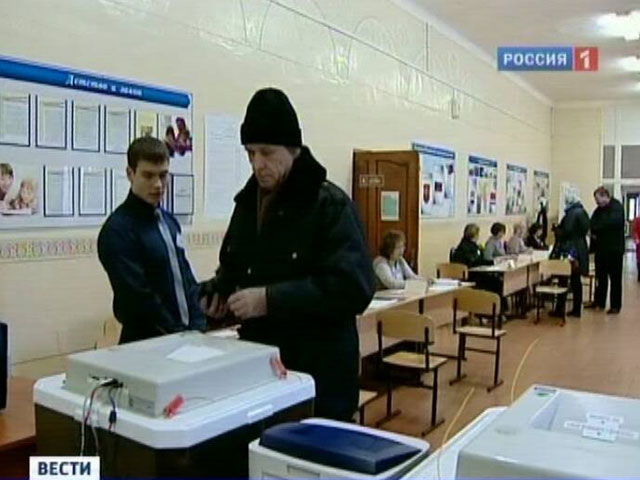
Austrian scientists, using a new statistical model, came to the conclusion that in the March presidential election of 2012 in Russia, cases of fraud were probably widely practiced - the stuffing of ballots and nudges. In a study, the results of which were recently published in the scientific publication of ProChedings of the National Academy of Sciences , scientists have revealed another country where the situation with the honesty of the elections is also deplorable - this is Uganda.
The survey of specialists in the field of the Blog elections The Los Angeles Times is written by the observer John Bardin. The model, designed by Peter Klimec, Yuri Egorov, Rudolf Hanel and Stefan Tourner, is based on the idea that the likely fraud is evidenced by an extremely high turnout of voters (almost 100%) - if most of them vote for one candidate.
To prove the hypothesis, scientists studied the election results in 11 countries. In some countries - for example, Romania, Finland, France - the turnout in most areas was approximately the same, and the candidates who had gained victory gained about the same number of votes.
At the same time, abnormal zones were discovered in Russia, where almost the entire population voted, and the vast majority gave their preferences to the winner Vladimir Putin. Recall that, according to the documents of the All-Russian Central Executive Committee, we are talking about the republics of the Caucasus: for example, in Karachay-Cherkessia, Putin scored 91.36%of the vote, in Dagestan 92.84%, and in Chechnya this candidate received record 99.76%, while the appearance in these regions was almost 100%.
Such data suggest that other candidates frankly took away voices, quoted by Inopressa Bardin. As the author of the article emphasizes, the researchers do not claim that such numbers clearly indicate fraud, but they note that in this state of things the assertion that the results of the elections reflect the will of the people clearly does not correspond to reality.
Previously, the elections were checked by the methods of Benford and Spilkin
We will remind, earlier researchers tried to prove possible falsifications in elections in different countries, including Russia, using the Benford Law - paying attention to the results of voting in numbers. The numbers ending in zero could testify to fraud.
Russian researchers earlier, to prove the possible falsification of elections, used a similar method of physics and programmer Sergei Spilkin . In 2008, during the previous elections of the president, he discovered an unusually large number of sites that, reporting the appearance and percentage of the votes submitted for the victorious candidate Dmitry Medvedev, indicated the numbers ending in zero or five.
Spilkin discovered that the level of support of Medvedev was subordinated to a normal pattern until he reached a level of 60%, and then began to rise higher, instead of logic to go into decline. According to the conclusion of mathematics, these jumps coincided with interest lobes ending in five or zero.
In the fall of 2009, a group of mathematicians analyzed, guided by the same method, the results of the elections to the Moscow City Duma. The analysis showed that the turnout was overpriced by 13%, the results of United Russia were 20%, and the interest of the rest of the parties was sharply underestimated .
Summing up the results of the latest presidential elections, mathematicians came to the conclusion that Moscow as a whole voted "on Gauss", that is, the laws of normal distribution of votes were fulfilled there. But in St. Petersburg, a skew towards Vladimir Putin is noticeable in many sites: with the growth of the turnout, the number of votes for the candidate from the "party of power" is growing disproportionately. This fact leads to certain suspicions, the researchers noted.