
Translated material
: Offline power

The future of the Russian segment of the global network is interested in and even bothers representatives of various communities. Here you have the authorities that do not fully understand the challenges of new technologies, and the society that actively uses these technologies, and a business that strives to earn money on new methods of communication.
Topics like “new media against the old” or “Internet party against the TV party” are discussed in the media and the expert community very actively, even too much. The reason for this is at least multi -billion dollar transactions for the sale or conclusion to the exchange at first glance virtual products, such as the Instagram service or the domestic search engine "Yandex". However, there are not so many examples of a serious expert understanding of the Internet work of the 2000s, its social, communication and political consequences.
On the eve of the Fund for the Development of Civil Society, a study of the Russian Internet called Runet Today was presented. The authors say that the work on the analysis of Runet will still be continued. As the authors considered, in the last four years, the system of emergence and dissemination of information has fundamentally changed. Namely: if traditional media formed the agenda several years ago, and social networks were a distribution channel, now, according to the authors of the study, the picture is exactly the opposite - the social networks form information waves.
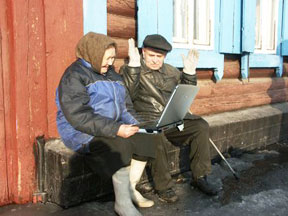
Russians are increasingly perceiving the Internet as a serious channel for obtaining information, according to some reports, almost ahead of television in authority. This allowed the authors of the study to conclude that in the next political cycle the Internet will play the role of the main source of information for Russians.
There are plenty of grounds for such a conclusion. Say, in April of this year, the daily attendance of Yandex exceeded the audience of Channel One - in the first, but not the last, presumably, once. It is not entirely clear what share of visitors read some socio-political news at the same time, but not the whole “Time” program on the Channel One is on the “Channel One”.
Fix the growth of the popularity of the global network and sociologists. According to VTsIOM studies, at the beginning of the year the Internet used 55 percent of Russians, and the share of those who enter the network daily grew up most actively. Similar results are given by the Levada Center survey. According to the spring survey, Levada Center, does not use the Internet at all 45 percent of Russians. A year ago there were 52 percent of them, and in March 2011 - 62. The trend is obvious. The number of those who perceive the Internet as a source of news has increased significantly compared to March 2011. 24 percent in the spring (in March 2011 - 11) responded to sociologists that they go to the Internet in order to follow the last news, another 14 - for events in the country.
You can, of course, interpret a sharp increase in interest in news from the network is not so linear. Still, the election time traditionally increases the demand for news. But we can say for sure that these news Russians get more and more and will receive from the Internet.
At the same time, a significant part of popular Internet resources are global projects or projects with significant foreign participation. 5 of 20 attendance leaders, the report is noted, "are not Russian in their origin."
This state of things concerns the Russian authorities. True, they did not lead the “Battle of the Internet” for a long time (until the mid-2000s), believing the Internet community with the marginal stratum, and the technology itself is fashionable. A mental fracture occurred when a Twitter -revolution occurred in Iran - protest performances with difficulty suppressed by the authorities. Later, social networks were actively used by Protestants during the events of the Arab Spring.
“According to Comscore, for April 2012, Russian Internet users spend 12.8 hours a month on social networks, which is the highest rate in the world, and uses 99.7% of the daily audience of Runet,” the numbers in the report of the civil society development fund are quoted. Therefore, the Russians are familiar with social networks better than some Egyptians.
This could be recorded on the example of capital's rallies: almost all organizational work (fundraising, agitation, invitation to a rally) occurred through social networks and a global network. Several tens of thousands of those signed in the corresponding groups on VKontakte and Facebook networks are a clear illustration.
You can say here (as the authors of the report and many decisions of the person do) about information security, or you can think that the power at some point de facto missed the work with the Internet community. But oppositional citizens and political activists, excommunicated from the TV, rushed into a free media platform. December 2011 demonstrated very well that the authorities now cannot ignore the global network.
She, in the person of different departments, has long conducted such a job, but there was no systematicity in it. The security forces tried to catch extremists (they were rarely caught), political management had fun with fashionable gadgets, from which, by the way, the same Protestants on Twitter and go out. But no detailed analysis that the power deals with, it was done. So the unexpected swamp area came.
It is clear that the reason is not on Twitter: a microblog itself is only a tool. Dissatisfaction was born for some other reasons and will not go anywhere, even if the FSB prohibits Skype and Facebook. The “Chinese Internet” strategy in Russia in this sense cannot work without additional suppression of dissent.
You can’t pay attention to the network either. Still, in addition to peaceful Protestants, they coordinate their activities via the Internet and real extremists and terrorists. And the risks of self -organization of the opposition, including quite radical, are seriously increasing.
Thus, the authorities need to master the language for communication on the network and develop the mechanisms of information protection. Previous efforts in this direction were not too much. The power on the network reproduces offline. Or even yourself in the version of Channel One: heavy, monumental, soulless something. Examples of another approach are units (not always successful). Unless the shares of the PRs of the Ministry of Health with the “Squirrel of the Ministry of Health” on Twitter and the Holbacco horse. Or the election videos “United Russia where you are” aimed at the Internet audience.
It is likely that this communicative dysfunction occurs simply from the misunderstanding of the authorities, with which they generally deal with. The risks are high in the sense that the “Party of the Internet”, which was described by the Public Protestants, can become a reality very soon. And she is unlikely to vote in the next elections for the “offline” “United Russia” in its current form.
See also: Runet gives Russia 1.6 percent of GDP Julia Fabritskaya, constructed by one network Anatoly Levenchuk physics, lyrics, forester and their fuss around control behind the rune