
Translated material
And no intellectuals
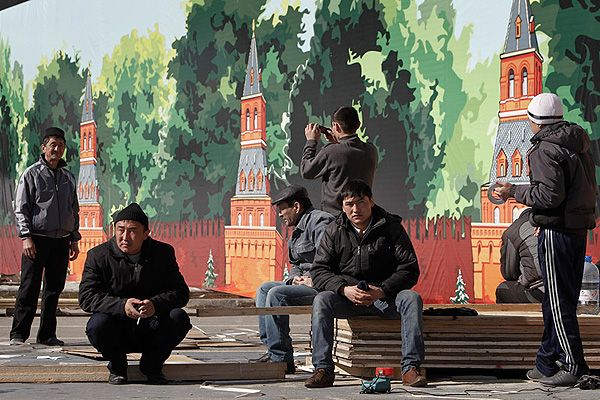 Photo: Denis Sinyakov (Moscow). "Changing face of Russia"
 On October 4 , an exhibition of photos of the “minority” will open in the center of documentary photo “Fotodoc”. Then they will award the winners of the photo contest “Minorities” -2012 , which out of 284 applicants have already chosen the jury.
Publicpost spoke with the authors of the winning pictures and with the photographer Igor Gavrilov, who was one of those who judged this competition.
Igor Gavrilov worked for 16 years in “Ogok”, published in Paris Match, Le Photo, Der Stern, Der Spiegel, Independent, Time. Relied the Chernobyl nuclear power plant, Nagorny Karabakh. Seeing his report on the earthquake in Spitak, Margagret Tetcher sent help to the victims to Armenia.
Tell us about the “minority” project: how did he think, who determined what minorities will be represented in it?
The tasks of depict the entire range of minorities living around us were actually not.
The photographers themselves determined what a minority was, chose topics, but did it very traditionally: one could find some new minority, intellectual for example. About those who went to Sakharov Avenue and to Bolotnaya, they did not send a single selection about the intelligentsia, but this is a minority that nourishes the whole society, develops his brain.
And what can be said about the level of all the works that you have watched? What did you expect to see and what did you see?
There were few frankly bad and stupid photographs at the competition, and the overall level turned out to be high. But I did not see children's novelty, but I so wanted to learn anything myself.
Among those there were many repetitions: gypsies, migrant workers, people with non -traditional sexual orientation. The latter personally did not excite me photography. And most of all he hooked the material about the old man, a veteran of war.
What do you value more in the picture: skill of a photographer or a good plot?
Every fool can shoot. A drunken monkey can shoot and inevitably get a good frame.
Now in the photo the trend is primitive artistic means. A person cannot be removed in motion, they simply put him on the wall, removed, and then signed: gay. There were a lot of such photos, I did not vote for such.
The easiest way to photograph foam. Here is the water in a glass - a simple, unattractive surface, but as soon as you warm it as soon as the bubbles went, an external effect was created. It is very easy to remove it.
Fixing things that shock on their own is very simple. Removing gays is simple. It’s simple to shoot in the war: everything moves around, and you stand and fix. The main thing is that the bullet does not hit. Just shoot in prison, especially when you do this for the first time (Igor Gavrilov’s photo report about the prison was published by one of the first in the Soviet Union - Publicpost).
Remove that which is not visible is skill. And it is priceless.
Tell us how you yourself shot representatives of minorities.
When I took pictures in prison, I did not think that I was taking off the minorities. I came up with this topic, suggested that the head of the photo department of the magazine "Spark". Perestroika times were approaching, and Guin (then FSIN - PublicPost) gave permission. I was allowed into one of the colonies for young convicts in the Vologda region. I stayed there for five days, began with the fact that I looked at the business in a special unit. I came across one thing: a 14-year-old boy raped a 7-year-old girl, then trampled in the bathroom and turned on the gas. I asked me the head of the colony only to show him before leaving, otherwise I would be there with my own hands - my daughter was just seven years. I have it in my photographs - such a jerk.
It was simple to work in prison: such a thing as human rights did not exist then, the prisoners did not know that they could refuse to be photographed. But I did not force anyone either. I just walked and took pictures. Then, in the Pentacle (one of the five colonies for lifelong prisoners - Publicpost) on the fiery island also shot in other prisons.
There have been any significant changes since then, except that all unprotected people are now commonly called minorities?
Strange, but for some reason there have been no more pictures on such topics over the past 20 years. It is clear that now someone wants to become famous for such works, because they are noticed faster. And someone really wants to help help-crazy wonderful people.
Comment on the jury, tell us why these pictures were recognized as the best.
This is definitely the first place. Each photograph in itself is masterfully taken. And the whole series is folded correctly, without tautology, so that a real emotional photo story turned out.
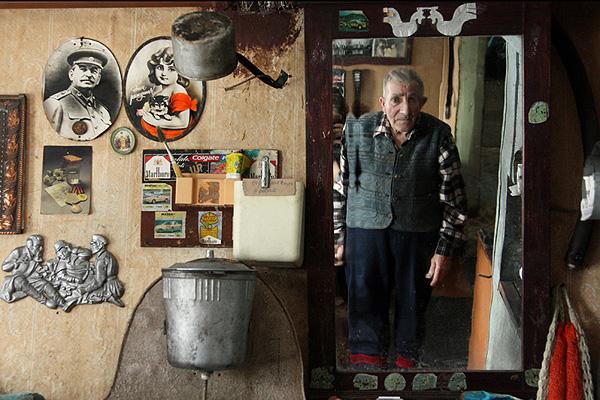
1st place. Maria Alekseeva, “The Last” is a series of the last surviving veteran from the village of Ratnitskoye.
Maria Alekseeva: “From the journalism faculty of Moscow State University, I went on a training trip to Suzdal and I accidentally met a veteran there, I saw the conditions in which he lives. I realized that you need to urgently do something. I agreed with the veterans themselves, with his relatives, came to the village several times. After the series got into RIA Novosti, they paid attention to the veteran, and even allocated money to buy a new apartment. I really hope that he will live to her. " |
Regarding the second place, I voted for another series. Here the texture interrupts everything, skill goes into the background, in most pictures it is not noticeable at all. Only in one thing - and with him the photographer was very lucky, because it is the highest aerobatics. If it were presented in the category of “single photo”, he could take first place. Everything is here: the fact that this family is not the only one, and the hope of the mother, and the request of the child.
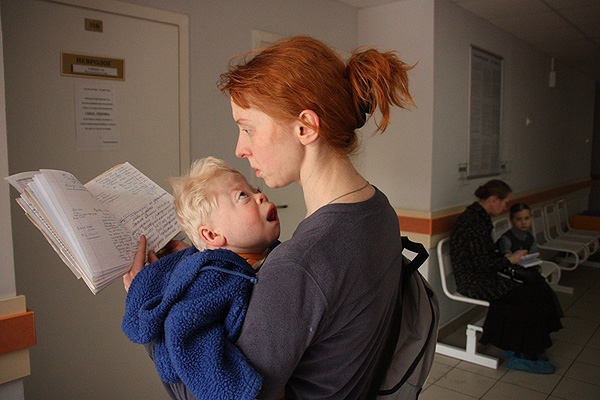
2nd place. Vera Filippova, the “family of a special child” is a series of parents and their child, a patient with a severe genetic disease.
Vera Filippova: “As a volunteer, I took off the therapy for children with such violations, saw this family and was at first scared, because the child looks very unusual. And then I watched my parents, saw how gently they relate to each other, and invited them to take a cycle of photos. These people are used to discussing their problem, accustomed to publicity, so they quickly agreed. I went to their house for several months in a row once or two a week. " |
An interesting topic. Photography was also very cool. And light, and color, and close -up, and compositions - everything is fine. That's just the signature is more interesting than the photo. If you remove it, it will become completely incomprehensible what is about. And to make clear without a signature is really very difficult.
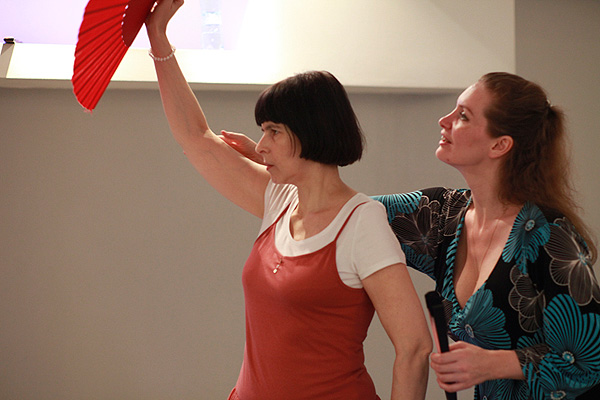
3rd place. Pavel Smertin, “Irina”-a series of a blind-deep woman who is engaged in dancing, “looking” at teachers with his hands.
Pavel Smertin: “My friend, Marina Men - she helps such people - she offered to introduce me to Irina, who does not see and does not hear, but is engaged in dancing, a living and open person. We talked through Marina, but we also talked: I wrote a finger at her palm, and she understood me. She was even able to see my work - she has residual vision - under a special light and an increase and said: "I am beautiful, I like it." |