
Translated material
Favorite flea market
Favorite flea market. Few people can deny themselves special pleasure-to roam among the collapse with old things, looking at household items, ancient books, interior details that once adorned someone's life. The concentrated history of human life is what a flea market is
In the UK it is called Flea Market, in Germany and Austria - Flohmarkt, in France - marché aux puces (puce - flea), in Spain - Mercado Rastro, in Italy - Mercato Pulciaio, in Russia - a flea market. The tradition of street trade in used objects and clothing, books and antiques, dishes and furniture, in general, has a long history in Europe. At the end of the 19th century, such markets were called flea. Why? 
Rag business
There are several versions that are not documented. One is connected with the trading of worn clothes, which the junkers gathered around the courtyards - fleas, in fact, were found in it. Another - with a randomly dropped and dispersed phrase on a postcard: at the end of the 19th century, postcards became a very popular means of communication. In addition, in the cities there were a lot of stray dogs who rummaged through the trade rows (here are fleas to the place). They also say that the "fleas" teased the junkers.
In the late 80s of the XIX century, the Paris Prefect expelled numerous junkers beyond the city line. And they, by the way, collected 75 tons of junk per year. Paris fought for cleanliness, Paris was rebuilt ... Outside the gates of Klinjangkur, to the north of Montmartre, and the current conglomerate of markets arose under the common name of Saint-Uan, to which the word “flea” forever and stuck. He is considered the largest in France (Parisians say that in the world; guides claim that up to 11 million people visit him annually. They lie mercilessly, but who thought?). Already at the beginning of the 20th century, stationary pavilions were built on Saint-Uan. The flea market became a serious business. 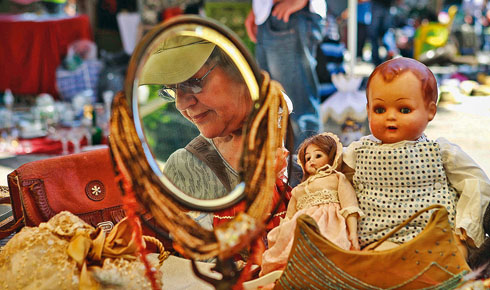
Another large market arose in the south of Paris. This is march-o-pussy de Vanv, now a favorite place for clothing collectors. VanV is located in the open air, which, in principle, corresponds to this kind of trade more. Naturally, he also became Bloshin.
Today, flea markets have multiplied around the world, sorry for the tautology, like fleas.
Cities and things
In London, this is Portobello (old outfits) and Camden Market (author’s design). There are seven such markets in New York. The most famous is Brooklyn Flea (more than 150 shops and stands; famous for extraordinary jewelry; you can pay a credit card, which is not nowhere else in the world). In Tokyo, the flea market (nomi-ithi) is located on the territory of the Admiral of the Admiral of that Heihatiro, the winner in the Russian-Japanese war (wedding kimono, ancient scrolls, porcelain dolls; here, according to Japanese rules, they practically do not bargain). In Amsterdam, this is Waterlooplein - a former Jewish market closed during the war (high -quality antiques and copyright souvenirs). 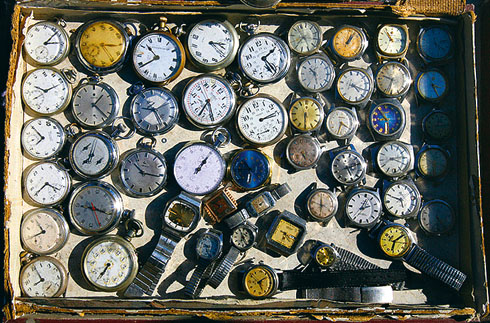
At the Madrid Mercado Rastro and Barcelona Mercat del Belcair on sale - silver dishes from cordoba, embroidered shawls and shawls from Seville, Andaluz lace fans, knives and daggers from Toledo; There are even Tula samovars and “Russian” nesting dolls made in China. The most famous Italian flea market appeared after the war in the Roman quarter of Porta Portes (then traded humanitarian aid, today - fakes of spirits and paintings, interior items). But in the Zurich flea markets in the area of the fashionable street Bahnhofstrasse (they are open every Saturday from May to October) they offer really interesting things. The regulars prove that there are few fakes, and mainly the products of local residents are sold.
In Austria, they are sure that it was in Vienna that the history of “fleas” began and that in one of the central squares they traded junk out of 1150. Now the famous Naschmarkt grocery market and blosh Flohmarkt are neighbors.
The soul of the nation
But in order to understand and evaluate all the power and variety of flea markets and the scope of street trade in general, you must go to Germany. This is the estate of markets, a whole industry, which has a long tradition. In the Middle Ages, in the Middle Ages, each ruler gave a fragmented to the feudal principalities to one or another settlement (usually the city) the right to hold the “annual market” - Jahrmarkt (hence the “fair”, “Yarmonka”) - and removed his percentage from this.
In every more or less significant German city today there are shopping and exhibition centers-Messe. Everyone knows the world's largest exhibitions-fairs, which have been held in Germany for decades. Industrial-in Hanover, agricultural and tourist-in Berlin, book-in Frankfurt, toys in Nuremberg. And Leipzig (remember from Soviet times), and Munich, and Hamburg, and Dusseldorf! The financial turnover of fairs is about € 10 billion.
  |
Fairs and markets of all types are included in the everyday life of the Germans. The so-called weekly markets are organized once or twice a week in city squares, near the town hall, and in Berlin, for example, at the largest European store-Kadewe. They sell both fresh products and things. Products, by the way, are more expensive than in stores. But there are always a lot of people.
In Berlin, over forty classic flea markets, where they sell everyone in a row on weekends and holidays. But there are specialized ones, for example, “children's” (Kinderflohmarkt): kindergartens, youth and charitable organizations, church parishes sell things and objects for babies and made by kids. There are special markets for collecting donations, again with charity goals. In the thematic flea markets, they sell goods of a certain category - books, records, dolls or toys, mail brands and coins, computer and musical equipment, etc. For example, the market at the former Northern Station is known for selling spare parts, tools, plumbing and uniforms from former American and Soviet military bases. There are separate flea markets for antique and collection objects. There sometimes you even need to pay for the entrance. The goods, although not cheap, but still much more accessible than in antique stores.
King of a flea market
His name is Max Strompel. Twenty -five years of his thirty -two passed here. Here everyone knows him and calls long. This man in a strange way knows everything that happens in the vast space of one of the most famous Kunst-Ned-Flohmarkt markets in Germany in Tyrgarten (Forest Park in the center of Berlin and the name of the urban area). The market stretches almost one and a half kilometers along one of the main streets of the capital, named in memory of the workers's uprising on June 17, 1953. In this market, you can buy a bronze tap crane, a barn lock, a mink coat, an old chest of drawers, a Chinese service, the Soviet Order of the Red Banner of Labor, a theater hat with feathers and a uniform of the Gaderar policeman, a wild beer mug and an Elvis Presley plate, a picture of an unknown German expressionist and worn women's boots. In general, that's it. True, among the rest of the "fleas" of the city the local is considered a road. Local merchants soldered by perennial standing in any weather hold prices. Yes, and the very prestigious place for that forces. You can walk to the Brandenburg Gate on foot ... 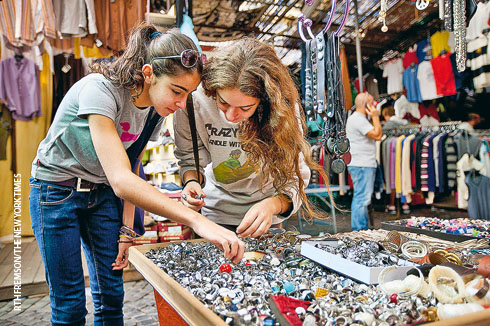
Max is a kind of arbitration judge, an foreman who resolves all conflicts, of which in such a rich trade space cannot be avoided. Nominally, of course, there are representatives of the district authorities. They give permission to trade and charge money (approximately € 22 a day from a place). They also approve the rules for each individual market, what is possible and what is impossible. But in reality, the city authorities do not interfere. “Nobody cares about them here,” says Max. “After all, they, in fact, can not ban anything.” We know without them how and how you can trade here. None of them will cut a bitches on which thousands of merchants are sitting. ”
By the way, for two decades on this "flea" the author did not see a single policeman.
Subculture island
And in the rain, and in the snow, and in the wind, people still come to the market. Nobody and nothing force them for this. They want to enjoy the process. German sociologists called the "flea market virus." For those who became infected with this “virus” to search and find something turned into a hobby.
Despite the general purpose (purchase of goods), traditional markets and flea differ from each other. This applies to everything: history, public, atmosphere. On the "flea", where an endless variety of goods, a certain special understanding, a sense of belonging to a certain product and a certain group arises between people: customer-seller buyers, buyers-buyers, sellers-sellers, which determines the nature of the flea market as an island of the subculture. "
It is in the simple -mindedness and unpretentiousness of the flea market that its charm probably lies
"What is based on the attractiveness of flea markets? Perhaps on the fact that they are based on a simple principle of a medieval weekly bazaar: not only trade, but also direct human contact between the seller and the buyer, which, in fact, determines life relations. No wonder in the Middle Ages the main markets were the main flea markets reflect the historical and cultural features of this They are a kind of chroniclers and archives of a certain region and the country as a whole.
In the days of consumer abundance and “cloned” shopping centers precisely in the simple -mindedness and unpretentiousness of the flea market, its charm probably lies. “In our difficult world, a huckstain is a place where simple rules reign,” says Max Strrompel.
A commendable word
They say that on the "flea" someone once accidentally bought paintings by Toulouse-Latra, the Luther Bible, and Dadar's daguerrotypes. Everything can be. It is such romantic stories that supports the weightless authority of the flea market. He is like a card game. Anyone who knows how to play is losing less often. But the main thing is nevertheless - Her Majesty Luck and Her Highness Passion. Without them - nowhere. Long live the flea market! Long live simplicity!
The first official German flea market after World War II was arranged in 1967 in the old part of Hanover. In the 1970s, flea markets had already spread everywhere. Today, about 10% of the population, or over 8 million people, are visited by street shopping malls 2-3 times a month. Markets in Germany are subordinate to the craft charter (Gewerbeordnung), that is, they are part of production activities. Over 2 million people trade in German flea markets. The first place is occupied by the capital.
How to bargain on flea market
• If the counter is not one seller, but a few, do not rush to discuss the price right away. Take a closer look. Understand who is the main one here. As soon as the main departs, contact the assistant. He has more really bargaining his “” price. • Having heard the price, for example, € 10, do not reduce it to € 1. Too much difference may offend the seller, and he will no longer want to bargain. • When knocking down the price, stubbornly point out the owner to the unimportant state of the thing. And there will always be flaws. • If on one counter you saw several items that you want to buy, first find out the price of the first thing. Then the second, third. After that, say that you want to buy them all. Usually when buying in bulk, albeit small, the price drops sharply. • Seeking the price you are ready to pay, get out the money right away. Their very appearance often makes the merchant give in.