
Translated material
Apartment number 169
From the new book of Benedict Sarnov "Phenomenon of Solzhenitsyn"
Apartment No. 169. A new book by Benedict Sarnov “Phenomenon of Solzhenitsyn” is published. The writer explores the literary fate and vicissitudes of the social activity of the great contemporary, talks about the events whose witness was. The New Times publishes the chapter from the book 
The beginning of mine - first in absentia, and then full -time - acquaintance with Alexander Isaevich can be dated January, on the latest - February 1967. In any case, on the individual - “Conspisovsky” presented to me by the publication of “One Day of Ivan Denisovich” is: it is:
"Benu Sarnov with a sincere location of 20.3.67."
Therefore, at that time I was already not Benedict Mikhailovich for him, but “Ben”. This, however, does not mean anything: the book was not awarded to me by the author personally, but transmitted through common friends. From them he adopted this homemade, friendly, almost friendly reduction in my name. So, bringing this gift inscription here, to the shortness, and even more the closeness of our relations, I do not hint at all. There was no shortness. But the relationship was. 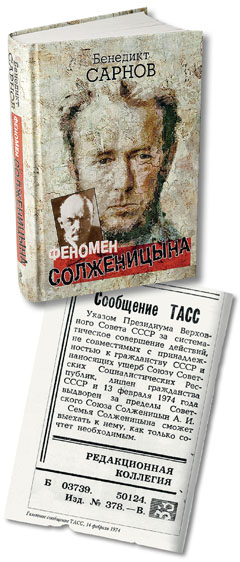
It would probably be necessary to treat these notes with great respect. And so, probably, I reacted to them if I had only a few of them. But since there were many of them and they were quite monotonous, even, I would say, the same type, and most importantly, because they were not some kind of emergency for me then, but part of my everyday life, it never occurred to me that it would not hurt to put them all in a separate folder with the inscription “Store forever”. I didn’t know then - I didn’t even think about thinking! - That I will write memoirs.
However, for memoirs, I have enough for me that they have been preserved. Maybe even one, the shortest. This is a narrow paper strip on which under a copy (I was clearly not the first, at best, the second copy) is printed:
“To the editorial office of the Literary Newspaper, a copy - the New World magazine I know that your newspaper will not print a single line, without giving it a distorting or vicious meaning. But I have no other way out to answer numerous congratulations otherwise than through you: “Readers and writers who sent congratulations and wishes for my 50th anniversary, I thank with excitement. I promise them to never change the truth. My only dream is to be worthy of the hope of reading Russia. Solzhenitsyn. Ryazan, December 12, 1968 "
And on the left, in the very corner of this typewritten strip - by hand - it was inscribed:
“Benedict Sarnov with gratitude and large location A. Solzhenitsyn. 12/18/68. "
***
The fact that almost all Solzhenitsyn notes disappeared from me, I am not particularly sad. But that one of them has not been preserved - I regret. In any case, it had to be preserved in any case. It was an invitation to the alleged presentation to him by the Nobel Prize. From other notes (those that were lost), this one was distinguished even by appearance. The address was attached to the short text of the invitation (Gorky Street, house 12, Kozitsky Lane, house 2, apartment 169), and to the address - also a plan, a special detailed drawing explaining how to find this apartment. This drawing was not superfluous there. Without him, in the Labyrinth of the confusing Moscow courtyards and lanes, it would be really difficult to get to her.
When Khrushchev allowed to print “One Day of Ivan Denisovich”, announcing that this story was written “from party positions”, Alexander Isaevich immediately, without any recommendations and statements, made a member of the Writers' Union. And then they offered him a Moscow apartment. But he then refused this proposal, deciding that he would be calmer for him to live “in quietness” in his Ryazan. Then, when his confrontation with the authorities began, he bitterly regretted it. Now he needed an apartment in Moscow - if only because only here, in Moscow, he could meet foreign correspondents, without constant communication with which he would not have survived. 
But by the time he became a Nobeliat, he already had a Moscow apartment. It was an apartment of his new family. His new wife Natalya Dmitrievna and mother -in -law Ekaterina Ferdinandovna shortly before exchanged two of her apartments, located in different areas of Moscow, one large - this very, where he planned to hold the award ceremony. Here, however, he was not prescribed, since his new marriage was not yet registered. For a long time they did not prescribe even later, when they could no longer interfere with marriage registration. In the meantime, they called his new wife in his official correspondence.
A constant monitoring was established behind the Svetlov apartment. The outdoor worked with might and main. Grishin himself, who was at that time, was the secretary of the Moscow City Party and a member of the Politburo at that time, and ordered the assistance to the “our comrades” who would observe the apartment of the Svetlovaya citizen, who recently moved to this house in the oppressive order. Assistance, of course, was provided: officers of state security who were entrusted with observation, allocated the room of the testing technique, and there was installed equipment for the "lapel".
There was no particular need for all these measures. From his plans, Solzhenitsyn did no secret. Invitations to the ceremony were sent not only to those who perceived the award of the “Nobel” Solzhenitsyn as their common holiday, but also to those who proposed applying the most stringent measures to him. Among these latter was even E.A. Furtseva is the then Minister of Culture of the USSR.
Whether this invitation was equipped with a special drawing-plan so that the minister would not get lost in Moscow courts-I do not know. But I am almost sure what it was. A.I., of course, had no doubt that Madame Minister would not appear at this ceremony. But - order is order.
As for the other invited, most of them, without such a drawing, would not be found the right apartment.
The address indicated in the invitation (Gorky Street, 12, Kozitsky Lane, 2) here he could not help them. With sin, in half it was possible to guess that this house is a corner and it should be entered from it not from Gorky Street, but from Kozitsky Lane. But this was clearly not enough.
This house was not just a corner. He was huge. Thirteen of his buildings, he took four streets. The main, facade building - the one where the famous Bullet of Filippov was to Tverskaya (then it was called Gorky Street). Another attraction of this corps was the small hotel "Lux" in it, in which the Cominternites - both ours and foreign ones lived then. In two such Comintern families, two girls grew up, my peers with whom life brought me up years later, when both I and these peers were already adults. One of them was called Lisa, the other was Lucy. Lisa was the daughter of the Secretary General of the Central Committee of the Austrian Communist Party of Kopplerig. (At the time of our already adult acquaintance, she, as I later found out, participated in the transfer of the Solzhenitsynsky “Archipelago.”) And I met Lucy when she was already the wife of Andrei Dmitrievich Sakharov, and, having talked, we found out that we studied at the same school before the war. True, in different classes. (She was older.)
Other own buildings of our house went to Bolshaya Dmitrovka and Kozitsky and Glinishchevsky lanes. (This latter was then called Nemirovich-Danchenko Street.)
Before the revolution, all these corps were, as it was then called, profitable houses belonging to the family of the famous Moscow rich Bakhrushin. Those pre-revolutionary times were then as far from us as some kind of ponic wars. And we had no idea why our houses were called Bakhrushka in everyday life. (How did not know why the store, officially called "Gastronom No. 1", is called Eliseevsky, and the bakery on the Tverskaya, where we ran after bread, Filippovskaya.) But we got used to the name of this as our own native. And they were not at all surprised when our class teacher Sergei Stepanovich, having sucked some overwhelmed boy from our court, loudly rolled his hoarse bass “P”: “Bakhr-Rushinsky hooligan, a sad fallen”. "
When Khrushchev allowed to print “One Day of Ivan Denisovich”, announcing that this story was written “from party positions”, Alexander Isaevich immediately made a member of the Writers' Union. And then they offered him a Moscow apartment
“By inertia, I wrote“ from our yard. ”And it would be necessary-“ from our yards ”, because there were several yards in our Bahrushka. From the side of Kozitsky alone-three stone wells. And which one should be turned into a Solzhenitsyn apartment, without a drawing plan, it would not be possible to understand.
And I, of course, knew that it was necessary to turn into my, medium. There, where was my native 163th apartment, in which all my pre-war childhood passed, but with which it was firmly connected and all my subsequent adult life. <...>
All this I tell you that at that time I had every reason to consider Solzhenitsyn to be my neighbor, and if I had to be among the invited, I would find this Solzhenitsyn apartment even in the afternoon, even at night, as they say, with my eyes closed.
But then I did not have to visit it not only to me, but to everyone who invitations with that explanatory drawing were sent.
The ceremony of presenting the Nobel letters was scheduled for April 9. And on the eve of the 4th, it became known that the secretary of the Nobel Fund Karl Girov was denied an entry visa. And all guests were sent notifications that the ceremony would not take place.
And I still had to visit that Solzhenitsyn apartment. But - already at another time and a completely different reason.
***
We sat four: Volodya Voinovich, Volodya Kornilov, his wife Lara and me. And, as almost every evening then (this time it was with Kornilov), either played chess, or drank tea, or maybe something stronger than tea-"for the success of our hopeless work." There was a sharp call at the door, and my wife burst into the Kornilov apartment.
- Here! She began right from the threshold. - You are sitting here! And just on the radio was transferred: Solzhenitsyn is arrested!
- Is arrested or detained? I asked. Being by nature an optimist (“does not believe the body”), I also hoped that Alexander Isaevich was only scared.
But my wife did not even understand the subtle legal meaning of my question, as usual, deciding that I froze some other stupidity.
And to friends, even if they understood me, was no longer up to these legal subtleties.
Having slaughtered, the three of us jumped out into the street and rushed to the subway.
We called the doorbell, and we were immediately opened. The first I saw in the hallway was Yulik Daniel.
- Well? I asked stupidly.
- And the fact that Alexander Isaevich is arrested! -he chopped off, and in the sharpness of this answer there was something similar to the intonation of my wife, when she burst into us with this “here, you are sitting here!” <...>
In the corridor, where we stomped, except for Julik and we were another person, as if not belonging to family members: tall, massive, with a largely blurred, somewhat heavy face. As it turned out, it was Igor Shafarevich. We were introduced, and we exchanged handshakes. 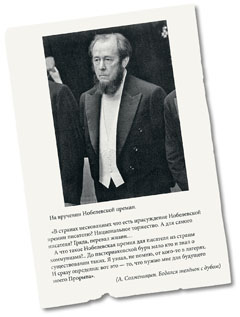
There was also Sakharov there. But when we entered, he was already saying goodbye. Someone asked Andrei Dmitrievich that now, after Solzhenitsyn was taken, he must have done, he replied:
- So far nothing. We must wait for what their next move will be.
Further development of events confirmed that he was right.
After the departure of Sakharov, we stayed in Solzhenitsyn apartment for a short time. We were briefly told how everything happened. Now I can no longer separate what I heard then, from what I read in the "calf" then. From what I heard, some details that were especially touching me were remembered: I took with him his “prison bag”, where the most important thing for him was home -made “overshadowns”, specially made by him in case he had to fall asleep in the cell with an electric bulb that was not turned off the whole night. And he cherished the night sleep, among other things, also because, as it turned out, he had already begun with pressure with pressure.
After listening to all this and sighing, we left. Leaving the entrance, from childhood I knew the passing yard, they jumped out to Tverskaya and plopped into the first car hit with checkers. The focus with a passage court, however, did not help: as soon as our taxi set off, after us, another car with three or four easily recognizable gavriks immediately moved behind us.
Two quarters from our metro sitting next to the driver Voinovich quickly paid with him and stopped the car. We also jumped out with “gardens, gardens”, that is, with alleys and courtyards, slightly looping to knock down possible pursuers from a trace, returned to the Kornilov apartment, from which we went out of one and a half hours-and it seemed that whole eternity.
All this Voinovich maneuver was the purest water with mischief: of course, there was no practical meaning in this “runaway from the pursuers”. But this inspired us with a certain feeling of contentment and some-alas, very short-time slightly improved our mood.
We parted late, and at night I (probably not alone I) could not fall asleep for a long time. The anxiety for Alexander Isaevich (something will be with him now?) Merged together with anxiety for Voinovich and Kornilov, who at that time had already embarked on the path of “dissident”, for all of us. I felt that the arrest of Isaich was the beginning of some turn in our common destiny. Somehow, he (the very fact of his existence, his invulnerability) defended, guarded “from them” of all of us. And now, without him, we seemed to become a hundred -sneaked more defenseless: if they decided to take it, then they will not go with us all at all. <...>
The main alarm was for him: what will they still decide on? What will they do with him? Do they really laugh after everything that he had already experienced once - in those days - to force him to survive it again, again?
The next morning, when the decree on the “expulsion” was announced, my stone fell directly from my soul.
Among the Lacques Rids that appeared on the same day in the press of this event of our literary luminaries stood out slightly (and maybe it seemed to me?) Valentina Kataev’s response.
It began somehow like this: "With a sense of great satisfaction, I learned ..."
After reading this, I thought that probably Valentin Petrovich expressed in this official way what he really felt. It even now seems to me that it was said there: “With a sense of great relief ...” And since “a sense of great relief” was the very feeling that I experienced, having learned that A.I. Already in Germany, with Bell, it seemed to me that Valentin Petrovich felt (and wanted to express) that is. Or maybe - who knows! - So it really was?