
Translated material
Spy because a spy
Under the new law on stateisms they can plant any

Spy, because the spy. Over the next 20 days, the second reading of amendments to the Criminal Code should take place in the articles “Spying” and “State treason”. The New Times talked with the former judge of the Constitutional Court Anatoly Kononov, who is referred by the authors of the amendments, with the deputies, with the lawyers who defended those who were accused of treason, and with those who were accused, and found out: if the law is changed in the way the FSB wants, the special services will be able to present the “treason to the homeland” to everyone who has contacts With foreigners. All about the new law - in the main topic of this issue “The law was missed simply under the noise. And we, unfortunately, missed him as a faction, ”Ilya Ponomarev, deputy of the State Duma from the“ Fair Russia ”, repented in an interview with The New Times, explaining why all 449 deputies of the State Duma voted on September 21 for these amendments. - We have Gennady Gudkov, and since it was recently deprived of a mandate, we simply lost control of this sphere with his departure. In our faction on Monday (September 24. - The New Times) there was a big scandal about this. There was no specialized deputy, there was no one to say about the law, the apparatus did not understand the law, and the faction took and voted, not understanding the essence. We believed that this is a technical thing. But it turned out that a fairly important topic and we ... were a little substituted. " According to Ponomarev, the Socialist Revolutionary faction decided to prepare a draft amendments for the second reading of the bill. Gennady Gudkov, as he himself told The New Times, will take part in the development of amendments: “And I think the position of the faction will be seriously adjusted by the second reading.”
The Return of the Socialist Revolutionaries cannot but welcome to a conscious state, but their fraction in the State Duma is only more than 14% of the total number of deputies, which means that amendments can be adopted in the current form. At least, an attempt by Fair Russia in June to fill up the State Duma with amendments to the law on rallies did not lead to anything. So, you need to prepare for the worst.
"
The reference in the explanatory note to the special opinion in the Smirnov case is not only used in vain, that is, in vain, but also meanly, contrary to the meaning
"
Spynomania is now scandalous amendments
* * Bill No. 139314-5 “On Amendments to the Criminal Code of the Russian Federation and to Article 151 of the Criminal Procedure Code of the Russian Federation (regarding the improvement of criminal law in the field of protecting state secrets from criminal encroachments)”. They were entered in the State Duma back in December 2008 - by order of the Government of the Russian Federation signed by his then chairman Vladimir Putin. When considering the Law, the State Secretary-Deputy Director of the FSB of Russia, Colonel General of Justice, Yuri Gorbunov, was appointed the same order by the official representative of the Government.
“Such laws are prepared by the legal department of the FSB, it oversees its Gorbunov. But it is clear that they are coordinated with the management of the service, ”explains how the law appeared, Gennady Gudkov, who was the deputy chairman of the State Duma Committee on Security and knows the“ kitchen ”. In addition to the two amendments expanding the articles of the Criminal Code 275 “State treason” and 276 “espionage”, it is also expected to introduce a new article - 2831, which provides for the punishment for those who “through the abduction, deception, bribery, coercion, or threat of the use of violence” got GOSTINE, but did not manage to convey secret information. What was the need to thicken the twilight around Gostaina in 2008, no one can really explain: some sources claim that the reason was the economic crisis of 2008 and it was required to take enhanced measures to protect economic information, others say that the FSB constantly introduces a different “heresy” to the Duma-they say that something will be wrapped in, and something will be accepted.
Why the bill was adopted right now - this issue also worries many. “Maybe I will disappoint you, but there is no intrigue,” Pavel Krasheninnikov, a member of the United Russia and the head of the State Duma Committee on Civil, Criminal, Arbitration and Procedural Law, through which amendments passed. -Since we are the Duma young enough, we raised all the bills that were introduced by the government, and decided to do some kind of revision. We really have many bills that are not accepted for a long time for one reason or another, and we decided to take up government. We have several dozen of them in the committee of such bills. In the first reading, we cannot do anything with them, and for the second reading, it is clear that we will rule this bill, and everyone agrees - both the government and the presidential administration. For all other bills, for some reason, no one had any questions, but here the topic is so sensitive to Russians, yes. Just the wording, so that there is no expansion interpretation, and we will finalize. ”
But it is suspicious that the law did not pass through the State Duma committee - on security and counteracting corruption, but through the Krasheninnikov committee.
“There is nothing strange about that,” Gudkov comments. - It is enough to recall the law on the fight against corruption, obviously, which is directly related to the Committee of Security and the fight against corruption, which was nevertheless launched through the Committee of Vladimir Pligin (the State Duma Committee on constitutional law and state construction. - The New Times), because it is easier there. In non -core committees there are no people who are suitable for the issue professionally. If he passed through the Security Committee, I think there would be a lot of questions for the wording. ” But the committee, which is headed by Pavel Krasheninnikov, had no questions. The explanatory note that accompanies the bill reports the following: “The analysis of Article 275 of the Criminal Code of Russia and the practice of its application indicates that the espionage and issuance of state secrets began to be considered not as forms of state treason, but as a variety of assistance to a foreign addressee, which led to an ambiguous interpretation of the subject of proof, in case of espionage matters in addition to Articles 275 And 276 of the Criminal Code of Russia, ”says it. And then the very beautiful: "The specified form of state treason in the current editorial design is extremely difficult to prove." That is, this is surprisingly an ingenuous document states that the amendments should be accepted in order to facilitate the work of law enforcement agencies in order to prove espionage and government agency not so troublesome.
The Supreme Court of the Russian Federation, having familiarized himself with the explanatory note in 2008, completely approved the amendments and even separately indicated in his official review that “the introduction of a criminal norm establishing responsibility for the illegal receipt of information constituting a state secret to whom it was not entrusted or entrusted or entrusted or entrustable
She became known in service or work, in the absence of signs of state treason and espionage, will ensure the systematic and effectiveness of the protection of state secrets. ”
The media and human rights activists in January 2009 violently responded to the publication of the bill. The then President Dmitry Medvedev accepted this reaction and agreed that the amendments in this edition were risks: the project was sent for revision. “The president listened to the opinion of civil society. I believe that this is an epoch -making and turning point, ”the chairman of the movement“ For Human Rights ”Lev Ponomarev said then.
But as is usually the case in Russia - as it turned and turned around. Almost four years later, the bill reappeared in the State Duma and was actually blindly adopted by the State Duma in the first reading. Exactly with the same formulations, without any improvements.
"
The new edition incredibly expands both the objective side of the criminal act and the circle of its possible subjects, and the proof of guilt practically nullifies
"
There is a special opinion in the text of the explanatory note, which accompanies the bill, there is another point that causes bewilderment. The authors of the note recall that the need to adjust the individual formulations of the relevant articles of the Criminal Code of the Constitutional Court of the Criminal Court paid attention 16 years ago: “See. Special opinions of Vitruk N.V. and Kononova A.L. In the Decree of the Constitutional Court of the Russian Federation of December 20, 1995 No. 17-P “In the case of checking the constitutionality of a number of provisions of paragraph“ A ”of Article 64 of the Criminal Code of the RSFSR in connection with a complaint of a citizen V.A. Smirnova. "
Professional biographies of both references mentioned - Nikolai Vitruk and Anatoly Kononov - say that these people could never write anything close in meaning to amendments. Judge Vitruk died in August 2012 at the age of 74. The New Times contacted Anatoly Kononov and showed him the text of the explanatory note and the proposed amendments. The Honored Lawyer of Russia, who in his special opinions criticized the decision of the Constitutional Court (including the cases of Mikhail Khodorkovsky and the correspondent of The New Times Natalia Moral), having familiarized himself with the documents, replied:
“The reference in the explanatory note to my special opinion in the Smirnov case was not only used in vain, that is, in vain, but also vilely, contrary to the meaning and purpose of my special opinion. In addition, it concerned a different composition (treason to the Motherland) of another (previous) Criminal Code, which has long lost strength. Now I am referred to in support of the allegedly the need to improve the text of the existing norm, although I argued that the uncertainty of a similar concept (providing assistance to a foreign state) is fundamentally cannot be adequate interpretation and use, and therefore the norm should be recognized as unconstitutional. ”
The special opinion in question was written by Kononov in 1995 on the occasion of the refusal of the Constitutional Court in the revision of the case V.A. Smirnov, convicted of treason in 1982. In a special opinion, the judge explains that Smirnov was convicted of issuing the West of information, whose classification he could not know. “Smirnov was known from open sources. He was not warned and did not give any subscription about their non-disclosure, was not allowed to secret documents. Information of this kind is not indicated as a secret in the previously previously open list of information constituting a state secret, nor in the current law “On State Secret”. However, the investigation and the court, charging Smirnov in the form of issuing state secrets, referred to a secret and unpublished “list of the most important information constituting state secret”, approved by the Decree of the Council of Ministers of the USSR of 03.12.80, about which Smirnov could not know, ”the judge writes. Kononov criticizes in his special opinion the content of the 64th article of the then Criminal Code (“betrayal of the Motherland”) and suggests that “the uncertainty of both terminology and the legal content of a number of corpus delicti is obviously admitted by the legislator precisely in order to expandable interpretation and freedom of discretion of law enforcement agencies, which contradicts the general principles of law and the principles of criminal law in particular ".
In correspondence with The New Times, Anatoly Kononov emphasized that the concept of state treason in the current Criminal Code almost reproduces the formulations, and therefore the shortcomings and threats of the articles of the old Soviet Criminal Code, which, in turn, go back to the 58th article of the Stalin Criminal Code.
“The marginal blurry of all signs of the corpus delicti, the uncertainty of concepts inevitably leads to arbitrariness in law enforcement, especially taking into account political needs, departmental interests, etc.,” writes Kononov. “And the proposed changes will not improve, but, on the contrary, will aggravate this arbitrariness.” According to him, the new edition incredibly expands both the objective side of the criminal act and the circle of its possible subjects, and the evidence of guilt practically reduces. “Even a commonly used understanding of espionage as a secret (hidden) targeted activity to extract state secrets for a hostile state has been embarrassed. Now the state secret is identified with commercial information, the secrets of operational-search activity, and even just “other information”. The main thing is not their content, but the possibility of using the security of the Russian Federation. The concept of security, contrary to legal and constitutional traditions, includes such completely independent values as the constitutional system, state integrity, sovereignty and, in general, everything that will please fantasies of the accusation, writes Kononov. “At the same time, the crime of intent, the orientation of the will and the moral reproachment of the motives of the accused do not matter and are not evaluated, although it is significantly important to assess guilt and legal qualifications of the act, it was committed from selfish or ideological motives, whether it contained a betrayal or exercised the right to information (the incident of the Wikilles).”
"
Expanded lists of information constituting a secret are published by ministries and departments that grant such a right. And these lists themselves are also a state secret
"
Strictly legally talked with lawyers, among whose customers there were convicted for espionage and the transfer of state secrets. All of them argue that the current formulation of the laws on state and espionage allowed people who do not have direct access to state secrets, and new amendments, if they are adopted in the current form, will allow you to hold accountable, if not everyone, then almost everyone. The New Times asked lawyers to comment on all significant changes.
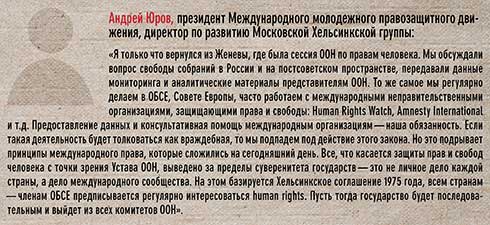
The first thing that caught my eye: we are talking about issuing secret information not only to foreign organizations, but also by international. “A foreign organization is an organization that was created either directly or with the assistance of any one country,” explains Boris Kuznetsov, lawyer Igor Sutyagin, who was convicted under the 275th article (espionage) in 2004 and was released in 2010 as part of the exchange of prisoners between Russia and the United States. - And international is an organization that is created by representatives of two or more countries. An organization such as Amnesty International is an international organization that fights for human rights. And for these amendments at any time of its employees, Russian citizens, you can recognize people who commit state treason. ”
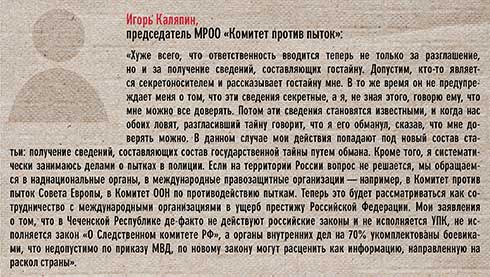
Secondly, in the amendments there is no longer a definition of gosmen as hostile activities. Lawyer Anna Stavitskaya, who also took part in the Sutyagin case, told The New Times that now the Stateismman is a crime with direct intent. That is, a person must definitely know that he receives the information constituting GOSTain, and must definitely be intended to use this information to the detriment of the security of the Russian Federation. The new wording allows law enforcement officers intent, that is, “hostility” of actions, not to prove. Lawyer Yuri Schmidt, who in the second half of the 1990s conducted the case of an employee of the Norwegian Ecological Organization of Bellon, captain of the 1st rank of reserve Nikitin, accused of treason, indicates that this amendment exacerbates the already confusing situation around the concept of “state secret”. The fact is that, under the Russian legislation, GOSTain is the information protected by the state in the military, foreign policy, economic, intelligence and other areas, the spread of which may damage the security of the state. Detailed lists of information constituting a secret are published by ministries and departments that grant such a right. And these lists themselves are also a state secret. So a person, having received information on open sources and, for example, having made certain conclusions from it independently, can even accidentally affect the subject of state secrets without realizing that. Therefore, it was so important that the formulation of “hostile activity” was important in the law: “A mass of things that are attributed to state secrets is available today by applying the most ordinary means,” says Schmidt. “Law enforcement officers, however, did not work much more than to prove an element of hostility before, but now they want to save themselves from the need to do this.”
Thirdly, the amendments of the Stateizer were defined as activities against the security of the country. The current law says more clearly: "Against external security." “That is, the threat comes from the outside,” explains Stavitskaya. “The amendments are just about the security of the country, and this is too broad the concept: it can be internal security, and intellectual property security, and information security, and any other.”
Finally, the amendments expand the circle of persons who can be held accountable. Появилось уточнение: госизменой может быть выдача сведений, составляющих государственную тайну, доверенную лицу или ставшую ему известной по службе, работе или учебе, либо оказание финансовой, материально-технической, консультационной или иной помощи. «Сейчас нельзя осудить человека, которому стала известна тайна просто по работе, — говорит военный журналист Григорий Пасько, в 1997 году арестованный по 275-й статье (государственная измена) и отсидевший около четырех лет. — Например, журналист взял интервью у какого-нибудь стукача или гэбэшника, опубликовал это, и нельзя журналиста привлекать, такой случай был в Тольятти. Теперь можно будет».
Что касается новой статьи 2831, по которой предлагается привлекать к ответственности людей, которые «путем похищения, обмана, подкупа, шантажа, принуждения либо угрозы применения насилия» заполучили гостайну, но секретные сведения не передали, то адвокат Ставицкая ответила коротко: «Это какой-то бред».
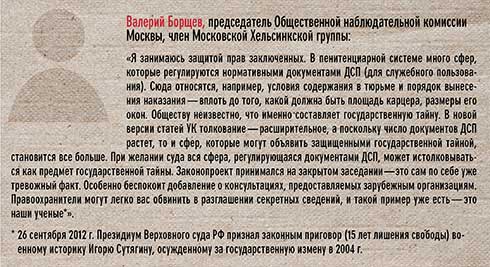
Последствия Почти все собеседники The New Times сошлись во мнении, что возрождение законопроекта стоит рассматривать в одном ряду с законами, принятыми Госдумой весной и летом: закон о митингах, закон о клевете, закон об НКО — иностранных агентах. Мол, раз взяли курс на закручивание гаек, то и закручивают.
Член правления правозащитного общества «Мемориал» Александр Черкасов сказал The New Times, что под поправки подпадают даже люди, которые подают жалобы в Европейский суд: «Гражданин России собирает для международной организации сведения с целью нанесения материального и морального ущерба РФ — он же подает жалобу конкретно против России, там так и указывается».
Глава российского отделения организации по противодействию коррупции Transparency International Елена Панфилова считает, что под новые поправки подпадает и она сама: «Наша организация — часть международного движения. Первая проблема возникает у меня лично, потому что, с одной стороны, я российская гражданка, с другой стороны — я член правления международной организации. Можно сказать, что я передаю информацию о российской коррупции», — констатировала Панфилова в интервью The New Times.
Исполнительный директор ассоциации «Голос» Григорий Мельконьянц считает, что привлечь могут любого человека, позволяющего себе публичную критику каких-либо действий государства: «Например, наблюдатель рассказал в СМИ о фальсификациях. По новым поправкам теперь можно говорить, что эта информация посягает на наш государственный строй, на наш суверенитет, на наш авторитет и так далее».
А бывший депутат Геннадий Гудков уверен, что это прежде всего удар по оппозиции: из-за нового толкования привлечь к ответственности могут даже за общение с сотрудниками посольств.
Короче, шпионом можешь ты не быть, но по закону — быть обязан.