
Translated material
Three cases of private-state partnership
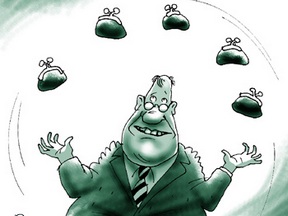
Residents will be able to asphalt their paths themselves. A social contract with the state - it will give money, but what does it want in return? Forced census or fill out the column "Personal code" in the passport?
Support your path
It is reported that the Moscow City Hall developed the procedure for the voluntary participation of citizens and companies in financing the construction, repair and reconstruction of roads. In the presentation of Izvestia, this looks like a psychotherapeutic effect: " As the publication was told in the metropolitan department of economic policy, residents, dissatisfied with the state of a particular road, will now be able to transfer the necessary amount to the Moscow road fund ." Well, here the key word looks “dissatisfied”, that is, the matter is in emotions.
But there is serious: first, citizens need to conclude an agreement with the road fund. After receiving the approval of the city planning commission of the city, the Moscow Economic Policy Department develops the appropriate project, otherwise the money is returned to the initiator of the case. But there are two questions at once: how does he know how much money to make, if there is no project and - from what money the project is paid? Again, and the consideration and coordination of something worth it?
This partnership begins to look completely psychotherapeutic, but there is clarity: " The Department of Economic Policy explains that they are primarily counting on commercial structures whose objects are located near the roads ." That is, so that they, for example, make convenient entrances. For what - well, they are commercial structures - they pay logically. Both sides are satisfied, mutual partnership in kind. However, the question is here: does this mean that without the appropriate consumer initiatives, the city will not build anything like that?
And there is also a completely private business: it is said that ordinary Muscovites are also ready to allocate money for the arrangement of their own yards and parking lots. It is not at all clear how this readiness was caught and, moreover, the details are incomprehensible. Now, the courtyard throws up and gets banging the parking lot instead of a scaur? Okay, the parking is more important for them, the issue is in price. But prices, in general, are quite commercial and this partnership already looks quite a business for the city. Here, it is said that the repair of the courtyard path will cost 1 thousand rubles per sq. Does it should be from here that the city will never be repaired in the courtyards?
Social contract with vague content
The State Duma in the first reading adopted a bill , " which provides for a new way to provide assistance to the poor on the part of the state - through a social contract ," - (" Russian newspaper") . That is, a private-state partnership as such, in addition to all other relations of a citizen and state, and even in a humane form. The idea is that " poor citizens or people who are in a difficult situation will be able to conclude a contract with a state that will allocate a sum of money in the amount of 30 to 100 thousand rubles to help them ." This is great, but what should a citizen in return?
So far, instead of the details of the lyrics: it is reported that " such social contracts will be a certain start of a" new life "for a person and should stimulate a person to earn, and not be dependent in the state ." It is interesting here: does not be dependent on the state of dependent after - under this contract - receives money from him? And how, in fact, will the issuance of money stimulate it to earn it?
Again: Does the contract refer to the refund? If so, then what interest? In this case, you could understand that it is just a loan that banks would never have issued a citizen, referring to his current financial situation. The Rossiyskaya Gazeta provides the reasoning of the first deputy chairman of the State Duma Committee on Labor, Social Policy and Affairs of Veterans G. Karelova, who explained that " the initiative has been developed for the category of poor citizens who are not able to help" traditional methods of "social support ". Among such cases, loss of work or illness is mentioned. Moreover, " this is also relevant for villagers who have no sources of earnings, large families ." In general, some completely different stories are somehow reduced here. Well, maybe for this, they are reduced to close them all this idea. Banks really would never have given a loan.
It’s just that, of course, they will not give here: to conclude a contract, you should contact the social protection authority at the place of residence. " The starting amount will vary in the range from 30 to 100 thousand rubles, depending on the position of a person. The amount of the region’s authorities will be determined in which the human who has applied to them lives ." Here, of course, the words "starting sum" are interesting. Does it mean that such amounts can be obtained from time to time?
And, again: what is the contract? They give money to a citizen, but what should he? So far, some kind of paradise is drawn purely: "A citizen who signed the contract, in turn, undertakes to spend the money provided to him exclusively for their intended purpose ." For what purpose, it is not said about him? Start a "new life"? In addition, " the mandatory terms of the contract will be a search for work, professional training and engaging in entrepreneurial activity ." It is completely incomprehensible here: the search for work, let’s put it, you can certify some kind of certificate. It is unlikely that there is enough oral statement? Professional training - well, probably show some crusts. But where does the entrepreneurial activity, what is meant by the poor entrepreneur?
Karelova finally added fog: help from the state can also proceed not only in the form of funds. Under the contract, " authorities will be able to help citizens with payment for repair, treatment and even engage in the construction of a child in kindergarten ." Of course, the word "can." Here, without this document, the authorities could not help citizens with the construction of children in kindergarten.
But the topic of working out the contract remains completely unsolved. It is only reported that a social contract can be concluded for a period of three to six months, and sometimes it will be possible to extend to a year. But what, what happens at the time of its end?
The column "Personal Code" is not for long to be empty?
The most specific example of private -state partnership is the census of the population. Moreover, while participation in it was not mandatory. And now Rosstat proposes to make it mandatory, and " for evasion or provision of incomplete or distorted information about himself to provide administrative liability ." It is clear that for this the law "On the All -Russian Census of the Population" must be corrected.
The topic is clear. By law, a person has the right to participate or not to participate, which is why about 1 million refused to participate in the 2010 census, another 2.6 million scribes were not found at home. And those whom they found often did not want to talk about their nationality, citizenship, education, sources of livelihood, and economic activity. Rosstat is worried that " all this reduces the quality of the census, its information value ." Conclusion: participation in the census should be strictly obligatory, and for evasion - fine.
To fine is completely within the framework of mutual partnership of man and the state. Well, the state to a citizen with all his heart, and he does not even want to say who is and what he lives on. Moreover, it was precisely precisely the partnership, since Rosstat did not say a word about criminal liability for giving false testimonies or for refusing them. Only fines.
But Rosstat also has words that are somewhat protruding beyond the boundaries of his competence: " It is necessary to enter a single identification number in the list of information about the population ." Well, yes, there are registration codes in many countries, because passports and so on are changing, and such a number is forever.
Here, on the one hand, it is not clear how exactly this registration number can help with the census. Well, apparently, in order to be fined in the absence of a fact of participation in the census. But, then, then there will be a large and universal base of citizens? Why, in fact, not? It is even somehow strange that she has not yet been collected. Here, for some reason, it is believed in Rosstat that to introduce this number " it would be possible to use the database of the Pension Fund and the Compulsory Medical Insurance Fund ." But how? Meanwhile, the passports have a column "personal code" while empty. They, in fact, about this. In general, with a private-state partnership is always like this: it cannot without counting everyone forcibly.