
Translated material
Everything that you wanted to know about the KS, but were afraid to ask
In the opposition
 Everything that you wanted to know about the KS, but were afraid to ask
October 4, 2012 Denis Bilunov
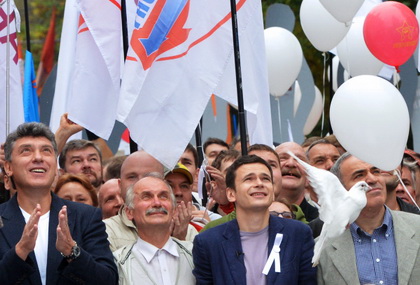
In December 2011, political reality changed in Russia: dozens and then hundreds of thousands of people in the most directly declared their dissatisfaction with the status quo and the desire to change it. The general interests of these people were tried to express the organizers and speakers of rallies in Bolotnaya Square and Sakharov Avenue. The results of these attempts are contradictory, for them there is no other objective scale of assessments, except for the dynamics of the number of rallies - and this is a very blurry criterion and strongly depending on external circumstances.
In fact, the positive dynamics of the number of rallies, with all its desire, is not an end in itself. When the account of supporters and sympathetic goes to hundreds of thousands, it is important to understand how the protest can grow further, not limited to the physical dimensions of the same area in Moscow, how to ensure the visibility of this growth, finally, how to convert this effect into political results.
1. Why is it all needed and who invented it all
Obviously, here we are faced with the problem of the formation of a political subject adequate to the common interests of the “new Protestants”. The political heterogeneity of the dissatisfied with the Putin model of the management of Russia makes the creation of a number of various political structures uniting like -minded people (“parties”), but even more important to ensure their interaction strictly according to certain rules and uniting efforts in order to ensure the growth of protest mass. In addition, even a wider circle of citizens (here the account is already going on millions), who have not yet participated in anything, but monitor the development of events (with sympathy/interest/distrust), to understand, “how it works” - who makes decisions, is responsible.
The very first mass rallies immediately led to the appearance of the queue of “political leaders”, with larger or smaller grounds striving to take a “place in the presidium” or at least get the opportunity to come out of the stage. Attempts were made to somehow streamline this process, but they could not solve the problem of the fundamental inconsistency of the at that time the political structures of the huge mass of the “previously not consisting” rallies.
After a well -known vote about the speakers at the rally on December 24, which was organized according to the spontaneously adopted format (my proposals did not pass), the contours of the structure that could solve the problem became clear. The main conditions for creating this design were formulated by me after a series of conversations on this topic with key people (Navalny, Kasparov, Udaltsov, Chirikov, I. Ponomarev). The first project of the primaries became the basis for discussing the “Organizing Committee” of the format of the future of the Constitutional Court. During these discussions, it was necessary to compromise, which, unfortunately, significantly distorted the initial plan (more details in terms of quotas). Nevertheless, I think the very fact of achieving this compromise is a huge step forward, which is indirectly confirmed by an impressive number of people who continue to register as voters (23 days before the day of voting - more than 40,000).
2. What kind of "Organizing Committee" and who enters it? Why and how does it affect CVK?
The creation of any new form of legitimacy (in this case, CS) can only be initiated by people who have informal authority. In my opinion, it is better that there were few such people and that when starting the initiative, they do not determine their status in any way. Life showed that these wishes are too cabinet. In practice, in the process of discussing the KS format, everyone who came to meetings of the working group, according to the prevailing tradition of the "Organizing Committee", took part. In contrast to the Organizing Committee of the December 2011 model, which jealously protected the “chairs in the Presidium”, these meetings were fundamentally open, which, of course, made a certain chaos of discussion and the decision -making process. For example, I personally did not know at least a quarter of people who sometimes appeared at meetings and voted. I still do not know some of them, I got acquainted with others more or less on the fact of their participation (this, for example, Alisa Obraztsova, Isabelle Magkoeva and Grigory Kolyutsky). However, it can be said with confidence that the organizing committee includes Alexei Navalny, Harry Kasparov, Sergey Udaltsov, Gennady and Dmitry Gudkov, Ilya Ponomarev, Evgenia Chirikova, Olga Romanova, Ilya Yashin, Alexander Belov, Vladimir Tor, Sergey Davidis, Peter Tsarkov, Alexander Ryklin, Andrei Piontkovsky, Alexei Sakhnin, Alexey Sakhnin, Alexey Sakhnin, Aleksey Sakhnin, Alexey Sakhnin, Alexey Sakhnin, Alexey Sakhnin, Aleksey Sakhnin, Aleksey Sakhnin. Mikhail Schneider, Ivan Tyutrin and Vladislav Naganov. Alena Popova and Tamara Lezhnin with Konstantin Merzlikin regularly took part in his work, but, as I understand it, they relate to the idea of creating the Constitutional Court with varying degrees of skepticism. Occasionally, Masha Baronova, Nadezhda Mityushkina, Anastasia Udaltsova, Elena Lukyanova, Nikolai Lyaskin, Nikolai Levshits and Petr Verzilov came. Almost always at the meetings were Olga Shorina and Anna Vedita. Since the establishment of CVK, Leonid Volkov began to come from Yekaterinburg. Separately, it should be said that members of the “December organizing committee” who were not listed on this list have repeatedly and, as far as I can judge, persistently called to join work.
The ambiguity of the concept of "Organizing Committee", in fact, was the immediate reason for the emergence of the concept of the Constitutional Court. Either this is a working body engaged in the search for money on the stage and the sound and the decisive organizational interference, or it is a political body that formulates meanings and claims to represent the entire Russian protest. In fact, of course, one and the other need - only so that the political body is recognized, it must be elected according to a clear procedure, and then it may well appoint a working group to solve organizing searches. That is how the CVC was appointed, headed by Leonid Volkov.
Of course, guided by all the same cabinet priorities, the organizing committee should, having determined the powers of the CVC, no longer concern his work and provide him with all issues on his own. On the other hand, both inevitable minor conflicts and technical inaccuracies, as well as obvious raider attacks on the whole concept as a whole (Case MMM), demanded arbitration decisions. (In more detail-in the part of eight.) In general, it is obvious that the regulatory part of the structure of the Organizing Committee-CVK-Black CS was not fully thought out and contains weaknesses, some of which have been revealed in recent weeks. Nevertheless, in my opinion, so far all the mistakes made, in all their annoying aggregate, and closely called the storage of the project and its further prospects.
3. What will the CS do, what are his regulations and powers
The powers of the COP in general form are directly formulated in my project of the primaries :
The mission of the elected council is the development of uniform requirements of supporters of changes, general planning of protest tactics, coordination of pressure on power and in case of success - negotiations with it. The Council contributes to the dissemination of protesting throughout the country, explains the meaning of joint protest actions to induced citizens, and carries out an external representation .
As far as I can judge, no one argued especially with this position (except that Ilya Ponomarev with his exotic proposal to consider the KS “technical body”, but it is obviously refuted by practice), and, in my opinion, it is quite enough to remove “what kind of cat in a bag is slipped by us”.
Of course, the detailed regulations of the Constitutional Court is also necessary. Preparation of the project (projects) of such a document is an urgent task that must be solved before the elections and then voted for a particular option at the first meeting of the Constitutional Court.
4. Why are quotas needed, and why are they just such
The dominance in the Constitutional Court according to the geographical, ideological or group feature carries much more risks for the concept as a whole than the so -called motley. Quotes allow you to reduce these risks.
The initial project provided for quotas that guarantee the representative office to opposition organizations (left, liberal, nationalist and extra -ideological), as well as federal districts (and the size of the quota on the district was proposed to be made depending on the number of voters). The organizing committee removed the extra -narological quota and refused the guaranteed regional representative office, which I consider the most serious of the mistakes made. Our country is already too much Moscow, I would say - dangerously Moscow -centric to still duplicate these problems in new opposition structures.
In addition, the proposed quota concept during the search for a compromise was seriously distorted. I suggested that each voter choose by which one - from the lists he would vote: left, liberal, nationalist or extra -detective. Then it would be possible not to arrange a filter in the form of a “representative of the curia” in the CVC, which is a voluntarist decide whether to register a candidate on his list or not. For example, Artem Loskutov could, as he wanted to register on the quota of nationalists, and then the voters who chose the ballot of this curia - and only they! - They would decide whether he may be their representative in the Constitutional Court or not.
Finally, specially for hard -shaped opponents of quotas, one could introduce the dependence of their size on the number of voters - although this would probably complicate the format too much.
5. How to ensure feedback from KS members with voters
This important question was drew attention to a colleague from Novosibirsk Alexei Mazur. He was practically not discussed, but, I believe, his decision should become one of the priorities of the newly elected Constitutional Court. It is possible, for example, in line with the concept of Volkov-Krasheninnikov “Cloud Democracy”, which provides for the possibility of a dynamic recall of voice, if the activities of the delegate do not meet the expectations of the voter. Since, probably, the technical implementation of this model is not easy, for starters it would be possible to launch a project such as Parliament Watch , what I intend to do and invite interested KS voters to join this initiative
6. There will be only VIPs/Muscovites in the COP, why is it needed?
Participation in the elections of Ksenia Sobchak, Dmitry Bykov and other media stars undoubtedly increases interest in the project from external observers. It is clear the disappointment of the candidates for whom the entry into the game of the “civilian platform” with its impressive VIP list turned out to be sudden and reduced the chances of passing in the CS almost to zero (in general, this applies to me), but objectively for the project, such a level of competition is an advantage.
It is extremely important that the powers of the CS are limited in time and in a year new elections should be held (of course, all this makes sense only in the case of an inertial scenario of the development of events in the country, but by default we will proceed from it). If, as many activists fear, for “stars”, routine work in the Constitutional Court will not be of interest, then in the new elections the factor of media knowledge will no longer be so significant.
The roll towards Moscow can be fixed even before the next elections. In regions with a high level of protest activity, it is quite possible to form representative regional coordinating structures (as, for example, in Nizhny Novgorod), with which, if they have sufficient authority, the Constitutional Court itself will look for ways of interaction.
7. What are the collected money, who controls it
This issue is completely in charge of the CVC, but it is obliged to publicly report on the expenditure of the funds raised.
8. Why and how exactly the tesak, emampers, etc. were removed.
There is still a question on the CVK website in the FAQ list “what will happen if Vasily Yakemenko will be advanced to the elections to the Coordinating Council? Sveta Kuritsyn? Maxim "Tesak" Marcinkevich? Vladimir Putin? ” There is also the answer: “There will be nothing: it will be advanced and take part in the elections. What is the problem? ” It is understood that, they say, let them be registered: in this way they will express their consent with the requirements of rallies in Bolotnaya and Sakharov and they have a little chance of being chosen. I completely agree with this. In August, on the debate on the topic of the KS in Repino (near Peter) they asked me about the same question, and I answered about the same. I do not believe in raider seizures from the pro -Kremlin youths, etc. In my experience, this danger is always violently discussed and always serves as the basis for restrictive measures to prevent people for meetings, refusal to receive, etc. Meanwhile, I can recall only one story of this kind from real life - and then it was about the capture of a meeting in Samara, where the general turnout did not exceed several dozen people.
The situation is more complicated with the emanity, because they are still much more than a sect than any “ours”, and the level of motivation is higher. The submission of clones for all places in the Constitutional Court was, of course, a tangible threat.
On the other hand, I think that it was really to recapture it without the use of administrative measures. But most the organizing committee decided to completely remove these risks, at least at the cost of refusing the position set forth in the FAQ list. In my opinion, an organizing committee, almost completely consisting of candidates for the Constitutional Court, should not carry out arbitration. It would be more reasonable to form some “dispute commission” and prohibit the candidates to enter it.
9. Why distract the opposition forces from real affairs (you would be better ...)
To begin with, I want to ask a couple of questions: how many of the 219 candidates in the Constitutional Court are you known? How many real things do you recognize for them? The answers to them can be predicted with a high degree of confidence. It is known, in the best case, about a quarter of candidates, and the vast majority of them, in your opinion, do everything not so, and in general, they are in vain claiming leadership in the opposition.
Well, very well. Now let's think about how to convince these grief of the leaders what to do. What, if there were no elections in the Constitutional Court, would they work more intelligently?
On the contrary, the Constitutional Court is precisely the mechanism (I agree, still very imperfect), with the help of which, in particular, the choice of priorities, planning and joint implementation of decisions taken. It should be noted that the consent of the informal leaders to participate in the COP (Navalny, Kasparov, Udaltsov and others, whose victory in the elections is practically in doubt) leads to a regulatory limitation of their leadership-firstly, the term of authority (in a year it will be necessary to re-elect) and, secondly, a democratic procedure as such.
Fears are expressed that, they say, if the initiators of the CS see that he is getting out of their control, they will not obey his decisions and everything will go to dust. Well, there are always such risks.
But let's recall those three quarters of the candidates who are unknown to you. Perhaps among them there will be those who in this situation will be able to keep the ship afloat? Perhaps it is worth taking a closer look at their election programs, find ideas close to you and support them in the elections in the Constitutional Court?
An important mission of the KS is the casting of applicants for new leaders. The protest community, if it claims to be an all -Russian scale of its activity, is obliged to develop and implement working mechanisms of self -renewal. Only in this case, new ideas (“You would better ...”) have a chance to be heard and evaluated.
10. How to change the format of the CS?
First of all, one should develop a regional representative office and contribute to the direct contacts of selected members of the Constitutional Court with voters (see above).
As for the development strategy, two different approaches can be distinguished. A direct polemic on this topic is not yet visible, but the main fork is already visible in the reasoning of the CS: a large “batch of protest” or “alternative legitimacy” ? For many of the first, the option is almost obvious, but it is also vulnerable to criticism from the perspective of "everyone has too different goals." The second option seems more interesting to me. But, on the other hand, the prospects of alternative legitimacy, i.e. Development towards the Constituent Assembly and/or Protoparlia, still have too distant landmarks.
It is very important what final parameters will be at the election on October 20-21. The total number of voters, turnout, distribution by regions, the ratio of offline/online, voting activity according to the list of kuri - and, of course, the composition of the Constitutional Court. The more diverse it is, the more chances for development.
Based on this, I urge you to vote for the number of “second echelon” candidates as acceptable for you - for activists and candidates from the regions.
The author is a member of the election list of the United Civil Front Harry Kasparov
Photo by RIA Novosti