
Translated material
Nemilery quarrels
The main intra -tandem disagreement: how to manage energy?
Nemilery quarrels. The government, inspired by the unexpected reprimands of the president, introduced the budget-2013 to the State Duma. But unlike previous years, when everyone and everyone was immediately satisfied, now a serious conversation is just beginning. The State Duma, the public, experts and the presidential administration will surely criticize the draft budget. But the main in the intra -tandem disagreement is how to manage energy 
After on the eve of the discussion of the 2013 budget at the government, Putin arranged the ministers to the ministry for failure to fulfill instructions from his inauguration decrees, some of the “forward” instructions were taken into account in the budget for the next year, and part in the amendments to the budget of this year, which is now being prepared by the Ministry of Finance. About 300 billion rubles will be redistributed. These are funds from the more expensive oil price (about $ 110 per barrel instead of $ 97 in the budget), savings on separate expenditure articles, dividends from Rosneftegaz and mainly funds from the sale of a stake in Sberbank. They will go to increase social benefits and make money in the capital of another “Institute of Development” - the Russian Direct Investment Fund.
"Choose one thing"
The introduction of the budget in the State Duma does not interfere with the discussion and “fresh ideas” requiring an increase in budget expenditures. In pursuance of Putin’s order to maintain not only small and large, but also the average business of the Ministry of Economic Development and Vnesheconombank, as the Finmarket recently found out, they propose to create a federal warranty fund, which will distribute guarantees for bank loans to companies. Guarantees must be issued, according to VEB, in the amount of up to 40 billion rubles a year. The Ministry of Finance, of course, is against: the budget already spends a large amount per year in state guarantees, and medium -sized businesses may well use existing mechanisms.
The government is fully aware of the main problem of the budget. “We cannot afford to have a very high level of social protection in a system built on paternalistic principles, at the same time a very large army and at the same time a very large volume of state property, and also very low energy prices within the country,” said Deputy Prime Minister Arkady Dvorkovich the other day. “Choose something one, maximum two.”
The fact that the budget has been overloaded with social and military obligations, and recently also financing a large number of “development projects”, the fact is not at all new. But the government cannot make the choice proposed by Dvorkovich, this is clearly beyond its authority. In addition, so far the Cabinet of Ministers itself has not formulated for society (and, probably, for the president too) the main budget forces and alternatives between which you need to choose.
And if so, the government continues to support everything and everyone. For example, justice expenses in 2013 reached 146.5 billion rubles (this year - 134.4 billion). In addition, as this year, the courts will receive 10 billion rubles for modernization and development. The salaries of judges, which increased by 6%this year, will increase by another 5.5%in 2013. But back in the first half of the year, until the next indexation of payments, the average salary in the courts and the prosecutor's office, according to Rosstat, reached 52,500 rubles per month. This is almost twice as much as the average salary in the country. Whether citizens are satisfied with the business of the courts (except for the arbitration system and the prosecutor's office) is an almost rhetorical issue.
In 2013, defense costs will grow most in 2013 - by 25.8%, to 2.3 trillion rubles. They will reach 17.5% of all expenses of the federal budget. Law enforcement costs will increase by 8%, to 2 trillion rubles. These two types of expenses will reach 32% of the budget expenditures, as if the country is at war. 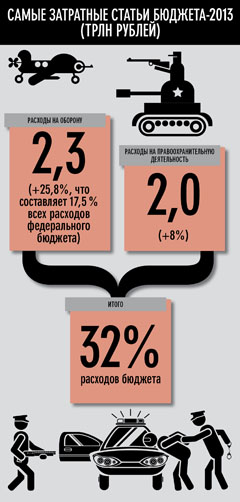
Another serious conflict is associated with the continuing resistance of the government of the plans of Igor Sechin, the head of Rosneft and Rosneftegaz, and consolidate on the basis of the second of these state -owned companies the state’s assets in the energy sector. We are talking about stakes FSK EEC, IDGC, RusHydro, Interrao. Rosneftegaz holding, which receives dividends from the state -owned shares of Gazprom and Rosneft, would give, according to Igor Ivanovich, other energy state -owned companies, the money they needed for investment programs. Sechin Vladimir Putin approved the plan immediately, entirely and completely: becoming the president, he allowed Rosneftegaz, which belongs to the state 100%, to buy shares of TEK in the course of privatization.
The key condition for the implementation of this plan is to leave the holding received by him at the disposal of the holding for shares (140 billion rubles have been accumulated), and not transfer them to the budget. By logic, on the contrary, this money should be transferred to the budget: Rosneftegaz only runs 75% of Rosneft and 10% of Gazprom belonging to the state. He has no other income.
Sechin was not at all embarrassed and another logical ambiguity: why call the privatization the purchase of the company sold by him?
By the way, about six months ago, exactly according to the same scheme, he tried to achieve permission for Rosneft to acquire shares of the Novorossiysk port (NMTP). This deal was blocked by the First Deputy Prime Minister Igor Shuvalov and the then Minister of Economic Development Elvira Nabiullina. As a result, on October 4, the government decided to sell 20% of the NMTP on the New York, London and Moscow exchanges. However, nothing prevents Rosneft from buying part of the shares there, and then increase your package in the secondary market. Perhaps, at the same time, she will have to compete with the group “Sum”, which is owned by Ziyavudin Magomedov, who is friends with Deputy Prime Minister Arkady Dvorkovich.
Sechin’s plan criticized the government, proposing another option (and, according to the Finmarket, even wrote the appropriate directives for voting to its representatives at RusHydro) - financing RusHydro and Interrao almost without the participation of Rosneftegaz, and the state of state. But at the same time, RusHydro should consolidate energy acts with Eurosibenergo, owned by Oleg Deripaska. The transaction is ambiguous: it will allow metallurgists, the tax burden on which in Russia is small, even more to reduce the cost of energy for themselves - the main cost article in the production of metal.
From Rosneftegaz, the government wants to transfer money to the budget. For the weight of the idea of Dvorkovich at a meeting of the government, which considered the budget, the relevant ministers and the head of government voiced. Say, otherwise we cannot fulfill social orders from yours, sovereign, decrees. Now nowhere to retreat. "
Defense and law enforcement costs have reached 32% of the budget expenditures, as if the country is at war
“But there is nowhere to retreat, whose crystal state-energy palace collapses in front of his eyes. Putin adviser Anton Ustinov, who previously worked in the SECHIC apparatus (and even earlier, formulated tax claims to Yukos as the head of the legal department of the Federal Tax Service), wrote a rather harsh letter to Medvedev. The president asked the government to report on the implementation of measures approved by his commission under the commission under the commission under the commission under the commission TEKU (responsible secretary - Sechin), and not offer alternative options.
However, the government will not be able to implement its plan without Putin's sanction. RusHydro is a strategically important company, the issue of its shares without the sanction of the head of state is impossible. And Putin, according to Finmarket, has already set the resolution “I agree, work with the government” on the Sechinsky complaint that the government is taking investment resources from Rosneftegaz.
As a result, the dramaturgy of the “Medvedevs against Sechin” struggle was lined up very elegantly. Putin does not even need to do anything to prevent the implementation of the consolidation scheme of energy actes in Dvorokovich. It’s enough simply not to release the decree. But for non -fulfillment of the president’s instructions on the implementation of the Sichinsky energy plane, members of the Cabinet of Ministers may be punished. And in this sense, three Sochi reprimands to the ministers at a budget meeting are only a prelude.