
Translated material
Window to the tropics

For almost 25 years, the Russian-Vietnamese Tropical Center has already existed. Created for joint research and the exchange of experience between scientists of the two countries, it allows Russian specialists to work in exotic conditions for them. In recent years, the most powerful area of work of the trop Center remains the study of the ecology of forest and marine communities. Annually, graduate students and employees of the Institute of Problems of Ecology and Evolution named after A.N. Severtsov RAS, other institutions and Moscow State University. M.V. Lomonosov. I was lucky to work in the southern branch of the tropcenter, to conduct observations in the Kattienne Reserve, on the northern border of Kokhinkhin - the plain part of Vietnam. The wealth of Kattin is a high -barrel forest growing on volcanic rocks. I came to study the life of insectivorous singing birds - Timelius. However, being in the tropical forest, it is difficult to limit yourself to a narrow topic of research. I was carried away by multi -valuable flocks, which can be found not only of various birds, but also small animals - protein, dumb and anti -Olenoks, as well as biology mouse Tupaya - frequent satellite Timelius.

Other ornithologists, teriologists, herpetologists, soil zoologists, entomologists worked with me in Kattienne ... It is not often possible to spend the field season in such a company of diverse naturalists. Once in the tropical forest, you involuntarily begin to study it to the touch and taste, understanding where the danger lurks and what fruits can be eaten. Working with colleagues, you also receive unexpected scientific discoveries. For example, helping to look for lizards under the stones, I found a peripatus - a representative of the type of animals, then not known for Vietnam. Like many invertebrates, peripatus turned out to be a look new to science.

( Malacocincia abbotti )
To transfer experience, young specialists are conducting tropical schools. This year, within the framework of the school, it was possible to take out to the Vietnam students several departments of the Faculty of Biology of Moscow State University. In a short week, cut out of the winter holidays, students gave lectures and conducted excursions through the forest. Sometimes they spent almost round the day in the forest. One has only to get used to the tropical forest, as it becomes an amazingly comfortable environment for life and work. Hunting in Kattien is prohibited, and animals do not perceive a person as an enemy. You can get closer to the gibbons located in the crowns for the morning concert, observe Olenko, meticulously choosing juicy leaves, for the royal cobra, catching up with the forest rat. Having mastered in the forest, you manage to go around the deadly poisonous snakes in time - Kraitov, biting ants and scorpions, dotted with frequent thorns of the whip of a rattan palm. The organizers of the tropical school hope that some of the students will return to Vietnam to continue research. Vietnam is developing rapidly. Bicycles disappear on the city streets, they are replaced by motorbikes, and skyscrapers grow instead of shacks and buildings of colonial development. Vietnamese are open, cheerful, hospitable people, so Vietnam becomes one of the most popular tourist countries. The Vietnamese government is taking efforts to maintain the country's natural wealth, but these efforts are not enough, the rapid rise in the economy leads to the loss of unique natural communities. In this situation, it is impossible to overestimate the role of a tropical center that allows Russian scientists to conduct careful long -term studies of ecosystems, some of which, possibly, are doomed to an early disappearance.

Draco ( Draco Indochinensis )
In addition to studying the biology of individual groups of animals and plants, the employees of the tropcenter conduct studies of community structure, using the most modern methods - with the involvement of isotopic analysis, using instruments for monitoring climatic parameters. However, my own studies and what we show students lie in the field of classical naturalism, which allows you to directly face the inhabitants of the outlandish forest. Some of them are presented in photographs taken in Cattien.
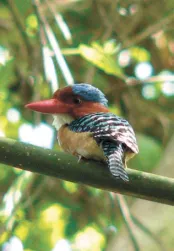 Striped winter -bearing (Lacedo pulchella)
 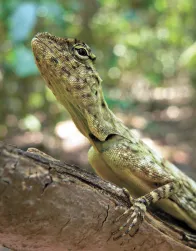 Indochina Flying Dragon
 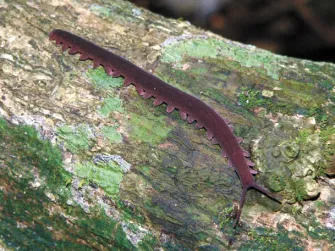 Peripatus (euperipatus sp.)
 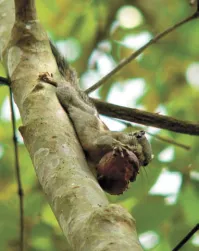 Striped protein (Tamiops Rodolphii)
 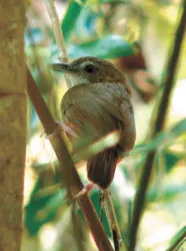 Meshina Timelia (Malacocincia Abbotti)
 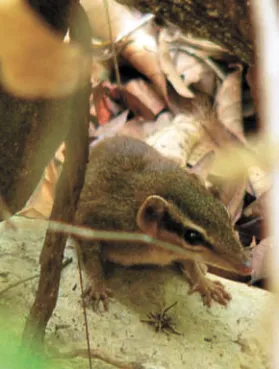 Dendrogale mouse (Dendrogale Murina)
 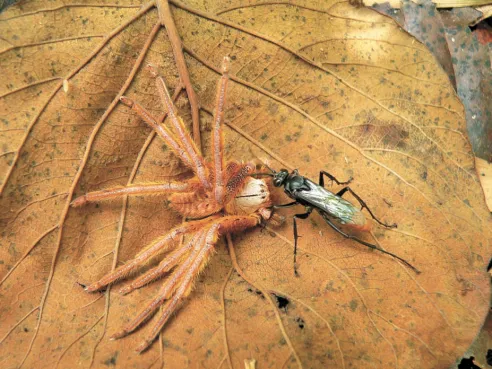 The OSA is a hunter with prey
 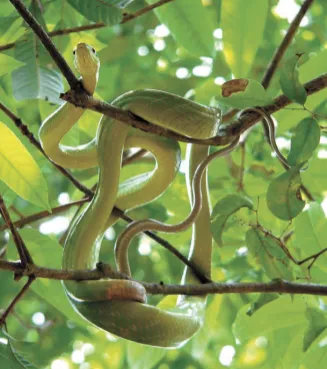 Red -tailed runner (goniosoma oxycephalum)