
Translated material
: Song and Dance sentence

The court replaced one of the participants in the Punk-Feminist group Pussy Riot to Ekaterina Samutsevich a sentence for the conditional and she was released in the courtroom. Two other convicts in the same case, the court of second instance upheld the verdict in force. Girls' lawyer Mark Feigin promised to contact the Presidium of the Moscow City Court. In addition, protection can apply to the European Court of Human Rights. Lawyer Samutsevich Irina Khrunova also did not exclude the appeal of the sentence, "after all, this is not a final victory."
 Irina Khrunova. Photo: monavista.ru
 Earlier, Samutsevich, like the other two arrested members of the group, Maria Alekhina and Nadezhda Tolokonnikova, was sentenced to two years of the colony-settlement for the action in the Cathedral of Christ the Savior, held by the group on February 21, 2012. The girls, recall, put on multi -colored masks in the temple and jumped on the amvon for several seconds, after which they were expelled by the protection of the temple. The court found that the defendants were guilty under the 213rd article of the Criminal Code of Russia (“hooliganism”), as they offended the feelings of believers. The defendants themselves did not find themselves guilty and filed for a cassation. The girls do not find themselves guilty now.
After the active public campaign in defense of Pussy Riot regarding the actions of girls and their shares, representatives of the Russian authorities, including Vladimir Putin, have repeatedly expressed. Commenting on the case during a visit to the London Olympics, Putin, in particular, said that very strictly girls should not be judged. After the statement of Vladimir Putin, the prosecutor asked “only” three years in the colony, and the court awarded all three detained participants in the action for two years, although many observers believed that the sentence would be more severe.
Russian society reacted to the verdict, to put it mildly, violently. The TV presenter Arkady Mamontov devoted the second “journalistic investigation” for the second year in six months, which seemed to find out that Boris Berezovsky stands behind Pussy Riot. The audience is not so engaged also divided. Pussy Riot supporters considered the sentence unreasonable and politically motivated, the opponents as a whole were satisfied with the outcome of the court, although among them there were supporters of replacing the conclusion of correctional work.
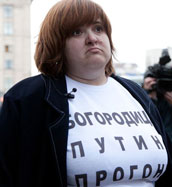 Violetta Volkova. Photo: svobodanews.ru
 During the consideration of the cassation, Samutsevich refused to the services of her lawyer Violetta Volkova, now she is defended by the lawyer Irina Khrunova, who cooperates with the Human Rights Association of Agora. Even during the consideration of the case, many noted that lawyers are more occupied by political statements than the actual management of the process. A lot said that passages about the conditionally “control of the court” and the “indicative political process” can melt the hearts of the jury, but the heart of the judge is unlikely to be possible. And there were no jury on the process.
The casus of the situation is that Ekaterina Samutsevich, unlike other sentences, did not get to the amvon, the guard managed to bring her out to this. Meanwhile, they charged the girls and condemned them for identical acts, namely: “Tolokonnikova N.A., Alekhina M.V., Samutsevich E.S. and unidentified faces ... penetrated into the fenced part ..., placed on a hill in front of the iconostasis in the altar part of the temple (fuel) ..., being in bright open dresses with masks on the face for about 1 minute, shouted, chanting the swearing phrases and words insulting the believers, as well as jumping, lifted up their legs, imitating dancing and applying blows and applying bars fists on imaginary opponents. " On this, the new lawyer Samutsevich actually built the defense line.
 Punk-band. Photo: Pussy-riot.livejournal.com
“In fact, she was about 15 seconds in the fellow, not having time to make any of the actions that the court was recognized as hooligan. She did not sing, did not shout out any words, did not pray, did not jump, did not do anything that the victims and witnesses describe, and that was invaluated with the sentence, ”the text of the cassation appeal of Irina Khrunova said. Based on the testimony of witnesses and the verdict of the court of first instance, Khrunov asked the court to terminate the criminal case, and the verdict to cancel. However, the court only softened the punishment for one of the participants in Punk-Molebne.
The Internet community, especially its "liberal-processed part", has split about the results of the cassation. The verdict of the second instance regarding Samutsevich is discussed almost in the inclination of “could she change the lawyer” and even “whether she has the right to be free while Alekhina and Tolokonnikova are sitting.”
This inclination is extremely significant. Early criticism of Pussy Riot lawyers, I must say, seems quite justified: the lawyer is not to the face together (or even instead) with the work to protect the rights of his client to play the role of a civil activist and human rights activist in a completely different sense. The change of such a lawyer seems to be a logical and very rational move. If he cannot get you out of prison on a clearly linden prosecution - so why do you need such a lawyer? And the position of Khrunova, who rests on a clear inconsistency in the verdict of the court of first instance, seems much more positive from the perspective of “how not to go to jail” than requests to call Patriarch Kirill, Vsevolod Chaplin to the process or to prohibit comment on the process to Vladimir Putin.
In fact, it turns out that the defense had some chances to achieve a different process of the process, but too much effort was spent on illuminating the case. Which ultimately additionally politicized the trial.
Yes, this is not normal when the court says that participation in a crime is a real term, and non -participation is conditional. This is not quite a normal court or even not a court at all. However, it is strange and surrendering without a real battle, starting to shout “we have no chance” when there is no good reason to believe that there are really no chances.
Similarly, the Russian political opposition sometimes behaves. To which the legitimate question receives from the authorities: "Guys, so it is a political struggle, why have you not fought?" It is clear that the struggle will not lead to success with a probability of 99.9 percent. Obviously, it is extremely difficult to win in a political confrontation without resources, if at all. But to this damned question you need to find an answer better than “Putin go yourself” or “I won’t get out with these in one site”. Such an answer sounds not serious.
The conditions are unequal, the system is discriminatory, the elections are falsified, and it is forbidden to sponsor the opposition to business. But if you do not fight, then there is definitely no chance to win. The same Bryansk incident proves that the struggle is at least possible. And you can put the entire system on the ears with all its curvature, if you want. Kazus Samutsevich, of course, is another matter, but in the same conceptual series.