
Translated material
Light cover
Light cloud. October 14 (October 1 according to the old style) Orthodox Christians celebrate the cover of the Blessed Virgin Mary. A highly respected religious holiday falls in the middle of autumn, coincides with the change of seasons, preparations for winter and related household chores. It is not surprising that Pokrov entered Russian literature and marked by many proverbs and sayings. The New Times tried to figure out the secrets of a particularly revered Christian holiday 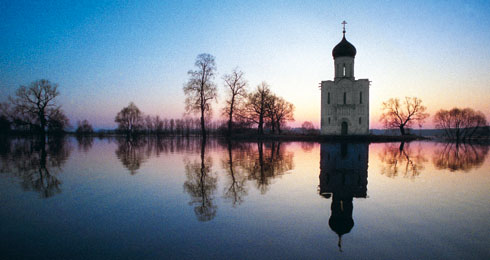
“Rejoice, our joy, cover us from all evil by your honest homophore ** omofore, mulmia (Greek) - a head cover, a bedspread. Today, the Omofor - part of the worship of the bishop, a wide tape with images of crosses, descends at both ends on the chest. ” - all those present in the temple sing on this day. And even people who are far from religion know: this is an important day. Since ancient times, it has been going: cover - unleashed everything. They prepared for the Pokrov ahead of time, “untied” all things. The cucumbers were salted on Ivan the Extra, they had cabbage harvested, and apples were wetted under the very cover.
And now they try to insulate the housing, roll up, close the banks, dry or at worst to freeze berries and herbs. You will prepare for Pokrov - and winter it.
Vlaherne miracle
The cover of the Blessed Mother of God, its robe and part of the belt, are considered the greatest shrines of the Christian world, from the 5th century kept the Blaheern Church near Constantinople. According to legend, many amazing events are connected with this church. Every Friday, a miracle took place at the all -night service in the church: Pokrov, half closing the image of the Mother of God, rose invisible by force and remained soaring over the icon throughout the time of prayer.
The Temple icon of the Virgin is attributed to the salvation of the capital of Byzantium during several sediments. In 626, when the Avars threatened Constantinople, Patriarch Sergius, accompanied by the future emperor Constantine III, wore this icon along the city walls. The vision of a woman on the city wall scared the Avar leader so that he lifted the siege.
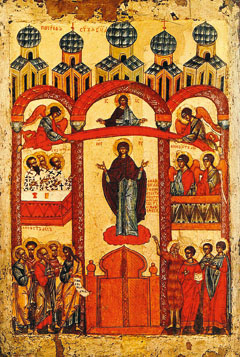 The icon "Protection of the Blessed Virgin Mary." The end of the XIV - beginning of the XV century. Novgorod production
The great miracle that happened three centuries later is described in many chronicles. In the fall of 910, the enemy approached the walls of Constantinople, according to some sources - Rus, the soldiers of the prophetic Oleg, which is not excluded, since the Kiev prince had repeatedly raided Constantinople, and in 911 he sent an embassy to the Constantinople, which signed a peace treaty with Byzantium. On October 1, 910, an all -night worship was underway in the overwhelmed by the Vlacheern Church. At the end of the service in the fourth guard, Juddy Andrei, a captive Slav, sold into slavery in Constantinople, saw the Virgin soaring in the air. She was surrounded by angels and saints, accompanied her by John the Baptist and Holy Apostle John the Theologian. Having kneeling, the Blessed Virgin with tears began to pray that the King of Heaven would hear "every man ... calling my name for help." After the prayer, the Mother of God took off the bedspread from her head and spread it over the prayers in the temple, protecting them from the enemies of visible and invisible. Tradition says that the Omofe shone "more than sunny rays."
While the Most Holy Theotokos shone on the cloud, the homofer shone when the Mother of God disappeared, and the cover was invisible. But grace remained in the temple. Andrei told people about a marvelous phenomenon, the news of the miracle spread through Constantinople. This inspired the Byzantines, gathering strength, they defeated the enemy.
In 988, the Patriarch Nicholas II Khiverg sent the Constantinople clergy to Kyiv to baptize the "enemy" into Orthodoxy. In 1075, the Byzantine writer and theologian Mikhail Psell in the “Word for a miracle that had committed in the belchernes” described the icon over which he soared the Intercession. She will be called the Vlahern Mother of God. This icon (or a list from it on the same board) in the 17th century, after long wanderings, will go to Moscow.
Loved God
Although the sources that have reached us do not give accurate information about the time or the circumstances of the establishment of the holiday of the Protection of the Blessed Virgin Mary, no one is in doubt that he is Russian origin. Back in Kievan Rus, individual rituals of the Vlacheern cult of the Virgin Mary began to reproduce. In 1148, the mention of the wooden Church of the Intercession in the animal monastery in Novgorod, which burned out that year from the lightning strike, was first found for the first time. A brief, unexpected “prologue” of the first half of the 13th century from the Sofia Cathedral of Novgorod is the earliest Russian legend about the cover that came to us. As part of the Novgorod service Psalms, the oldest text of the Pokrov service was found, which is a significant argument in favor of the Novgorod origin of the holiday.
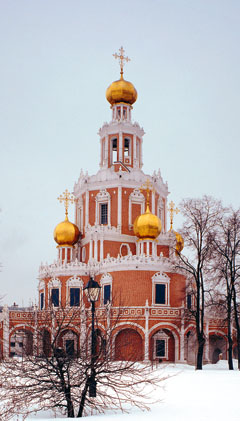 Temple of the Intercession in Fili
Nevertheless, most experts are inclined to believe that the Festival of the Protection among the main, bypassing the Metropolitan, established Prince Vladimir, Rostov and Suzdal Andrei Bogolyubsky together with Bishop Fedor. He is considered the founder and builder of the Russian Christian state. A bright historical figure, brave in battle and wise in business, Prince Andrei managed to do a lot - and after martyrdom, as a result of the conspiracy, he was canonized by the Russian Orthodox Church.
The visible argument in favor of the Vladimir-Suzdal prince is a white-stone masterpiece of ancient Russian architecture, the first stone temple in Rus' in the name of the Blessed Virgin Mary, the “honest cover”, built in 1165 on the arrow of the Klyazma and Nerl rivers, which today is one of the symbols of Russia.
Bogolyubsky himself chose a place for the temple. A man-made hill was erected in the pouring meadow and “committing one summer”, that is, in a year, erected the memorial temple in memory of the deceased from the wounds received in the battle with the Bulgarians, the son of Andrei-Izyaslav and the victory of Andrei Bogolyubsky over the Volga Bulgars. At the intersection of the most important trade routes between Suzdal, Rostov and Vladimir, a snow -white church with a helmet -shaped head, a construction of exquisite proportions and harmony, rose on a hill, a gended stone. Gallery surrounded the church on three sides. A wide staircase led to the pier. 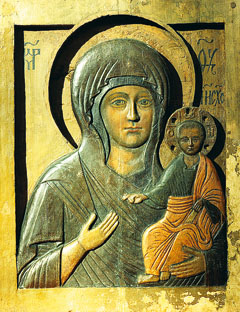
The facades of the temple were first decorated with a sculpture. The central figure is King David sitting on the throne with a psalter in his left hand and blessing two -iteously with his right hand. He is listened to by animals. Lions, pigeons, griffins, female faces with long braids encircle the temple. There is also a leopard that has risen on its hind legs (in Directus-Pardus)-the oldest sign of the Russian people. In contrast to the facade, the inside of the temple was generously painted. On the dome - Christ with angels and six -winged seraphims. Bright frescoes on the walls harmoniously moved to the color major of the floor.
Bogolyubsky personally took dear guests to the service to the temple of the Intercession, he himself wrote prayers for the holiday: “Word”, “Service”. In the cycle of ancient Russian monuments “Word on the Intercession” there is a “laying legend” attributed to the Bogolyubsky. This is the presentation of the “terrible and fucked vision” of the holy fool Andrei and the message about the establishment of the Festival of the Protection in Rus' by the will of a certain “sovereign prince”.
However, like many Christian holidays, the cover did not arise from scratch. The Orthodox who have found a single faith “renamed” the ancient pagan autumn holiday, marked by the end of field work and harvest. But the main thing: the Vlacheern miracle, which was contemplated by the captive Slav Andrei, found a response in the Slavic soul, to the miracle is always susceptible. The holiday has become close both in spirit and in arrangements. Just as in antiquity of the Israelis from Egyptian captivity, a cloud led into the promised earth, so Rus' gained its co -light cloud, which gives strength, unites, saves and leads to the kingdom of God.
What is the cover ... *
Today only in Moscow there are more than a dozen temples built in honor of the Protection of the Blessed Virgin Mary. The most famous of them, of course, is the Pokrovsky Cathedral - the temple of Basil Blessed on Red Square, a symbol of Moscow, Jerusalem, which decorates the capital since the 16th century. And the most visited is the temple of the Protection of the Blessed Virgin Mary in the Pokrovsky Stavropigial Convent at the Pokrovskaya outpost, where the relics of the holy old man of Matrona are now resting.
The Pokrovsky Monastery was in Moscow under Ivan III, but burned down. In 1655, by decree of Tsar Alexei Mikhailovich, in memory of Patriarch Filaret, a monastery temple was erected in the evening of the Protection of the Virgin. The lands under the monastery were allocated by his father Mikhail Romanov, but construction began only twenty years later. The monarch encouraged the event that happened in October 1653 on a good matter: it was then that the Greek merchants brought the famous Vlacheernic icon as a gift to the Moscow Tsar. Alexey Mikhailovich honored her especially. Now it is stored in the Assumption Cathedral of the Moscow Kremlin. 
Another marvelous beauty of the Moscow temple is the cover of the Blessed Virgin Mary in Fili. Uncle Peter I, Lev Kirillovich Naryshkin, who received a village in his estate at the end of the 17th century, built there on his own common project (architect, possibly Yakov Bukhvostov), which became the ancestor of the style of Moscow Baroque. Here today is the Church and the branch of the Central Museum of Old Russian Culture and Art of Andrei Rublev.
How is the cover celebrated? On Sunday, the Orthodox came to church with the whole family. The young young ladies were especially striving for the temple on this day - to pray for an imminent wedding. Grandmother said: if you put a candle in front of the icon of the Protection of the Mother of God and say: “The cover, the Blessed Virgin Mary, the cover of my poor little head with a pearl kokoshnik, a golden slap” - then at night I will definitely dream of a narrowed one.
Pokrov is a cheerful holiday. Therefore, on this day, for centuries, weddings have played. In many churches, on this day after the service, festive tea parties and children's matinees are held.
And the cover is rich in signs. They say that on this day it is necessary to “bake the corners”: the brownie is fitting, and he is asked to store heat in winter. To do this, baked special pancakes - small pancakes. The first pancake was divided into four parts and carried in the corners as an offering - so that the brownie is fed up and calm.