
Translated material
The disadvantages of contemporary art
An exhibition of young Russian artists with the curious name “It seems that something is missing here” (until November 5) opened at the Winery. Her curator Stas Shuripa explains the general idea as follows: “If something is missing, then this is good, in art they become value: absence, lack, breakdown, error, lack.” It is believed that in the new art there is not enough understanding , but the curator is convinced: "This is a false idea that art is high -luminous and abstruse, it talks about understandable things, about everyday life."
Shuripa selected works in which "interest in formal search is combined with a conceptual component - when the artist tells the story, but not with the help of a direct political or other action, but in a plastic language." Reading these stories is not always easy. For example, Zintsova objects are very convincing. A photo frame, hanged face to the wall, and turned to us by the back side so that we see a design on which the photo should rely to stand on the table. This device turns into a semblance of a suprematic composition, what should be a cozy family photo is bristled by a geometric abstraction, the black color of the background reminds of the “black square”. In another work, it acts the same way - it sees the function and leaves it in form that it breaks our usual perception: the composition from the old Soviet watches in wooden buildings - in it the clock does not show time, but their design. Nadezhda Busheneva has a layout of a pool on high legs, a shell in which there is no water, and the depth turns into a void and height.
In the work of the Association “Issues of the Experimental Group” the familiar function is deprived of the viewer. They placed their project in the end of the exhibition hall, where the organizers usually broadcast on the openings in the microphone, talking about the exhibition, answer questions. Here, the equipment is deployed to the viewer, and he himself finds himself at the microphone in front of the party party. These questions ask him from the speakers, very complex, like: "Should the action be reasonable to be permitted?" One question from the score is missed and the viewer can read it into the microphone himself: “Do you want to be heard when you say, listening only to what deserves your attention?”
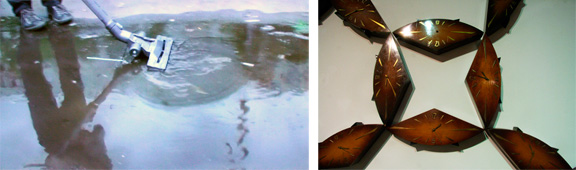 Frame from video documentation of performance Ksenia Sorokina, where she vacuumed city puddles, 2012. Natalia Zintsova, "without name (mechanism)", 2012
But there are works that are not easy to interpret and can be at a dead end. For example, the work of Yana Tamkovich, made in an interesting genre, “Installation for Radi -Mide” - a podium, a stepladder and a box with a bust of Nefertiti. The curator tells about her: “This work is about social conflicts. Jan searched in Cairo among souvenirs the most similar to the original bust of Nefertiti, and brought it to Moscow in a wooden box. This is not greeting “Arab Spring”, here we are talking about two processes - logistics of transportation and exhibiting, and both of them, according to the author, are very charged with power currents, exhibiting, for example, - this is a hierarchy of catwalks, a copy of the bust is at the exact repetition of the catwalk from the Berlin Museum. The fact that the souvenir is exhibited here recalls the conversations about the Berlin exhibit now - and some claim that there is also a fake. ”
Or Anna Titova’s installation “in the sparse air”: a gypsum bust, photography and assembly from stone on a marble board on a podium covered with a film. The artist talks about her work: “This is all about fantastic utopias, which, it seems to me, we lack. Nikolai Morozov, like Tsiolkovsky-a self-taught scientist, he was fond of everything that can be represented, both chemistry and physics, and many others. He spent 28 years in prison, studied 12 languages, wrote a number of monumental works on science. One of his most scandalous works that delighted Lenin and was printed by multimillion -dollar circulations - “Christ”. In it, he says that our whole story is being built on the volcano of Vesuvius and Pompeii, and on the fallen asteroids. I made his bust in a harsh style, like a submarine for a giant monument, which was rejected and thrown away. On the wall - a large photo from the covers Newsweek - the first photo of the American drone with the view of Kanbon, where Bin Laden was hiding. I am convinced that any resistance is romanticism. ” And at that moment I think that the audience at the exhibition will really miss the guide who will tell all this, or explicated explications. Because as if the viewer did not seek to understand and interact, he will not be able to guess that this gypsum bust is Nikolai Morozov, because it would be a well -known sculpture that the artist would appeal to, or a very famous face - but she made a bust herself and we see him for the first time. And certainly almost no one remembers this cover Newsweek.
But in general, Shurip is right - mistakes and shortcomings give rise to artistic quality. And at the exhibition of AES+ F “Trilogy” (until October 12), this is visible in the “Manege”. When discussing their work, they usually concentrate on the plots of the video that are combined here in the trilogy: hell, the “last uprising” with adolescents infinitely killing each other in the computer game; Paradise, “Pir of Trimalchion”, whose action takes place in a luxurious hotel, and saturated with the pleasures of the Lord change roles with service personnel; And the purge of “Allegoria Sacra”, in which a variety of types, nationality and cultures are autically freezing in the inter -space of the airport waiting hall without interacting with each other. It would be interesting to focus on how everything is done: the video is called super -technological, but, nevertheless, sometimes we see frank flaws, mistakes - and they are left consciously. This is not a video filming, but photographs connected by morphing, flowing one frame into another - in the first video there were 25 per second, in the last one already 50. Periodically, this flow gives a malfunction, and they make a terrible impression - when the hand passes in front of the body, it seems to wash it in front of her and creates it again. A person turns his head, and at some second it is clear that his eye disappears, and his face grows a new eye, at a different spatial point. Lightning on the hand of the glamorous lady moves on its own, as if shaking away after unfastening. Her trembling teeth echoing with an insect-flair that runs through all the characters, unnoticed by them, and plays an important role in the plot-in the end she kills an old man lying on a hospital under a dropper, and he reborn into a mutant child with an insect tail. The world in which there is death, old age and illness, gives way to the world to the perfect, but through and through artificial. The characters of the “sacred allegory” will never wait for their flights - not only because in some frames we see that all the planes are entangled in the vines and sprouted the jungle, but also because these characters have no past and future, they are only a sequence of individual pictures.
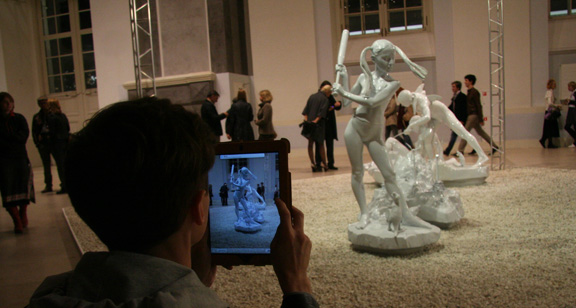 At the exhibition Aes+F "Trilogy" at the Central Military District "Manege"
AES+F sculptures, also presented at the exhibition, are extremely naturalistic, as if they were cast from living bodies - they were not missed through the author’s artistic will, they have not the slightest stylization. So the computer could create the image of a person, following the data loaded into him on the average indicators and standards characteristic of the human body. These are cyborgs, and a person, in order to remain himself, is necessary an individual deviation from the norm, shortcomings, errors, lack of shortness, which Shurip spoke about.
In the AES+F video, racial affiliation implies a strictly defined role, so Muslim pilgrims outside the airport waiting room turn out to be jihad warriors. At the hotel from the second part of the servants, you can find out by colored skin. Aborigines appear to make contrast with the high -tech world of the airport and dance with European girls.
A completely different story with the nationality at the Taisiya Circular exhibition “Cinema for Migrants” (until October 13) is a video station shown in the cinema, one five -minute session is one language. And in each film, the main thing is not the nationality of his hero, but work and human qualities. Everything starts with a tadjik janitor, who explains how his working tools are called in Tajik. But further stereotypes are destroyed. The Latin American carries spare parts for Russian machines to Colombia, that is, supports our domestic manufacturer. Ossetian performs Latin American songs in clubs, that is, depicts the Spaniard. They say the same phrases in their native and Russian, which are then duplicated in the form of a white text on a black screen with an audiopolist. It can be noted that the peoples of the Soviet republics and Russians have long been together that the words that appeared along with the technologies of the twentieth century sound in these languages in the same way as in Russian, these are common words from a long life together. Sent Kulumbekov, connecting the speakers, says that in Ossetian it is also “wires”. The Georgian bearded hero "Uncle Roma" in a camouflage jacket goes to work in the evening - to carry passengers in a taxi. Immediately we are faced with prejudice - on the side of the young man catches the car, but when he saw such a formidable driver, he refuses to go. It is possible to attract and bring it to the place, and even interesting to chat - but at first it was frightened. Latvian actor plays the role of d'Artagnan in the theater. The last session is the Kyrgyz who teaches at a music school, the dictionary ends on this, the credits go to the music of Schumann, which he performs.
Another project in the same spirit is the exhibition "Caucasian Dictionary" (until October 14) in "Tsaritsyno". Those who abuse the allegations that the “people who have arrived” do not have enough culture, they will be convinced at this exhibition that they themselves simply do not have enough knowledge about the peculiarity and wealth of cultures of the Caucasus. The exhibition’s space is arranged as a labyrinth, which, according to the curator Olga Sosnina, “conveys the drama and ambiguity of the plots presented in the project: confrontation and dialogue, enlightenment and faith, male and female, war and peace, death and memory.” Entrance to the maze - through the “mountain of languages”, as the Caucasus called the geographer from Baghdad in the 10th century. Now there are more than 50 of them, among them-the Ubykh language, which is breaking out world records in the number of consonants-there are 82 of them. According to legend, when God is taking languages to all the peoples, his horse stumbled in the Caucasus and part of the bag scattered-this also coincides with the term of philologists, who call the region a "linguistic bag." Already from the first hall it becomes clear that the exposition is made very modern and exciting - the language mountain is represented by a geometric form with a video projection on the ledges of the “peaks”, and in the cave there is a very modern painting by Magomed Diaeva with the inclusion of texts in the Dagestan language.
The Caucasus, the Mountains of the Kaf, seemed to ancient historians the edge of the world, a ridge, encircling the world. From here, German historians tried to deduce the origin of the Aryans, and ours considered the cradle of the Slavic peoples. Many legends end here - the ark of Noah sailed here, they were looking for the Amazons, Prometheus was chained here, Jason sailed here for a golden rune.
From the tongue - to the mountains as such. They, strong and adamant, gave rise to the highlanders of the highlanders "down" on other nations. So, about the Chechens at the beginning of the 19th century, historians wrote that they recognize the power only Russian, calling themselves, however, “the friends of Russia, because in their language, as in the languages of other Caucasians, there is no word that means a political dependence, except for already perfect slavery.” Houses are, as it were, a continuation of the mountain, they are similar to the “gigantic Druz of Crystals”, which finishes the mountain. Interestingly, in the Dagestan language, for example, there is no word a house, there is only a plural number of the word room. That is, the houses of individual families are the rooms of the common house-aul. It seems that the scattering of these forms is the reason that geometric abstraction has become popular in the Caucasus. Among the photographs, ethnographic pre -revolutionary drawings and Soviet painting and sculptures in this section there is one abstract work - it is interesting that it portrays Swannia. As they said, in this area of Georgia a very peculiar icon painting, similar to cubism. True, Svans consider their icons to be very personal and do not show strangers.
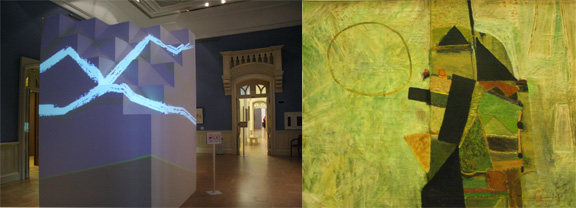 Hall of Languages. Anzor Chegelishvili "Swannia. Autumn", 1986. Exhibition "Caucasian Dictionary", Tsaritsyno.
The next hall begins with the video "Karakul" of the modern Dagestan artist Taus Makhacheva. She works with gender and national topics, and here is a horse, proud, but domesticated, is under a rider, a strange, almost fabulous creature, entirely, including a face covered with curly fur. Some of the old legends, a foggy, curly forest spirit, perhaps a girl. In a person is more strange and wild than in an animal - a horse.
In the windows - daggers, sabers, belts, harnesses and bedspreads for horses, burka and Circassian. In general, much of what was considered in the Caucasus a “sign of happiness” - a 1903 list is attached. It is touching that there are such items in it: 1. Get a Qur'an written in outstanding handwriting. 2. A beautiful wife from among cousins, and then - a stallion, a pistol, a dagger, a saber, amber rosary. And the last, 8th paragraph-"A few careless lifestyle." To realize paragraph 2, it was necessary to be a wonderful rider: as the Adyghe writer ser. The 19th century Adyl-Girey Keshev, "the heart of the Circassian one belonged not to the one who combined more mental and moral virtues, not even to the one who possessed an excellent appearance ... But only to the one who meets all the requirements of the ideal rider."
The material world was symbolic and status. About the father: “The hat is not worn for warmth, but for honor”, “If you have no one to consult with, advise with your hat.” There was also a saying about the shepherd, who asks for advice from the staff.
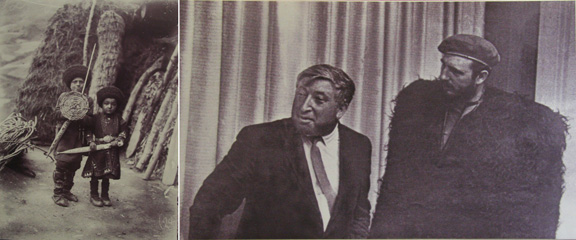 Caucasian boys. "Burka as a gift - Rasul Gamzatov and Fidel Castro.", Cuba, 1970s. Exhibition "Caucasian Dictionary", Tsaritsyno.
 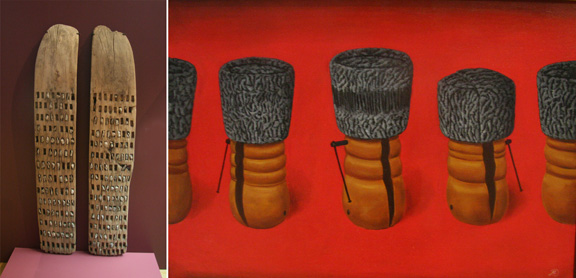 Hammer boards, K. of the 19th century, Chechnya. The newlyweds were transported to them, they were buried on them, old boards were placed like a door to the house. Magomed Dibirov, "traditional silence of the lamb", 2008, Dagestan. Exhibition "Caucasian Dictionary", Tsaritsyno.
Next are the halls with many exhibits telling about the family and house, religions, the Caucasian war, the customs of the Europeans from the abduction of the bride to the Caucasian captivity - from the film Gaidai to terrorism. With the drawings of children to the “Caucasian captive” of Tolstoy and the installation of Anastasia Khoroshilova with an interview with the survivor of the Beslan tragedy, which are shown in huge iron suitcases where a person will fit.
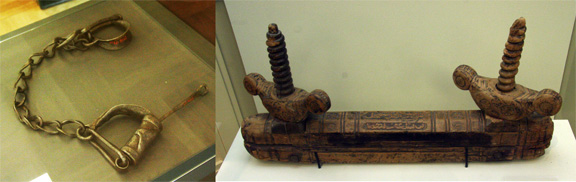 Putes with the key, the beginning of the 20th century, the Kutaisian province. Machine for interweaving books, Dagestan, ser. 19th century. Exhibition "Caucasian Dictionary", Tsaritsyno.
 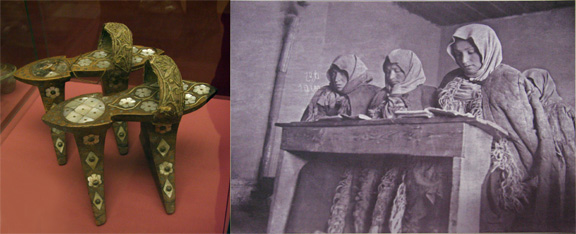 Shoes on the stand are female, Karachay-Cherkessia, beginning. 20th century. Liberated women of the Caucasus for reading. Exhibition "Caucasian Dictionary", Tsaritsyno.
And light - Caucasian feast and kitchen, Soviet architecture of resorts in old cards under the slogan "New Antiquity" and tender paintings of Totibadze with parks, vases and the sea. Myths and heroes. “Tsar Tamar” as a historical person and as a legend, “DEV”, an evil spirit, kidnapping beauties, and a carpet with Lenin in flowers - in a row. Masks wolves: “Wolf, the most poetic beast in the minds of the highlanders. Lion, eagle - they depict power - they go to the weak; The wolf goes on a stronger than himself: a lack of power replaces with courage, insolence, dexterity. ”
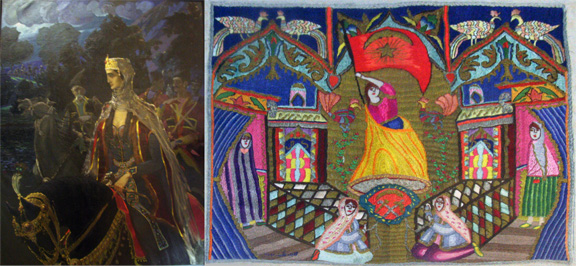 Valerian Sidamon-Eristavi, "Tsarina Tamara", 1917, Georgia. Embroidery, craftswoman Iskanderova, 1930s, Azerbaijan. Exhibition "Caucasian Dictionary", Tsaritsyno.
 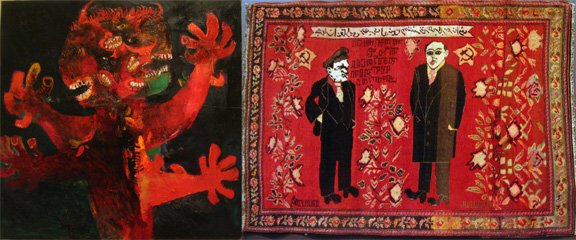 Rasim Babaev, Div, 1983, Azerbaijan. Carpet with portraits of Lenin and Narimanov, 1920s, Karabakh. Exhibition "Caucasian Dictionary", Tsaritsyno.
The last hall is industrialization, industry, oil production. The largest exhibit is a layout of an oil tower provided by the Museum of the LUKOIL oil company. At this place you fall into modernity - and say goodbye to nostalgia for those times when the money was not the main one. No matter how much the bad is in the USSR, we sometimes lack the past in which our peoples were together. Not only in art itself should be missing to provoke a dialogue, as Stas Shurip formulated, often art gives us what we lack in life.
Irina Corina’s exhibition “Swell to the fires” (until October 30) at the Vinzavod in the Gallery XL returns us to childhood, which is equal to the Soviet childhood. Strange visions collected from Russian shawls and adhesions, twigs and dry autumn leaves-a tent-frank locker room, bonfires and a tree on a tree, a doll of wood and bread loaf. Pioneer childhood, albeit sometimes forcibly, was collective, now forced to think about a career almost from school and take the path of individual survival.
We still do not have enough life, especially at modern speeds - there is no time to gain wisdom. About this the exhibition "Pipe, or the alley of longevity" of the inspection "Medical hermeneutics" (until November 10) in the Gallery "Ridzhina" at the Vincuration. Indeed, a pipe - at the end of which an office with a chair, a table and a bookcase, a dream like the one that was granted to the Bulgakov master. But we only dream of peace - a layout of the place of solitude at the other end of the pipe, and as a wonderful garden of Alice in the book of Lewis Carroll, it is not in size - it can only be increased with the help of a gaze to binoculars that lies at our end of the pipes. And along the walls, portraits of elders wrinkled to baked apples, crumpled rags, overgrown with beards, and below numbers with many zeros, indicating their age. Few people are so protected to wish such numbers not on the account in the bank, but at the age.
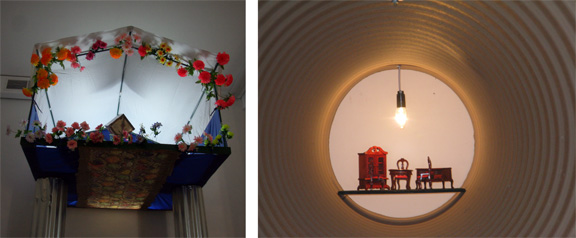 Irina Corina's exhibition "Swerten the fires." The exhibition "Pipe, or the alley of longevity" of the inspection "Medical hermeneutics". Photo: Julia Lebedeva.
But sometimes I want to not only watch art, but also acquire. In this case, you need to urgently go to another exhibition at the Winery - “Art for various classes of consumers” (until October 14) , representing the work of artists -daltonic artists under the control of Tatyanina Yuri Nikolayevich, the genius of the Lipetskoye Earth in the Pop/OFF/ART gallery. Despite the wild name, the artel is in order with color reproduction and the senses of humor. Priches - from 50,000 to 400 rubles. The appearance is somewhat art Brutovsky, but jokes are mainly for dedicated to modernity. Very conceptual - to make one of the central ideas of the project pricing. The paintings are repeated in three versions: “Premium, business and economy class”, and the plot is the same everywhere, but expensive on canvas and paint, and the cheapest are on a cardboard, and the paint is fluidly smeared. Or another series-the paint is the same everywhere, and the image is also: the houses from the paintings of Malevich of the “peasant period” behind the red horizon, but the prices are different-in the sky above the landscape, a discount of 10% to 90% is indicated .. Favorite heroes-hare and fly, hello to Boyce and Kabakov. There are small wood sculptures with them, about 5 rubles per square centimeter are sold. Kunshtyuk, the truth is that centimeters are measured in volume, that is, still 1000 rubles come about. But there are sculptures thinner. There are plates painted, and books with hand -drawn covers, classic and modernity, Elizarov and Zizhek. Another way of conquering is a framework for paintings . This method has begun to be used recently, so it can be found more often among contemporary artists.
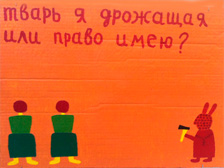
The exhibition is open until October 14, but then you can go in and demand to sell the works of artel, this is a gallery, that is, a store. In this case, you can afford to be a collector. As a hare with an ax says in one of the paintings to two old women: "I am a trembling creature or have the right?"
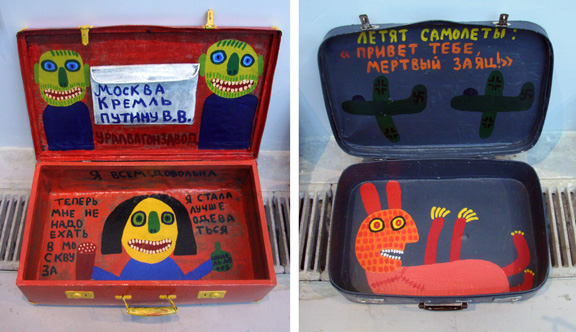 “Art for various classes of consumers” artel artists-Daltonics under the direction of Tatyanina Yuri Nikolaevich, the genius of the land of Lipetskaya.