
Translated material
Rhetoric "State Religion"
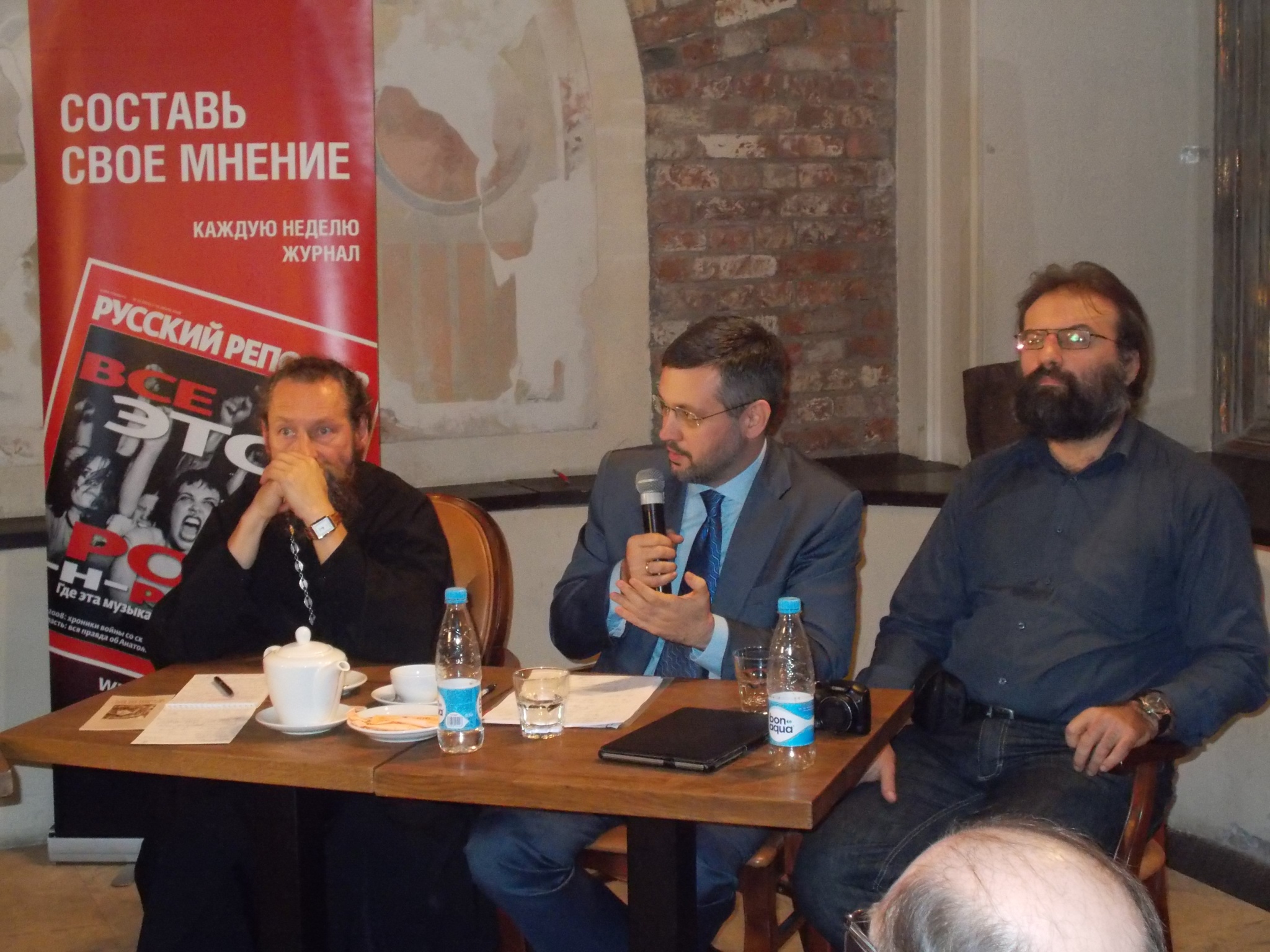
On October 10, in the Tomorrow club, as part of the Proza PR project, the Russian Reporter magazine organized a meeting with representatives of the Russian Orthodox Church. They tried to talk and find out whether the church and the state are really fetting. With whom in the end the church is with the state or with the people, and who is the “people”, and who is not? Where is the place of the church in modern society? They called the meeting "State Religion."
It turned out a lot of interesting things, only the question did not receive a clear answer: where is the place of the church in society. Apparently the most difficult.
Not without the usual rhetoric, and without "draining" of questions. The audience received about the horrors of the Inquisition in response: “What are the horrors? Are you a historian by education? Do you have a scientific degree? ” Happens.
But to the question (to the "church") about the temptation of power, that, they say, he was not engaged in his own business, took seriously - and answered seriously. Of course, “fraining”, including in terms of the appearance of the notorious foundations of Orthodox culture at the school, did not recognize any.
The guest of the meeting Father Maxim Kozlov explained that it was impossible to perform good deeds and carry a direct duty of the Church - comfort, without dense communication with the state.- They say to us: “You are nasty! Whatever the song you sang, you still fuss with the state. Become a kind of department of Orthodox confession,” the priest cited an example. - Now let's see where we are allowed. To the prisoners? How much you want! We have in prisons of prayer rooms for prisoners under a thousand already. We are allowed to be dying and elderly in the nursing homes. To the patients - to hospitals. And when it comes to what serious, we take the same younger generation ... We wanted to introduce the foundations of Orthodox culture, but what did it all result in? In some amorphous orks, God forgive. Here Venediktov wanted to be orks, so it turned out by the word of him. They also say that our liberal society has no influence. Has, and what!
Then Father Maxim gracefully wrapped criticism against the opponents of church allocation themselves.
- Our diplomas are not recognized to this day. But we have a large system of spiritual education. Throughout Russia 35 seminaries and academies, but we are all wipers! If you want to adhere to a sequentially atheistic position, atheists do not need to be offended and say that they are oppressed, ”said the priest.
Father Maxim complained that the clergymen were not actually allowed into the armed forces.
They say: "Here you are sanctifying nuclear bombs that do not explode after that." For all Russian armed forces of military priests, only 150 people.The state sometimes, according to the guest, considers the Russian Orthodox Church and as what can be translated into public criticism in case of something, and asked not to overestimate the proximity of the church and the state.
“As it comes to a specific case, it turns out that they want to have us in the form of some decoration,” he said. - I'm not sure that the state is ready to consider us as the Church considers itself - as an ontologically significant part of society. The state considers the church instrumentally .
True, he later explained that some priests in the regions are too closely, say, they communicate with the governors, and speak publicly very warmly about them. And this sometimes gives a reason to blame the whole church of excessive power.
However, separately, the priest noted that the church respects and provoke it, spurring the incitement of the Russian rebellion.
Another guest of the meeting, the Orthodox publicist Andrei Rogzyansky, also emphasized that the shit of the church with the state should be evaluated critically.
- Does the state need to ate with anything if the keys to the well-being of the church in the hands of the state? - the writer asked and pointed out the innocence of the Russian Orthodox Church in history: “The church remains a quiet, home, desert institution, which, unlike the Vatican, was never seen in secret policy, lobbying, empires and the like.”
Archpriest Andrei Yurevich spoke about the serious problem of the church, which often finds himself outside of public discourse: is Russia the Orthodox, as often claim, the state? The priest called the situation contradictory, and the contradiction, according to him, affects the church community itself.
“Our problem, church people, is that we are not quite guided by what is happening now. The church should learn to tune in to the situation that is now. And the situation today is even contradictory in the church. We have now crossed the darkness-flowing people (we ourselves are to blame), and now they say-from 70 to 95% of the Orthodox in Russia. And now - the last journal of the Moscow Patriarchate, Vladyka Panteleimon (Shatov): “I came to the conclusion that only 1% goes on Sundays to the temple,” says Archpriest. - It turns out 99% of atheists in Russia and 1% of believers! In fact, we live in the country godless, secular country.
He believes that they still need to figure it out whether in Orthodox whether we live in the country, or the country of the godless world. And Father Maxim does not even know where to get help, either from analysts, or in conciliar prayer.
The answer to the question: "Where is the church sees its place in modern society?" - The chairman of the Synodal Information Department of the Moscow Patriarchate Vladimir Legoyda tried to formulate for guests and spectators, but did not introduce clarity.
Separately noting that he is currently not as an official speaker, the spokesman of the Russian Orthodox Church expressed the opinion that the place of the church is in relations with a person.
- First of all, it is in relations with a person, not with institutions, not with political parties, not even with any communities. But there is one moment - this does not mean that relations with institutions should be excluded, ”Legoada said. - Religion is an intimate and private business. And I would say that in the empirical space we have nothing more intimate and private. But the issue of religion has never been a private business.
Religion, according to the press secretary of the Russian Orthodox Church, has two nature-public and private.
“The church advocates both private rights, and for public rights, and, through man, still communicates with institutions,” summed up the head of the Synodal Information Department of the Moscow Patriarchate, confusing the issue completely.
Father Maxim approached the issue of a few other ends, but was also forced to limit himself to the most general definition.
- There is such a thing - a symphony dating back to the times of Emperor Justinian. Contact and consent,- said the priest, explaining that the consonance and consent of the church should be with the state and with members of society. - We are not to consider the institution of the state as something accidental, secondary and unimportant for the church.
The ideal symphony seems to the Father Maxim not with everyone, but only with the healthy, cultural members of society, which gather primarily around the university education.
“Unfortunately, we are only only groping this path,” he said, and just did not spread his hands.
Searching for a common language, looking for that very symphony of the church is really difficult. Today, representatives of Orthodoxy are easiest to conduct a dialogue with those who are engaged in productive labor, and with those who have knowledge. With those who are not waiting for the manna of heaven. With those who are inclined to work, not steal.
“Unfortunately, we have not learned to talk with readers of the Lisa magazine until now,” Father Maxim admitted. And so far, the priest, who comes to the receiver for minors and vocational schools, is in a much more difficult situation than coming to the university.
The editor -in -chief of the Russian Reporter magazine Vitaly Leibin, who performed at a meeting as a moderator, summed up the results of the event for Polit.ru.
- I was very interested, because I was not looking at the rhetoric in the style of Father Chaplin and not for anticleric exclamations that were heard from places and which sounded on social networks. I followed the general level of reasonableness of the statements of the church in a situation where any sharp remark can be interpreted against you, ”said Leibin.
According to him, the fact that the guests were careful and went aside in their reasoning is natural. The main thing is that priests and representatives of the Orthodox world still answered some questions.
- Of course, they go into high matters, hiding behind this screen. But if you join in an understanding mode, you can see that there are people in the church with whom you can work and conduct a dialogue. It seems very important to me.