
Translated material
: How important it is to be frivolous

At the exhibition “Moscow Conceptualism. The beginning ”in Nizhny Novgorod one of the most significant movements of Russian contemporary art was shown as young, daring and relevant as in Moscow they had never seen it. The “beginning” here does not look like digging in the distant past, no archival photographs, except for those that are the documentation of the shares, are not nostalgia, the “beginning” is read as if only now it all starts, although the works presented are done from 1972 to 1979. The reason is that the curator of the exhibition is not an art critic who set himself the goal of putting a phenomenon in the coffin of the history of art, but the artist Yuri Albert. By his example, he proves that conceptualism is currently relevant than ever: in 2011 he received the Kandinsky Prize in the Project of the Year nomination, this year was invited by Boris Groys to represent Russia at Shanghai Biennale, but in response to the request of Chinese organizers to perceive political moments in their work, refused to participate.
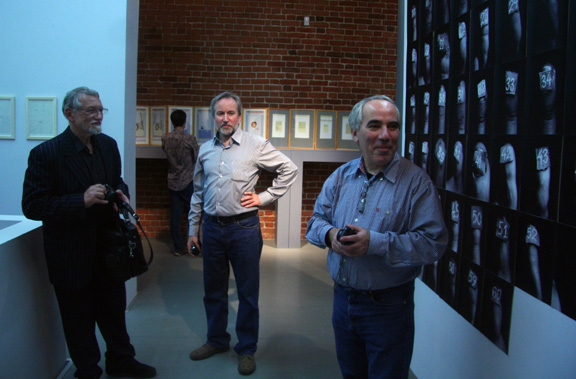 Participants in the exhibition "Moscow conceptualism. The beginning ”Alexander Yulikov and Georgy Kizwalter and the curator of the exhibition Yuri Albert.
He extracted things from the largest state and private collections that collect conceptualism - the GTG, the Museum “Another Art”, the Ekaterina and Stella Art Foundation, added a lot earlier from his own collection, and asked the artists to reconstruct unheated things. So the famous works received a new context, and the viewer had the opportunity to see something "new". For example, the object “Thermography of the Gorky” group “Nest” (Gennady Donskoy, Mikhail Roshal, Victor Skersis). Iron rectangle with the nariable dates of the writer's life. They are located from the hottest to the coldest. The coldest date is death, 1936, and the most important, burning - 1906, a meeting with Lenin, then a trip to Capri, and birth is already cooler.
Perhaps this work reflects the concept of the exhibition. Yuri Albert talks about what was before him - one of the hottest points of his biography, the formation of Moscow conceptualism, and chronology happened before his “birth” as a contemporary artist.
You can not believe that the accents in Gorky’s biography are placed correctly - then you can check, touch the metal with your hand, and it turns out that it is really hot on the one hand, and on the other - icy. One can not believe that conceptualism is so important for Russian art, but the exhibition convinces not to praise, but objects. As Albert noted, there are a lot of things, first invented in Russian art. For example, in addition to the mentioned “thermalography”, there are a lot of objects that experimentally work not with vision, but with other senses. The famous “gun” is Andrei Monastyrsky, where you need to look in the peephole in the box, and pressing the button, contrary to the expectations of the visual - hear the sound. The first works for the blind: the group "Nest" made embossed portraits of Sakharov from sugar and Solzhenitsyn from salt . This is the reconstruction, the originals are stored in the FSB of the Russian Federation, they were confiscated during the search - they generally have a good corporate collection. In this work, an interesting switch - we usually think that the blind people perceive everything to the touch, but they still have the opportunity to try the appearance of the outside world to taste. This topic of work with the rest of the senses is now becoming relevant again - and it is clear why Viktor Skersis supported the exhibitions of young artists "Barbara" and "Bessarius" , which included the sensations of the body.
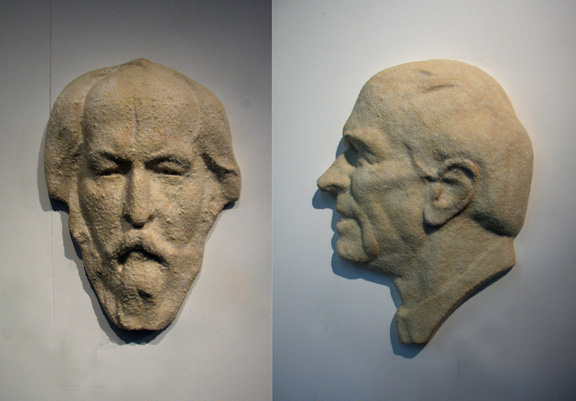 Group "Nest", "Solzhenitsyn from salt" and "Sahars from Sahara", 1975
But the most important impression of the exposition is not an abundance of discoveries and experiments made then, but the fact that conceptualism, which is often perceived as a sealed knowledge, a vicious circle of intellectuals “playing beads”, appears as a community with a civil position, fighters with the ideology of totalitarianism. As Skersis explained, our conceptualism can be divided into two lines. One tradition: literary and explorational, which went through literature-it was in it until the 70s remained the sprouts of modern art, the Oberiuts, the Lianozovo school, in the visual arts they were crushed back in the 30s. The second tradition models the phenomena of contemporary art, it is closer to the western, Joseph Koshutu, “Fluxus”. And you can divide the conceptualism into the “romantic”, which Grois wrote about, and the “analytical”, which is presented at this exhibition. We can say that he is close to social art, in fact, his “fathers”, mosquito and melamid, are one of the main characters of the exhibition. But thanks to the organization of the material conducted by Yuri Albert, it becomes clear that social art is by no means in the game with visual manifestations of ideology, flags, images of leaders, slogans, and pioneer. This is the identification of internal principles. In a number of works, there is a concept of an ideal average option that would be suitable for everyone, the unification that in the USSR they tried to carry out both with living conditions and with people. There is a photo of one of the first installations in our homeland. It lasted almost two years, from 1972 to 1973, on the corner of the trade union and Nametkin. In two rooms of a residential apartment, the contents of the head of the middle Soviet intellectual were reproduced: there were many things in it, you can’t list everything-the apostle Pavel, the Bust of Shevchenko, the perfumes were sprayed, there was a bridge over the rivers of Styx, the “face of mankind” from 4 parts-realistic, cubistic, icon painting and symbolist. It is curious that for that opposition you can also bring the average - the resistance was also typical. The dissident was supposed to love certain things, which mirrored the establishment of power on the standards. Another project is an ideal Soviet document: photos of all documents available to a citizen, work book, passport, all kinds of certificates, and a generalized option has been displayed.
Rare work from the GTG collection - a series of photos with texts in the form of "Catalog of Products", super -objects for superhumes. 1976-77-but Komar and Melamide have already managed to accurately criticize an alternative to the Soviet lifestyle. The worship of the unique, original, emphasizing the individuality of the owner, in contrast to the typical and wretched here, is ridiculed as the next type of limited thinking. The device in order for the alien aromas of the outside world do not fall into your nose, and you can breathe only yourself, but the device for growing nails on the legs made of the best varieties of red wood.
The relevance of Moscow conceptualism today is that it was not “anti -Soviet”, such as non -conformism, the value of which can be difficult to understand without Soviet context. Lev Semenovich Rubinstein, whose works are also presented at the exhibition, even noted the confrontation at a press conference: “The conceptual discourse in a sense subconsciously argued with the dissident. I knew them and admired the personal courage and readiness for self -sacrifice, but their tongue by that time seemed wrong because it was Soviet, albeit anti -Soviet. Dissants of the eldest from me, the generation turned to power and spoke its own language. The conceptualist language argued with him, he revealed the deceit and insolvency of any discourse that would claim authority and versatility. ”
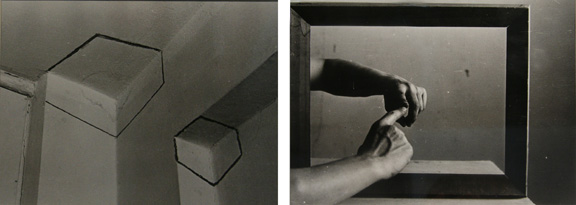 Virtual sculpture made by Ivan Chuykov in his workshop, 1978. Photo: Igor Makarevich. Ivan Chuikov, from the “Mirror” series, in which the reliability of the photograph is called into question: this is, for example, not a reflection, but the right and left hands on different sides of the framework that copy each other's gestures.
Confidence in your rightness is that it is you who have the correct knowledge, and the rest should obey is totalitarian in essence, no matter how good the intentions are. Yuri Albert confirms the opinion of Rubinstein: “The unofficial art of the late 60s-early 70s claimed spirituality, the beautiful, inexplicable. So it was - you came to some artist, he showed you his abstractions and religious insights on canvas, and no explanation from him or to receive - it was not that it was impossible, this was not supposed to. You either believe in it or not. Actually, conceptualism and social art, which arises in parallel, is an art that is fundamentally explainable, openly understanding. ” The employees of the Nizhny Novgorod GCSI, Elena Belova, who made the exposition and engaged in logistics, and Alisa Savitskaya, the compiler of labels and explications, who completely embodied the curator’s dream of the “university type”, which were held in the 70s Western conceptualists, confirmed Albert’s position on fundamental clarity. They said that they talked with the audience and heard-"Finally understandable exhibition!"
Miracle, mystery, authority - you yourself know who seduced this. Conceptualists did not look for a new version of the "bright future." Distrust of any serious idea that claims to be absolute and perfection is in all works of this exhibition. Bring to the point of absurdity any slogan claiming the truth in the last instance in order to identify its failure. Moreover, they began with themselves, with artists and positions on art. It is known that art should work with the soul of the viewer-and the mosquito and melamide are arranged by the auction of human souls enclosed in cells and accompanied by receipts-certificates. The exhibition shows the soul of Angela Johnson, who was sold by it “Komar and Melamid Corporation”, and then with them - for export to Moscow. From the Albert collection, as he says: "She is good, responsive, we bought it with Vadim Zakharov for shared ownership."
At that time, Sakharov’s article on convergence was printed, his ideas were widely discussed, and the Gest group to prove that art unites continents and peoples - made the action “We will become a meter closer”. They offered residents of the opposite hemisphere at a certain time, day and hour to dig a half -meter pit in the ground, and they themselves pledged to dig synchronously on our part, the implementation of the idea was confirmed at the exhibition with documentation. The communication pipe of the group “Nest”, which appeared in Solovyov’s film “Assa”, is another embodiment that art should connect people. The tradition is known to carry art to the masses, go out to the people, and the group “Nest” takes to the street Dmitry Ulyanov a copy of the painting by Franz Klein on Krasnoye Kumache.
The main technique is to understand something said literally. This manifests the separation of manifestos from real embodiment, incompatibility of word and deed. Conceptualists deconstruct not only ideas about art, but also social phenomena. Store money in Sberbank - and they will work for you! The “apparatus for rotating the savings book” of Komar and Melamide, made in the early 1970s, clearly shows the turnover of capital-the book is fixed in the holder, press the button, and the book begins to spin, turning into a whirlwind. The action is bewitching, but where is the income for the depositor? It is still relevant-we are convinced of the need to scroll funds.
In general, many modern topics and ideas are affected - for example, ecology. A mosquito and melamide made a project to turn energy from sexing into electricity, which portends a chamber form of the Dutch artist Jupa Van Lishaut “City of slaves”, where an attempt to use in eco -settlement as biofueling a person’s bowel moves turns into the fact that people begin to live in the sake of this fuel. The campaign of the 1979 nest group, a minute of nurse in defense of the environment - for a minute they saved oxygen and completely did not emit carbon dioxide.
Work at this exhibition is ironic in relation to any unambiguousness and affirm the need for reflection. The “finger” of Andrei Monastyrsky is an object where you need to look at yourself from the side, put your hand in a box and point yourself with your own finger is one of the key objects of the project. Before applying for objectivity, one must evaluate yourself as a subject. Actual work on the trial is a conceptual object of Rimma Gerlovina, a rectangle with cells on the wall, divided into three zones: “paradise”, “purgatory” and “hell”, and cubes with the names of famous people of the past, which the viewer can rearrange in accordance with their assessment of the activities of these people. Everything is subjective, positions are changing, sin can turn out to be a virtue, and a feat of crime. “Mobile gallery of Russian artists” by Igor Makarevich - a table with fingerprints of artists and boxes with casts. We know that any touch of the artist is unique, and there is another group with a unique touch - criminal elements, and in those days these types were connected, because the art was prohibited.
Now, it seems, the times are coming again when the artist’s figure is combined with the figure of a criminal. His fault is total irony.
Lev Rubinstein spent analogy at a press conference: “In 1974, creative people captured an imperious desire to prove themselves publicly. The movement of conceptualism was both a strategic and tactical predecessor of what we observed in the winter and spring of the past year. Stylistically and aesthetically, it was very rhyme for me with the mid-70s. ” On the streets of the beginning of the 2010s, we could see the ironic reflection in this exhibition in this exhibition in relation to the situation and ourselves. We can say that this is a banter, not leading jokes to anything. But is it so unproductive - to be frivolous? The exhibition presents the documentation of the CD promotion - a bunch of inflated balloons were put in a huge bag and launched the river. Among the balls, an alarm clock was hidden, who constantly called. Who knows, maybe jokes contain a sign of awakening consciousness. The main thing is that the balls are not blown away and the alarm clock is heard.
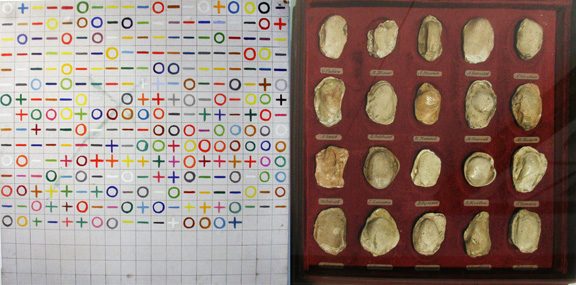 Alexander Yulikov, “The Diary of 1976”, 1976. The canvas was drawn for almost a year, 361 squares, and every day he celebrated how the day went: “+”, “-”, “0”, and still emotional coloring. He withstood almost ten months, then the diary remained unfinished. Igor Makarevich, "Mobile Gallery of Russian Artists", 1978.