
Translated material
Obsessed with color
Vandalism as an artistic course
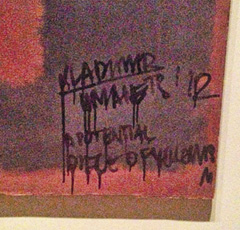 |
| If the picture is not able to restore, then it will always be such an inscription |
Obsessed with color. In London, an international art scandal erupted: the Polish lord artist ruined the picture of one of the most expensive artists in the world and claims that he was not Vandal at all, but the creator of the new art movement-Yellowism. The New Times not only figured out the essence of Yellowism, but was also able to talk with a partner and a fellow Polish figure on the morning of October 7, Vladimir Umanets, a 26-year-old native of Russia, sat on a low bench on the third floor of the Tate Modern Museum of Modern Art in the hall of the artist Rotko. The Uman, an unshaven young man in a long black jacket and a New York Yankees baseball cap, carefully looked through large glasses at the Black on Barrier canvas of the famous American abstract expressionist Mark Rotko, also a native of Russia. Mark Rotko is considered one of the most expensive artists in the world, and the painting “Black on Brown” is estimated at £ 50 million. Mark Rotko drew it in 1958, when he received a large order from the alcohol company Joseph E. Seagram & Sons for the design of a fashionable restaurant in their new skyscraper Seagram Building, located between the 52nd and 53rd streets in New York. Rotko, man
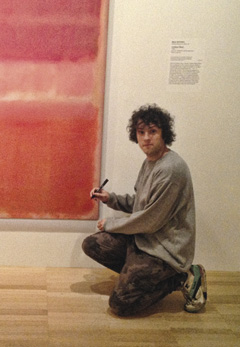 |
| A staged frame showing exactly how the inscription was applied |
The intransable and sharp, experienced complex feelings from this order: once he told his friend that, drawing the first fourteen canvases, he wanted them to “recover the appetite of every bastard who would ever decide to eat there” and that “the refusal to hang these paintings will be the best compliment for me”. But I didn’t have to wait for the compliment: it was also so enraged by the decoration and excessive luxury of the restaurant that he terminated the contract, returned the money, took the not established paintings and for more than ten years kept it in his pantry, and then presented part of the Tate Modern. Vladimir Umanets loves Rothko’s creations very much and knows that there will never be a second one in the world. And he also knows that he will be arrested for what he is going to do. He looked a little at the “black on the brown”, slowly stood up, went to the canvas, crossed the small wire fence, sat down on his knees and made a black marker in the corner of the picture a sweeping and spreading inscription, then rose calmly, left the hall, went down on the escalator and left the museum. He was caught in a day in the city of Vorting County of the Western Sussex 100 km from London and will judge that he left the inscription in the picture: “Vladimir Umanets'12. Potential work of Yellowism. "
Umanets says that he is not a vandal, and believes that he not only did not spoil the picture of his mouth, but on the contrary, he brought a new message and value to it, because now it is not just a picture - this is part of Yellowism.
The new color is the name “yellowism” comes from the English word Yellowism and can be translated into Russian as “yellow-storage”, which, of course, gives it a shade of tabloidity, and almost no one heard about this word until last week, until all the world media outlets spread: “Yellowsters are coming, and the art community did not come up with unanimous condemnation! In order to figure out what the Yellowists are achieving and what they want (and whether they want) to inform the world, The New Times found in Berlin Pole Markin Lodyga, a person whose signature, like Vladimir Uminz, stands on the manifesto of the Yellousters and all their works, a person, along with which the Uman came up with this movement. We contacted him by Skype. Markin Lodyga is now 33 years old, he is thin, wears a large knitted scarf and explains: “We respect art. We are not against art. We are not fighting art. ” From communication with an ankle it becomes clear that the history of Yellowism is the story of an idea and that you can do an idea with you if you surrender entirely to it. This is a story of obsession.
Lodyga was born and raised in the Polish city of Poznan, where he entered the Academy of Fine Arts and studied drawing. There, in his last year, he met a freshman Vladimir Umantz. Umanets was born in the small Karelian city of Kostomuksha, at the age of ten his family moved to Grodno, and then to Poland, where Vladimir received citizenship. After two years of study, Umanets quit his studies and at the beginning of 2010, following a comrade, moved to Cairo, where they both began to work in a glossy magazine and shot art video. At some point, young people decided to stop being artists: “We always wanted to find our niche, our place. And suddenly we realized that in the work that we do in the world around, in the video that we shot - about the news, politics, revolution, art, death - so much information that we began to think: if in fact all these things are about yellow? ” So Yellowism appeared. “It was a revolutionary thought,” Markin recalls. And then he adds: “In general, we do not like yellow. We do not like him visually. ” Young people began to develop a manifesto. The Yellowsters came to the conclusion that they are followers of the case of the theoretician of the art of Marseille Dyushan, who stood at the origins of Dadaism and surrealism, and, in general, came up with a simple scheme that, live yelloists in more ancient times, could well become a kind of religion. The meaning is as follows: everything can imply and denoting a yellow color, and if it falls into a special room-a yelloured room with purple walls, then it loses its original essence and becomes something new, we must only see it. “Our friends said: this is madness, people do not think so, but we realized that we discovered a completely new space, a new dimension - everything can express a yellow color,” Lodyga explains.
"
Every day we came to a supermarket like Marks & Spencer and took the expired food that they threw away. But all this did not matter - even when we washed the toilets in the luxurious London apartments, we thought about Yellouism, about our exhibition, how to do it, about our manifesto
"
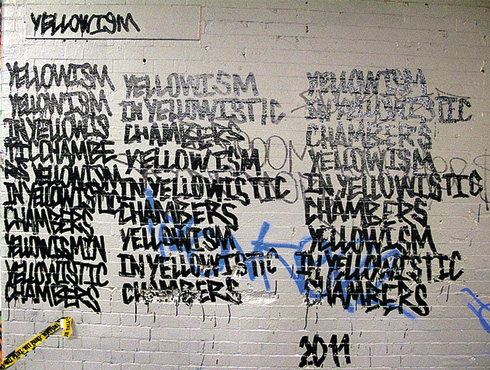
Everything can become part of Yellowism - a chair, a glass of water, and a painted wall in the name of art
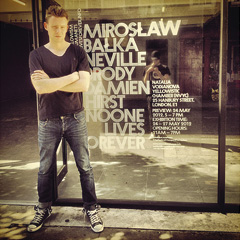 |
| Marchin Lodyga during the exhibition in London |
For two years, the Yellousters managed to open two exhibitions in Cairo: "Yellowstic room named after Natalia Vodyanova." The artists have planned eight more rooms by the names of famous fashion models of Slavic origin, including both Karolina Kurkova and Natasha Poli. They stayed there during the Egyptian revolution. Every night they, like the inhabitants of Cairo , went out to patrol the city from the looters, and the Uman, like every Kair in those days, took a weapon with him: who took knives and machete, who - axes and iron rods, who were hockey clubs, and the Uman, every night walked with a leg from the table, which was also part of Yellouism - it was written on it. Work of Yellowism. " This exhibit was presented at the first exhibition of Yellowism.
In February 2011, the Uman moved to London, Markin moved to him in a squat in August. They began to plan a new, third and so far the most important exhibition. In order to spend it, the artists denied themselves in everything - they worked at a construction site, did not spend the earned and ate “in the trash”: “Every day we came to a supermarket like Marks & Spencer and took the overdue food that they threw every evening.” “But all this did not matter - even when we washed the toilets in the luxurious London apartments, we thought about Yellouism, we thought about our exhibition, how to do it, about our manifesto,” says Lodyga.
The exhibition was supposed to last a week, and the week of renting a premises in the center of London under the exhibition along with insurance and maintenance cost £ 3.5 thousand (175 thousand rubles). The main exhibit of the exhibition was the work of the famous contemporary artist Damien Hurst (this is the one that inlated the platinum cast of the human skull with real teeth with diamonds) “Great 7”-seven white ping-pong balls signed by the artist, which Yelloustists acquired for £ 600 (30 thousand rubles). The whole exhibition cost artists £ 8 thousand, and during the opening the artists did not even have a pound. Natalya Vodianova wrote on Twitter that she did not understand why the exhibition bears her name, and promised artists to communicate with their lawyers, but they never called. The week passed, and the artists were in the same place where they were before - homeless young people without a penny for their souls, feeding on discharge, but now with an expensive work of the richest artist of our time, which they had nowhere to even children. Now the work of Hurst, which, according to Lodyga, is no longer an object of art, but an object of Yellowism, is sold on their website - for £ 7.2 thousand and that is why Vladimir wrote in the painting of Rotko the “potential work of Yellowism” - because this work is not theirs yet.
New move
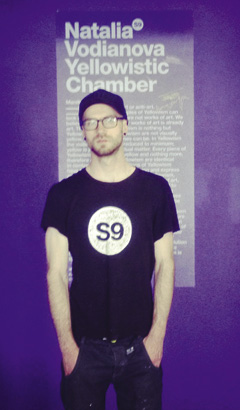 |
| Lodyga characterizes his partner Vladimir Umantz as a calm person |
Marchin Lodyga did not know that Vladimir went on business to Tate. On Sunday, Lodyga returned to Berlin, where he moved to friends from Italy in the summer, and on Monday October 8 at noon, shortly before the arrest, he received an e-mail from Vladimir: “Call me urgently”. But Lodig saw this letter only late in the evening - his and still stack from international media. “People write to us that we are the ended villains, that we should burn in hell, but we can place their letters in the Yellowstic room, and this will also become part of Yellowism. We want everyone to understand: Vladimir did not destroy the picture of Rothko, he added a new message to it - now this work expresses yellow. Now his picture should become twice as expensive, because it has ceased to be something that was before, it has become a completely new phenomenon. But we, of course, do not do it for the sake of money. ”
At the end of last week, Markin Lodyga went to London to support his comrade. He does not exclude that instead of a term of the Uman, they will be written a fine of £ 5 thousand, but there is no money, so maybe he will have to go to prison. Would he do the same? Yes, if Vladimir had discussed his idea with him. “I would choose the painting“ Water Lilies ”Claude Monet, which hangs in Tate Modern,” the Yellowist thinks.
What next? There will be no more spoiled paintings: “This stage has been passed. This is a point, all, now we are moving on than just take other people's work and do them with Yellout. We have shown that we have the opportunity to turn other people's works into part of Yellowism, we declared ourselves, showed that in our context everything can become Yellouism. Our time has come, it is now, and everyone can become a Yellowstone. ”
Well, for now, the room in the Tate is closed - “black on brown” is trying to restore. Experts without particular confidence say they can reduce the inscription.