Translated material
Unnatural life
Cannes films at the Moscow box office
Unnatural life. In October, the film of the famous Romanian Christian Munzhiu “Behind the Hills” will be released on Russian screens. This year, the picture received two Cannes prizes: Munzhiu himself was awarded a reward for the best script, and his two leading actresses shared a prize for the best female role. The New Times was convinced - the film about religious obscurantism is relevant for Russia
Munzhiu once won at the Cannes festival - with the film "4 months, 3 weeks and 2 days." Romania has already nominated the new film to Oscar. In Russia, he should be released on October 25, but it is embarrassing that ten days before the release, it is still unknown in which cinemas it will be shown.
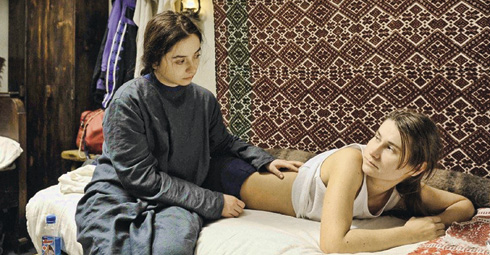
Cosmina Stratan and Kristina Flutur divided the Cannan-2012 prize for the best female role behind the walls of the monastery “Behind the hills” was shot by the famous operator Oleg Mutu, a native of Chisinau, who studied in Bucharest and shot not only Munzhiu’s paintings, but also “My Happiness” and “In the Fog” by Sergey Loznitsa, as well as “On Saturday” by Alexander Mindadze. We are told the story of two girls who once grew up in an orphanage and who formed there for each other the only happiness and comfort. They both considered this happiness to be love - the film does not go into the details of love: Munjiu prefers the displeasure that gives his films the form of spied reality. Now the girls have matured, and one of them, successfully settled for work in Germany, comes to Romania for the second to take her with him. But this second one, although he assures the first, as if he loves her as before (however, assures sluggishly), managed to surrender to another passion. Now her lover is the Lord, she lives in the monastery, the morals and life of which, it seems, has not changed since pre-electrical times, and completely trusts the commander-priest, who, like all other nuns, calls the dad.
The one who arrives does not intend to give up, loves a friend too much, with whom they overcame difficult youth together. She is trying to follow the advice of a friend, other nuns and dad himself: in order not to part with a friend, to imbue the spirit and charter of the monastery and stay in him. But everything in it riots. An unnatural life causes her hysteria. Then dad decides that her many sins and the devil who have instilled in her, and begins to correctly correct the forcibly with the help of other nuns: cold, hunger, as well as with the help of forms of exorcism. In particular, the unfortunate is tied to the cross.
The film is based on the real story of the expulsion of the devil in one of the monasteries of Moldova in 2005, which led to the death of the girl and the big scandal in Europe (but not with us). After that, the church officially banned the practice of exorcism, but Munzhiu says that on the Internet you can now find such promotions recorded on mobile phones.
However, he tries not to impose any conclusions. He believes that after watching the film, the audience himself should make. What “behind the hills” is generally a film about choosing. And also about how evil is able to manipulate people, finding roundabouts, almost invisible ways to their souls. Under the guise of protecting good, for example.
Munzhiu desperately tries to stay in his film on the fight and not to touch the problems of the church and religion itself. But how badly he succeeds! “Behind the hills” - a film, with hidden at first glance, but a distinct political anti -church statement.
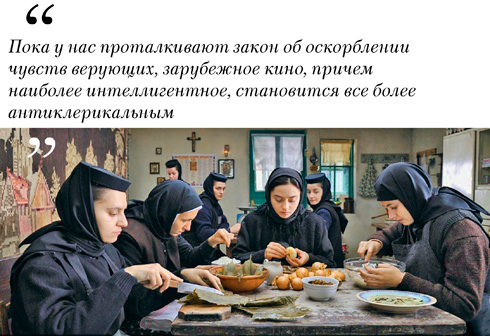
The frame from the film “Behind the hills” for politics is an interesting thing: while we are pushing the law on insulting the feelings of believers, which can not only force to walk along the string, but (with proper interpretation) to breed a fire from incorrect books, but subsequently burning those whom the witches, foreign cinema, and the most intelligent, are becoming more and more anti -cellric. It is enough to recall one of the best paintings of the 2000s-the “white tape” of Michael Hanek, which (and also casually, not directly, like Munzhiu) show how hard Protestant education became in the 1910s of the upcoming fascism. It is interesting that in the official catalog of the film “Behind the hills” Munzhiu speaks resolutely, but carefully, claiming that religiosity began to be reduced to many people only to the blind performance of the rites and that in the huge official list of sins published by the Romanian Orthodox Church (and there are as much as 464), there is no sin of indifference for some reason. Namely, he, according to Munzhiu, contributes to evil.
But in an interview with the press, Munjiu is much more concrete and a butt. Yes, it is felt that, as an artist, he sincerely tried (and almost managed) to remain neutral. But as a person he had long taken out a lot related to the church. He speaks in various Western interviews (we have little interest in the official media - and is dangerous for them), that there should be clear boundaries between faith, religion and the church as a social and political institution. The trouble, he believes, is that people began to interpret religious attitudes literally. And the spirit of Christianity is not at all the same as unquestioning submission to the rules and teams imposed by the Church.
According to him, the Church only has now gained giant power in Romania, that over the years of communism, people were accustomed to indifference, began to be afraid to express their opinion. Here's another fact from Munzhiu: the church, which is quickly rich after the fall of communism, is now building a cathedral in Bucharest worth almost € 400 million, while the country already has 20 thousand churches, but only 5 thousand schools and 500 hospitals. At the same time (again, Munzhiu) none of the Romanian politicians now dare to contact the Church now-what a parallel with Russia!
The most interesting thing is that in the May Cannes, after official shows, the film was perceived by Munzhiu. Church Orthodoxs will surely declare that it was removed by order of the Masonic West. The West, in fact, does not understand the relevance of “behind the hills” for the east of Europe. Nevertheless, the film still received Cannes prizes. But the main thing is that in the context of today's life, this film is extremely important for us.
* Cannes autumn.
The Russian screens finally reached the paintings of the competitive festival program of Cannes-2012 *“The share of angels” Great Britain-France-Belgium-Italy, director Ken Low
Prize of the Jury Cannes 2012 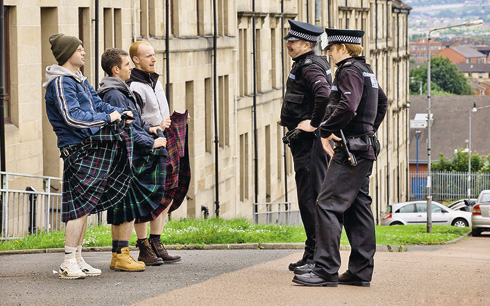
"Love" France - Germany - Austria, director Michael Hanke.
The main prize of the Cannes Festival "Golden Palm Branch" 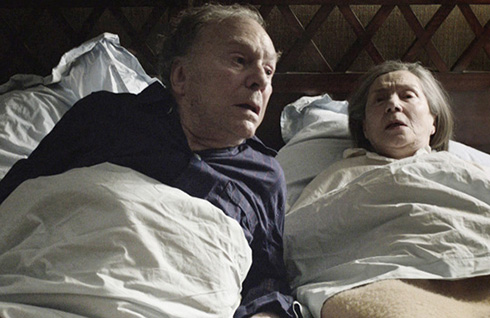
"On the road" France - Brazil - USA,
Director Walter Sallesh 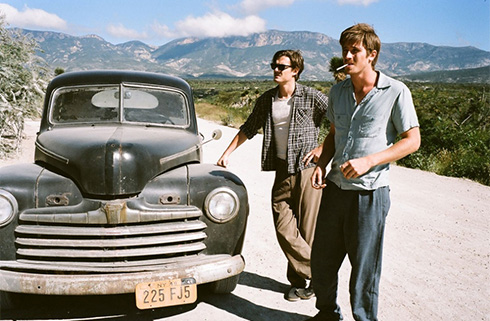
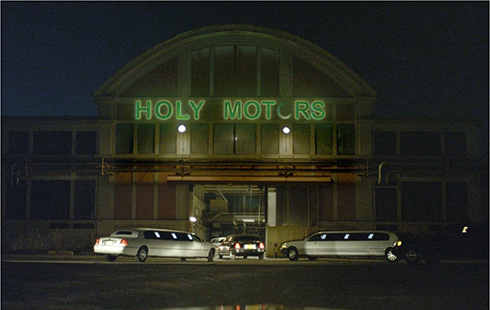
"Corporation" Holy Motors " France - Germany,
Director Leos Karax