
Translated material
Get to the water
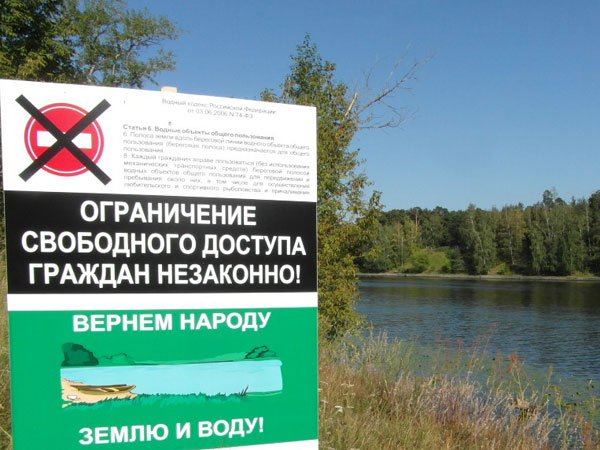
 Photo: Openberg.ru
The Ministry of Natural Resources and Ecology of Russia has published a draft federal law providing for the introduction of provisions to the Water and Land Code of the Russian Federation, obliging coastal land owners to ensure the access of citizens to the coastal lanes of water bodies.
In the Ministry of Natural Resources posted on the website of the Ministry of Natural Resources for anti -corruption examination , the draft Federal Law “On Amendments to Certain Legislative Acts of the Russian Federation” is proposed to supplement part 8 of Article 6 of the Water Code of the Russian Federation with the following proposal:
“Local self -government bodies, owners, land users, landowners and tenants of land plots, fully or partially located within the boundaries of the coastal strip of water bodies, or adjacent to the boundaries of the coastal strip of water,
are obliged to ensure the possibility of unhindered access of citizens to general water bodies and their coastal stripesIn accordance with this Code and the Land legislation of the Russian Federation, with the exception of cases established by federal laws. ”
Currently, this article of the Russian Federation of the Russian Federation looks like this:
“Each citizen has the right to use (without the use of mechanical vehicles) with a coastal strip of common -use water bodies for movement and stay near them, including for amateur and sports fishing and mooring floating equipment.”
It is also proposed to supplement Article 42 of the Land Code of the Russian Federation, which determines the duties of land owners, the ninth paragraph of the following content:
“Ensure the possibility of unhindered access of citizens to common water bodies and their coastal lane in the event that the land plot is completely or partially located within the boundaries of the coastal water -water -watering object, or adjacent to the border of the coastal strip of a common -water water.”
Since June 2006 in Russia, it is forbidden to privatize areas related to the coastal strip of water bodies - only their rental is allowed.In areas arranged in the property until 2006, there is a public easement, obliging the owners of these sites to ensure free passage and finding citizens on the coastal lanes.
This is due to the fact that the strip of land along the coastline of the water body (coastal strip) coastal strip is determined by public land, which should be organized for all citizens. The width of the coastal strip, according to the Water Code, is twenty meters. Accordingly, the section of the coastal strip can be provided only for temporary use to legal entities and individuals.
However, despite the legislatively prescribed restrictions, the capture of the coasts with a variety of private structures is a problem that has gained special acute in recent years. So, according to various sources, almost two -thirds of the coast of water bodies of the Leningrad Region are fenced by the owners of coastal sites and are closed for general access. The region has already developed a social movement that fights such violations. Activists on their own demolish illegally constructed fences, blocking approaches to the shores.
For example, on October 7, in the resort area of St. Petersburg, in the area of the Solomaya station, the participants in the “against the capture of lakes” dismantled 60 meters of the fence in order to free the passage to a completely fenced lake. The plot with the Lake located inside and part of the Gulf of Finland was fenced by the company Versia LLC, which, according to the media, belongs to the son of Valentina Matvienko Sergey Matvienko.
In Moscow, the situation is even worse - according to the creator and coordinator of the public movement "Open Coast" by Sergey Menzheritsky,
From 60 to 90% of the coast of reservoirs and rivers of the capital region has already been captured and fenced.In an open letter of movement, the mayor of Moscow, Sergei Krasovanin, notes that if some ten years ago all the silver boards could be walked freely, now its shores are cut by arbitrary fences.
“It is especially annoying that the main violators of the law are just those who themselves are obliged to show an example of its strict observance, namely: the line of police of the Lote by Water Transport, the rescue station of the Ministry of Emergencies, departmental cottages of the Ministry of Internal Affairs, the FSB and the State Duma,” the authors of the letter complain.
The initiative of the Ministry of Natural Resources deserves all kinds of approval, but even if the corresponding amendments to the Water Code are still made, there are great doubts that they will work. Indeed, despite the fact that the law is completely on the side of citizens, the authorities often ignore violations, since officials of a very different level, deputies and even law enforcement officers act as invaders.
According to the movements “against the capture of lakes” and “Toksovsky lakes”, the law tramples at the highest level - on the shore of the Black Sea there is Putin’s palace , the Patriarch’s cottage with a blocked shore and a captured area of the forest fund, and in the reserve of Utrish on a specially protected territory they are trying to build the residence of Medvedev.
Photos from the site "Open Coast" http://openbeereg.ru
See also: In the Leningrad region, activists demolish private fences interfering with water