
Translated material
Medvedev extended May holidays to Russians
Dmitry Medvedev signed a government decree, according to which several holidays will be translated in 2013. So, the weekend from January 5 and 6 (this is Saturday and Sunday), as well as from February 23 (falls on Saturday), they will not be transferred to the following dates, but will be added to the May holidays. Thus, the Russians in 2013 will have 10 days of rest for the New Year in a row (from December 30 to January 8) and 9 in May. For five days, Russians will be able to relax on May Day and four - on Victory Day.
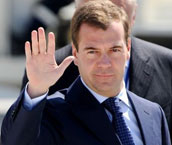 Dmitry Medvedev Photo: Fedpress.ru
 This was done without amendments to the Labor Code and in full accordance with its 112 item. That is: the long New Year holidays are so far reduced only for next year. In the future, you can continue the practice and accept the appropriate government decree annually, or abandon the venture and transfer the holidays falling on the weekend to the following everyday life.
The fresh resolution satisfies, at least in 2013, those people who, after the introduction of long New Year holidays, discussed a lot on the topic "Why the weekend cold in winter is better than a weekend in May for the needs of summer residents." In the public political field, the former speaker of the Federation Council and the leader of Fair Russia Sergey Mironov expressed more than others in this regard. In 2008, he even made a proposal to the State Duma to reduce New Year's holidays and transfer part of the weekend to May. The Duma and the authorities then did not go to the “oppositionist”, hardly and now someone will remember the “opposition copy”, except for the Socialist Revolutionaries themselves.
At the beginning of this year, during the presidential campaign, Vladimir Putin supported the initiative to transfer part of the New Year holidays to May. It must be assumed that the government’s decision is caused by the reaction of the current president of Russia.
Long New Year's holidays were introduced in Russia in 2004 and since then verbal battles have not stopped around them. There are a lot of myths around long holidays. The most common: the winter holidays lead to prolonged drunkenness of the population and damage the real economy (people after rest cannot start working productively by the end of January), long holidays in January were invented by those who go on mountain skiing, and ordinary people are more important than the garden and cottage in May and the like. It is important to plant seeds, dig the soil under potatoes and so on.
Of the positive properties of the long New Year's holidays, they usually note the opportunity to fully relax in ten days (it seems that psychologists even call such a period as necessary for the full restoration of forces).
In the reality, summer residents and gardeners among supporters of the transfer of New Year's holidays to May are not so many, only 23 percent of the respondents said about the desire to engage in the garden. The motivation dominates that in May it is much more leisure to conduct leisure time than in January.
 Photo: altapress.ru
In general, the reaction of Russians to long New Year holidays is very ambiguous. In January 2012, according to VTsIOM, almost 80 percent of the Russians believed that they had a good vacation and only 16 were unsatisfied with this. At the same time, the VTsIOM survey previously recorded that the number of supporters of the transfer of part of the weekend to May holidays is a little more than half (52 percent), the number of opponents is only a quarter. In April, however, the number of supporters of the transfer of January holidays in May was larger (apparently the approach of the May holidays affected) - 66 percent.
According to the March survey, Levada Center, 38 percent of the New Year holidays perceive the New Year's holidays, and 45 percent negatively. The idea to increase the May holidays at the expense of the January impresses 63 percent and does not like only 20.
At the same time, according to Romir, 56 percent do not believe that the New Year holidays are damaged by the Russian economy.
Interestingly, according to VTsIOM studies, residents of middle cities (56%) and villages (54%) want to transfer the weekend to May more than others. Opponents of the initiative, in turn, are more among the inhabitants of the capital (32%), youth (32%), highly educated (29%) and wealthy (39%) Russians. Almost “Tagil against Bolotnaya”, it turns out - a symbolic gesture. I must say, of all Putin’s election promises, the transfer of holidays is perhaps the simplest and most easily realized idea. And once again the showing that Putin is the president of ordinary Russians.