
Translated material
Nine grams of freedom
"Life and Fate" is a testing film. For the viewer
Director Ursulyak sews the installation, pulling out the screen space into a single stream of multi -figure action. And in Amalgam, a large torn family recreated on the screen of the saga, we see the truth of the country. Not only yesterday. But the current. With schizophrenic persistence of blindly crazy into the past. A magnetized stream of lies and duplicity. Forgetting about the impossibility of the coexistence of a person and totalitarianism
The film based on one of the most important novels about our history has become the most discussed by the theme of television season. Polar opinions are swirling newspapers and social networks. People argue. So it hurt.
Turning to the polyphonic uncompromising work of Vasily Grossman Sergey Ursulyak, he obviously risked being accused of “engagement” (the state channel would not allow seditaneous), of redrawing the meaning (the main claim to any adaptation), of inaccuracy (and the heroes are too fragmented, and the tanks are not overwhelmed, and the Stalingrad battleship does not reach). Part of the reproaches can be accepted.
The screen “life and fate” in comparison with the source sin in the simplification, and the tightening of plot lines associated with philosophical thoughts about the country, with fearless insights of the author of the novel. In addition, the obsessive “accompaniment” (the tormented by the Mas-Media of the Adult of Bach and the “Adagio” Vivaldi) Sometimes dialogues are jamming: squeezing a tear, interferes with perception.
The most alarming thought is also lubricated: about the identity of Stalinism and fascism. Director Sergei Ursulyak does not agree with this weighing Grossman fundamentally. He is convinced that with the general generic features between totalitarian states, it is impossible to set an equal sign.
But after all, Sturmbanfuhrer Liss in the book tells the Russian communist not so much about equality as about internal similarity, calls the Russian communists “teachers”, proving that there is no abyss between them.
An even greater rejection of a number of topics of the novel caused the author of the script by Eduard Volodarsky (he called Roman Rotten, and admitted that he easily “threw” “uncomfortable” lines from him).
At the same time, the profession and skill of the director Sergei Ursulyak (perhaps in modern Russian television cinema, only he and Nikolai Dostal continue to keep the brand not the series, but a serious artistic multi -part film) allowed to create an independent and intonationally close to Grossman.
There is no ghetto, concentration camps, crematoriums, engineering developments, according to which the mechanism of destruction of people should work in thousands (!) Camps are regular, like a clock. From the amazing letter of the mother, only the shell remained Strum. The spectators will not see the last minutes of her life and the death of someone else's child, at this moment ... But in the air of the scientific institution in which the screen scientist STREM Sergey Makovetsky works, the virus of household and state anti -Semitism is being spilled. This "measure of human mediocrity" is perceived by the colleagues of Strum as a norm.
Critics formulate the general idea of the novel by one phrase, comparing it with the idea of the film. Well, yes, if we assume that this is a novel about the identity of fascism and Stalinism, then the film did not work out. About the phenomenon of war and contrasting this phenomenon of personality? Also too specific. And it seems to Grossman himself enters into the discussion of the antagonists. Quoting Matisse, he speaks in the novel about the visible complexity and simplicity of color, blue or green. And for his beloved hero Strum, instead of flowers and colors, there are atoms and spaces between them. It seems that Sergei Ursulyak was attracted not so much by certain “colors” of the novel, his individual ideas, how these “atoms and space”. The history of lives and fate of unique unique people from flesh and blood, hatred, pain and joy, life and death, the plexus of these stories with each other with the fate of the country. “How strange it is to go through a direct, arrow built by the corridor,” says Commissar Krymov. "Life" along the Grossman painfully difficult equality of "freedom".
“Fate” is not only the pressure of the state, but the lack of freedom and the inevitability of the consequences of their own actions. Grossman's ingenious conclusions about the fate of a person in a totalitarian state have no statute of limitations. He proves that "a change in the very nature of man promises the universal and eternal triumph of the dictatorship of the state"
There is an important motive for the book in the film - the theme of the incomprehensible power of the spirit of freedom, waking up in the casemate of the system. Captain Greeks and his comrades are ready to pay their lives not only for the freedom of their country, but - for self -esteem. The Grekov manager is reliably played by Sergei Pukepalis with modest means. In his uncontrollable character, a rare convincing force. The defenders of the house number 6/1 have already tasted the freedom air mixed with the smell of Gary and the death of the air. After this beautiful “poison” they are ready to eat frozen potatoes, drink rotten water, die - but away from the rotten authorities. Na -ko bite - you won’t reach.
Only this state of inner freedom can explain why a handful of people was able to split the power of the Nazi army. From chaos, freedom, unaccountable thoughts, conversations on forbidden topics in Kazan, hatred of slavery and love with pumpkin seeds, a clear idea of opening a physicist Strum was growing.
The film, which is reproached for excessive gloomy, hopelessness, describes the very charm of life - almost all the main characters of the novel are in love. The joy of life is a pie with a jam in half-starved Moscow, and the first kiss, and prison gear, onions, a sign of the return of her beloved woman. No fighting forces will cope with this egregious vitality, and the instinct of life.
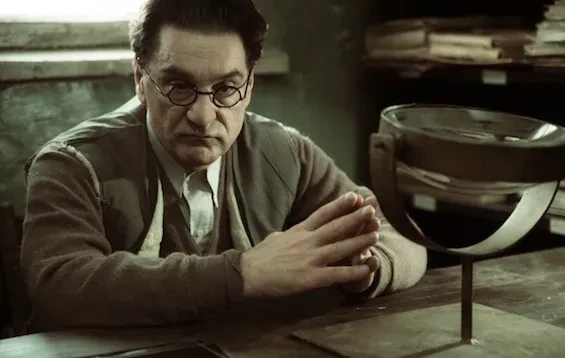
According to the grossman, the fate of each hero is a wave of wings of a moth, determining the fate of a whole stream of world energy. Winging daily choice - create their fates. Strum does not have the courage of Kapitsa, who wrote a letter to Beria, because he learned the covenant of Academician Pavlov: “Russia is a country where at least one person should tell the truth. At least one such should be. ” But Strum Makovetsky concentrates his remarkable talent on the effort to be honest, fair. And while the system presses him, yesterday's comrades-servants turn away-he copes. He is infuriated by the duplicity: “We say not what we think”, infuriates the deprivation of the right to conscience. It seems to me that the story of Strum, most carefully written out in the film, today looks extremely relevant. He surrendered after the benefits rained down on him. Like invisible acid, they dissolved its ability to self -will. Today, in the Stroum position, many of our fellow citizens, who have unprecedented rights and capabilities in Russia. In addition to one - free will. And in this, the director remains faithful to one of the melodies of the novel, namely the Chekhov’s motive, to which Grossman all the time returns to his idea “to start a person”.
The dramatic scene of sniper stories about the fascists they had shot by them was not quite successful. Grossman is a “production meeting”, and in this emphasized everyday life of what is happening all the horror of the “usual murder” that is happening around. But a number of episodes are solved without words - cinematic means. Here the girl radio operator transfers the data obtained by scouts at home No. 6/1, and the German ranks are falling on the parade ground - and no need to explain the significance of the “military work” of the defenders of the disgraced house: his own among strangers, alien among their own. Here are two families of Struma and Sokolovs on the train eat Vobla with tea. At first, a newspaper with a portrait of Stalin is cautiously turning over - as if not to stain, then their conversations are mixed up, only the eyes of people remain: loving and suffering, jealous, yearning for the house, hoping and ... not daring to hope. And outside the window, their homeland rushes into the unknown.
One of the leitmotifs of the movie is the energy of fear. In the totalitarian empire gaining Shakespearean dimensions, fear turns a person into dust, into insignificance. This is not only a horror in front of the fighter machine of the state anger, hanging over each hinge: it will be killed like a fly? Stroke? Fear gives rise to the gravity and earnings of the commissars and party officials of all stripes, fatty written out in the novel and television version.
Fear fetters hands and feet, freezes, makes a clumsy tongue yesterday a confident scientist Strum, who has lost his internal support today. Fear forces the strong Novikov, Krymov, to suspect Zhenya of the betrayal, informing of his loved ones, loved ones. The fearless and obvious longing for freedom confronts fear, not only the plebeian, but also the "bar". The one that after the call of Stalin in Strum melted into humility.
Strum, Novikov, Krymov are trying to preserve themselves in the request of life, not allowing to grow internal slavery. But the system machine stubborn in truth intends to tame and crush, violence in the very nature of totalitarianism.
Unfortunately, Stalingrad himself did not become the hero of the film, which is rebelled from the ashes, ruins in the novel: he looks terribly in the frosty sky with black pipes and skeletons of buildings with half -life people in basements. Even a decent, but “television” budget for such a swing is not enough. Grossman has a fighting Stalingrad - a world city with a soul, the capital of war and the future world. But after the victory, the city, like its surviving defenders, loses its former force. The nest of an indomitable spirit and free thought turns into a regional center, in which only 10 years later the "herds" of the prisoners will build the greatest hydroelectric power station in the world. In the same way, yesterday's brave men who walk under bullets will feel not only their own uselessness, but also a stuffy longing that turns individual people into meek masses.
The main emotional and semantic charge of the film in his heroes. Their visible, convex, honest existence. Ursulyaku is not too interesting to battal scenes. They have the "totality" of people led by the will of the "commanders". In this "separately" there is a confrontation between heroes of the system. The Ursulyak shows representatives of the "aggregates" equally brightly. Such individuals as the Commissioner of the hetmanov, who hugs Brutovically, is leaning (how the Partyers love to kiss!) The self-thinking commander Novikov, let him write a denunciation on him. The hetmanov from those sheep that “pull the skin of the revolution”, but using it rhetoric have a different filling.
In addition to excellent operator work (Mikhail Suslov), the film will be remembered by rare acting work today. Makovetsky with his compound-suicide hero: repulsive and beautiful, daredevil-truss, clever-grinder, faithful husband-an aging Romeo, a decent person who performed meanness-became the main discovery of the film. His best scenes are internal monologues, when, devoid of words and the intellectual “what”, the actor “plays” with unexpected facial expressions, with the eyes “unfinished” in the script. As in the episode where he reads a letter from his mother. He looks and does not see, blinks, holding back his tears, briskly crooked, realizing the scale of the tragedy opening before his eyes.
There are several brilliant, cinematic means of solved scenes in the film. Here the mother does not mourn, but gently talks with the dead son on his grave, covers the frozen grave with a warm scarf, gently shakes off the fallen snow from the tablet. So she would shake off the snow from his overcoat. And when the camera charges up, next to a sculptural figure covered with snow on the grave hill, we see thousands of the same frozen mounds to the horizon. The viewer involuntarily arises not only a sense of compassion, but also guilt. In full accordance with the spirit of the novel: "All people are to blame for the mother, who has lost his son in the war."
There is both in the novel and in the film the feeling of how the sense of fate grows in a separate person. When Zhenya decides to leave her beloved by the commander Novikov and return to the arrested ex -husband Krymov - this is the main choice in life. Her inability to betray is a personal moment of truth: who are you really. Without social and material undergrounds. Who are you yourself?
The novel "Life and Fate", which grew out of the first part of the dilogy, leaves the Soviet creation "For the Just Delivee", leaves each of the heroes at the time of a complex existential choice. The film is somewhat smoothes the final. It gives hope for moral rehabilitation of Strom, in a prisoner but quite comfortable car sends to the “settlement” of Krymov, gives his wife the opportunity to meet with her husband.
The epic-koloss "Life and fate" is written in editing, the discrete space of the novel is rafted from individual small chapters. That is, cinematography seems to be laid down in the “pattern” of the work. At the same time, there is a feeling that the mega-text resists the film adaptation. But the film, shot "based on" the novel was not going to become his cast.
Ursulyak sews the mounting, pulling out the screen space into a single stream of multi -figure action. Puts the chronicle into game episodes. And in Amalgam, a large torn family recreated on the screen of the saga - we see the truth of the country. Not only yesterday. But the current. With schizophrenic persistence of blindly crazy into the past. A magnetized stream of lies and duplicity. Forgetting about the impossibility of the coexistence of man and totalitarianism. Singing genius of the best of managers. That's why the film by Sergei Ursulyak is not just a television event. Not just a good movie with excellent acting work. This cinema - in many ways a testing one, makes it possible to try on to ourselves, helps us get out of the obsessive gloom of the myth.