
Translated material
Our man in Tehran
Ayatall
Hijab on the back of the head. “Sergey, I changed my mind. Don't call me. Do not write. Neither by mail, nor Facebook, nowhere. I'm scared. This is very dangerous. Sorry, brother, another time. " This letter came the day before departure to Iran. Then one more - the same content. And yet ... half of the planned meetings canceled at the last moment. But it was not easy to prepare this business trip: journalists in Iran are reluctant to let Iran, and whoever you talk to, the first question is about permission for journalistic activities. "No? Then I'm sorry. " Requests by e -mail and on Facebook hung in the air: the Internet in Iran is controlled by special services. Even emigrants in Paris, Washington and Ankara agreed to contact only on anonymity: at home many had families, friends, loved ones. What to do? The New Times correspondent spit over his left shoulder - and flew ... 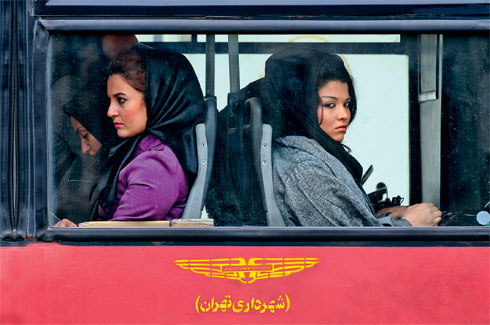
Iran got to Iran through Baku. The route was laid in advance: at first Tehran, then Tabriz, the capital of Iranian Azerbaijan. “There will be a tail immediately from the airport,” the author of the tabris, who fled from Iran, instructed the author in one of the noisy Baku cafes. “But you go to the hotel without panic and call our friends from the Russian phone, because they will not have time to put him on wiretap.” Say that you are looking for a translator. We will warn him. First you go to look at the mosque so that the tail behind, then it will show you the city, and at the same time talk to the people. ” This was followed by a lecture on how to behave on the spot: by mail, not to send anything superfluous, not to say anything superfluous by phone, SMS is the enemy of the spy, and the skip is its find. It was recommended to erase all suspicious numbers and photos from the phone, and leave business cards and magazines on this side of the border. Plus they asked to write a short o'key on a prompt daily, otherwise they promised to sound the alarm and call the editor. “Everything will be fine,” the tactricious guys reassured in the end, “you just have to be careful.”
Bazaar in the fog
The center of Tehran is one large cork. The city growls with motors, buzzing with car buzz and human dialect. It is difficult to breathe, Tehran justifies the reputation of one of the most polluted cities in the planet. Not to say that he is very beautiful: the buildings of the middle of the last century replaced the ancient development. Thousands of old cars drive through the streets, ignoring any rules, among which new SUVs occasionally come across: if the Iranians have money, they buy large cars. Through a wide, lively prospectus, the old man passes in hhargers and a long shirt with knapsacks in his hands. He goes slowly, not stopping and despite the sides, the cars drive, not paying attention to him, so it seems that the old man is in another dimension and the flow of transport moves through it. The sidewalks are also full: representative men in costume shirts with a short sleeve; wrapped in black women and others, in elegant shawls that cover only part of the head; Mullah, walking, grinning angrily something-either prayers, or curses to the crowd, because of which he is late for his business; Among the dark beautiful faces, not a single European tourist can be seen, so you feel like a white crow in the literal sense of the word. However, in surprised views you read hope rather: if there are visitors, then everything is not so bad. 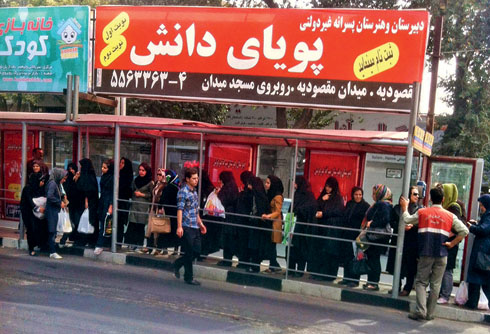
For many centuries, a bazaar has been the focus of Tehran’s life. Million transactions were made here, the last gossip was discussed, and political careers were decided. Bazari, as merchants call here, have become a whole political class, having its own lobby in power structures. The underground Islamic Associations organized in the 60s gave Iran to many political figures and billionaires. However, in recent years between the Ayatollah administration Ali Khamenei and Bazari has outlived cooling: on the one hand, the clergy is trying to remove the merchants from the authorities, and the latter blame him for economic problems.
The bazaar is a whole city in the city. Brick vaults that protect from winter snow and summer sun cover an area of 20 square meters. km. In the corridors-wools broken into sectors-carpet, gold, shoe, leather-there are more than 200 thousand stores. Today, many “quarters” are empty - international economic sanctions make themselves felt. But on the vegetable street, you do not push through: the crowd slowly moves in both directions, like a traffic jam on a garden ring. The merchants scream, advertising their goods, and the song bursts into these cries in the Middle Ages: a blind, beggar shadow walks against the stream and pulls something on Farsi. It smells spicy and fried, boiled eggs and chestnuts are sold nearby. Every now and then there are mosques, decorated with Arab mosaics outside, inside - pieces of mirrors that completely cover the walls and ceilings. "
Saber, Tehran marketing specialist: my parents in the 80s believed that the guard corps defends the ideals of the revolution, but now they even see that these are ordinary rods
“In October, the bazaaris was striking: RIL, the official Iranian national currency, fell by 17%in one day, so I had to raise prices, which means that Rial’s official Rial’s official exchange rate is 16 thousand per $ 1, however, in exchange points, 30 thousand per $ 1 .. In total, the cost of RIAL has fallen into stores in the country. In October, the country has grown around the country. A wave of hungry riots swept in the north, Azerbaijani and Kurdish separatism raised his head. Tumanov. 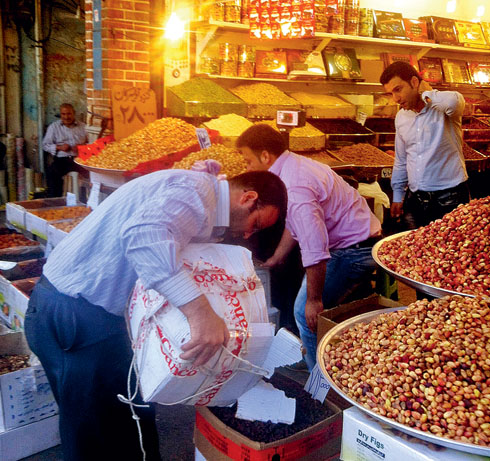 Tehran bazaars constitute real political force
The Iranian economy depends on hydrocarbons: 45% of the budget is covered with oil revenues, which make up 70% of Iranian exports. With tightening sanctions, oil production fell to a minimum of 1992, and in October the EU voted for the ban on the import of Iranian gas. The shortage of petrodollars beats the pocket of every Iranian. Clothing, household appliances, most of the finished foods are purchased in China, as well as feed for poultry and cattle, so even a “domestic” Iranian chicken, without which not a single feast is unthinkable, does not do without a foreign exchange component. In Iran, in this sense, you feel like in Zimbabwe: if upon arrival in the country the author changed dollars at a rate of 2850 fogs per dollar, a week later the dollar cost 3200 fogs.
In Iran, they remember that the 1979 revolution would not have happened without the Tehran bazaar: then the merchants sided with Ayatollah Khomeini, not only financing his supporters, but also supporting mass strikes. Therefore, when demonstrators with the slogans “Death of dictators” were held in October in the bazaar, the authorities were worried: today there are more police in the market than buyers. It is impossible to photograph: the police are right there and ask to delete the photo if employees in uniform came across them. Most of the merchants deny any involvement in demonstrations. “We closed the store because we were afraid of thieves,” “there were no people from the bazaar among the chanting anti-government slogans” and “there are some forces behind this who want to destabilize the situation,” they repeated the official version.
It took some time to understand: the bazaars simply do not trust the translator and therefore answer, as in interrogation. In a completely different way, they spoke one on one for a glass of strong Iranian tea. “We have a trade union,” explained Reza, carrier merchant, “he makes a decision on strikes. The trade union is official, but such decisions are made secretly so that the police do not intervene. ” Sales of cuts due to the devaluation of RIAL doubled: most of its carpets are made by city factories buying silk, wool and other fabrics in the same China. The Reza assures that there really wasn’t the merchants in the ranks of the demonstrators: “Everyone knows each other in the bazaar, but most importantly, Basiji knows everyone” * * A half -war police from volunteers, founded by Ayatollah Khomeini in November 1979. At the same time, he called the Bazari as his protesters. However, the riots in the bazaar of the merchants did not get away with: several people were arrested and for a week now nothing is known about their fate. When asked if this protest can develop into a revolution, the cut shakes his head: “The time of revolutions has passed. There is no one to go for, there is no one to believe. There will be nothing, do not wait. "
Great division
With Takhshin and his friend Saber, we are walking around a multi -storey building in Tiegran's sleeping area. Despite the tradition, they do not invite you to visit: they are afraid of wiretaps. Takhshin, a scientist, is engaged in pharmacology, Saber-a marketing specialist, worked for some time in a cellular company, but then quit: salaries were barely grabbing to pay for utilities. “The situation in Iran will only be worse,” Takhshin is sure, “both economically and political terms. Repressions will intensify, because only in this way the ayatolles can sit in their places. Only external intervention can radically change the situation. ” 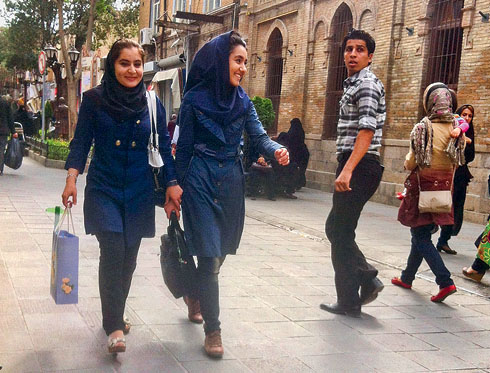
“Actually, we are afraid of war,” Saber picks up, “although I was a child, I remember Iraqi bombing * * The war between Iran and Iraq lasted from 1980 to 1988. They say that if Israel attacks us, 15 thousand Iranians will die. This is scary, but if we talk about a change in the regime, then this is the only way. Otherwise, no revolution will happen: people are too scared. ”
The “Green Revolution” of 2009 - as mass protests in Iran call in Iran against the falsification of the results of the presidential election - choked in itself. Her main leaders, Mirhocyn Musavi and Mehdi Carrubi, are sitting under house arrest, but they are not very trusted. “They are immigrants from the system. I don’t think that if they come to power, something will change, oil money will simply be divided in a new way, ”says Saber. “For real reforms, holyness should leave.”
The Shiite clergy, led by the Supreme Leader of Ayatollah Ali Khamenei, possesses the full power in Iran and through the Ministry of Oil Industry controls the distribution of petrodollars. Hameni himself and his close associates control different areas of business - from automotive to cellular communication. “Among my clients is one Iranian car concern,” says auditor Rashid. - Say, on paper, the concern received $ 5 million. Of these, one million goes to the Khamenei pocket, the other million in one of the boniads * * charitable funds subordinate to the clergy, the budget of which reaches 20% of the Iranian GDP, and the three remain the concern. But the problem is that on paper, the concern has still earned five million, and everyone behaves as if this money remained on the company's account. ”
The Khameni Ayatollahs are also in the jurisdiction of the Revolutionary Court and the All -powerful Corps of Guardians of the Islamic Revolution (Ksir), part of which are Basiji. Both of these militarized structures were created as an alternative to the regular army, played an important role in the Iran-Iraq war, but at present not only covered Iran with a huge network of secret agents, but also became closely introduced into the economy. Natives of the CSSI control banks, insurance and construction companies, telecommunications and energy. “In the 80s, my parents believed that the guard corps defended the ideals of the revolution, but now they even see that these are ordinary rods,” says Saber and tells the joke: “They collected specialists from the FBI, KGB and Basiji and said:“ Here is the forest, find the hare in it. The FBI came with translucent equipment, computers, satellite phones, found a hare. The KGB arrived, the forest cut down, and then set fire to, when there was nothing left, they pulled out a charred carcass. Basiji sat for a long time in the forest, then brought out a tortured bear, who began to jump and shout: "I am a hare, I am a hare."
Revolution of the hijabs
The northern regions of Tehran are the most prestigious. Here, on the hills surrounding the city, the air is cleaner, the living space is more expensive, and the audience is more consistent. On both sides of the prospectus of Vali ASR, built in the 20s of the last century by Shah Reza Pahlavi, to travel from the Northern Palace to Yuzhny, they grow out of the unique aroma of the fig tree, and in special ditches between the sidewalks and the carriageway, real streams are noisy that carry new ideas and trendy with mountain water. Siavash and I, a lawyer, the son of a famous Tehran Deer, are sitting in the Rock restaurant in the Darbant gorge, from which an amazing view of the night Tehran opens. The atmosphere and the audience are similar to the Moscow Vogue Café or the Parisian Hôtel Coste, there are only foreigners. In the cocktail-manager-“Bloody Mary” (tomato juice and Tabasco) and “Pina Kolada” (condensed milk, cream, milk). Serious men and very beautiful women are sitting at the tables: the latter has a variety of scarves and scarves on their heads any colors, except black, but they do not close the whole head, but only the back of the head. Type hijab. Bright makeup, narrow jeans, tall heels, fitted mantle (another compulsory element of women's clothing in Iran - a dress buttoning a dress below the knees, which should hide the figure, but it is often sewn to bypassing traditions narrow and short). And this is not at all a feature of Darbant - there are a lot of women who are voluntarily dressed in any area of Tehran. “There is so much money invested in this beauty,” Siavash laughs, “among the Iranian middle class, almost 60% of girls straighten their noses, the Middle Eastern hump is considered not very beautiful.” To the author’s question, what to do with the Basijs who act in Iran the function of the morals of the morals, Siavash answers as follows: “According to our laws, they can right now close this institution and take everyone to the station. But, firstly, no one wants to contact, and secondly, probably the owner of the institution pays who needs. ” 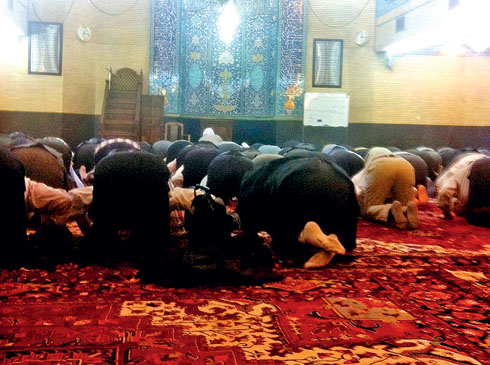
However, the Basiji does not sit back. From time to time, they spend in the Iranian cities of raids, arresting “casually” dressed women. Quite often, such checks are arranged in educational institutions or, say, in shopping centers. “Fifteen years ago, these multi -colored scarves were impossible,” Siavash explains, “but with huts *** Iranian president in 1997-2005. With the reputation of the reformer. The hijab crawled from his forehead to the back of the head. Ahmadinejad tried to pull it back, but nothing came of it. ”
Upon closer examination, the appearance of the Iranok is not the only non -ishomous detail in the country of Sharia. So, despite the fact that alcohol is prohibited, and for drunkenness it follows with sticks, many drink in Iran: either they buy smuggling vodka (Smirnova’s liter from Russia costs 70 thousand fogs ($ 2), or they themselves drive alcohol from the Kishmish. Recently, a wave of poisoning with several mortal cases swept through Tehran. They immediately started talking about what this Basiji specifically poison alcohol, although, probably, we are talking about dubious surrogates.
Western music is outlawed, in particular, it is forbidden to sing women, but in every second car a new album of the Gugush pop singer, this Iranian Madonna, who left in 2000 in the United States plays. Forbidden satellite plates cost 50% of Iranian apartments. Despite the fact that homosexual connection is punishable by hanging, gay para in Tehran, although rare, is. Facebook is also banned (like many other foreign information and entertainment sites), but you can hardly find an Iranian Internet user who does not have a profile there. Even Basiji sit on Facebook, using one of the many programs that deceive filters.
“Classes of public policy have become a taboo, especially after 2009,” Siavash explains, “but in private life people are tired of being afraid. Yes, Khomeini put a hijab on our country in 1979, but he will fly away sooner or later. ” However, Siavash also does not believe in revolutionary changes: “The people do not have a leader who could believe. But I have a foreboding that something should happen. ”
At the samovar
If in Tehran it is difficult to agree on meetings, but it was possible, then the tabriz was absolutely impregnable. The contacts on the phone broke right there, as soon as people heard the word "journalist". In Tabriz, in Azerbaijani *** in Iran live from 30 million to 35 million ethnic Azerbaijanis, which make up 45% of the country's population., Although the Arabic Vyaz is used for writing. However, they write without rules and grammars: only Farsi is taught in schools. The road from the airport runs a tabriz along the slope of red lifeless rocks surrounding the city. Stones are cast in the sun with copper, and it seems that the tabriz is built in a giant boiler. Its streets are similar to Tehran, only cars are even older and the air seems even more heavy. In the ancient bazaar, the assortment has not changed over the past centuries: carpets, gold, oriental furniture, spices and fruits. Trade goes sluggishly, so the sellers decorinely teas a decent next to the table on which there is a large metal samovar. "
Тахсин, студент Тебризского университета: Единственная возможность громко высказать свое мнение — футбольные матчи, мы там скандируем антиправительственные лозунги, можем даже развернуть баннер с надписью «Смерть оккупантам»
” Здесь тоже на повестке дня экономические проблемы, причем по сравнению с Тегераном рынок кажется мертвым. Мехди открыл свой магазин с часами только в двенадцать — с утра нет смысла работать, потому что непонятно, как изменится курс доллара: «Позавчера риал резко упал, потом немного поднялся, а за ценами надо следить, чтобы не остаться внакладе». На вопрос, откуда приезжают основные клиенты, Мехди улыбается: «Нет сейчас никаких клиентов. Посмотрите, половина магазинов закрыта, у других полупустые витрины: хозяева распродали запасы, а новое покупать боятся». 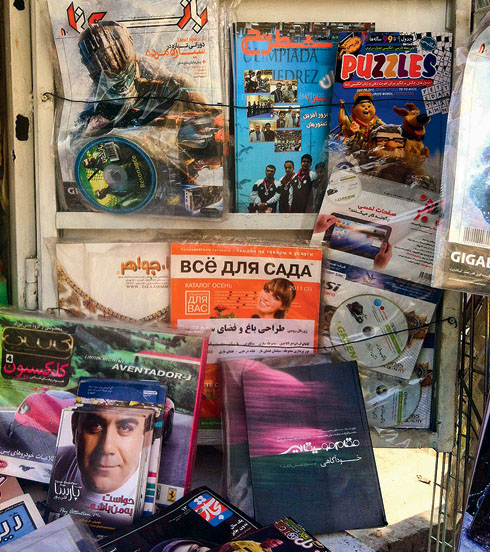
О небывалом росте цен говорит и «переводчица» Калима, по совместительству врач в местной поликлинике. Мы обедаем с ней в одном из тебризских ресторанов, больше похожих на столовую. За длинными общими столами, покрытыми клеенкой, сидит несколько больших семей. Еду приносят официанты, но выбор невелик. Суп из перловки и красной фасоли, йогурт с огурцом на закуску, на второе — выбор из разных видов плова. Плов здесь своеобразный — мясо отдельно, рис отдельно: с шафраном, куркумой или просто с маслом. «Год назад счет за газ был 30 тыс. туманов ($10) за два месяца, а теперь — 500 тыс. ($166), — жалуется Калима. — Если учесть, что я получаю 800 тыс. туманов ($266) в месяц, то у меня половина зарплаты уходит только на газ!»
Впрочем, как и большинство иранцев, Калима винит в экономическом кризисе правительство, но никак не связывает его с международными санкциями. «Санкции ввели недавно, а проблемы у нас уже много лет. Просто в Тегеране сидят люди, у которых три класса и четыре коридора», — смеется она. И внезапно меняет тему, перескакивая на Великий шелковый путь, который проходил через Тебриз. What's happened? И тут приходит догадка: рядом с нами сел представительный одинокий мужчина, нарочито не замечающий нас с Калимой, хотя русская речь обычно вызывает удивленные взгляды. Who is this? Ясно кто…
Национальный трактор
Если торговцы на базаре больше озабочены своими продажами, то тебризская интеллигенция до сих пор лелеет надежду на национальную автономию. «Еще во времена шаха нам запретили образование на родном языке, а после Исламской революции ситуация стала катастрофической, — жалуется Тахсин, студент Тебризского университета, с которым мы встретились в парке Эль-Голи по наводке его товарищей из Баку, — у нас нет ни газет, ни телевидения на азербайджанском, мы не знаем родного алфавита». Сестра Тахсина работает учительницей математики, рассказывает, что следовать правилу вести уроки на официальном языке практически невозможно: большинство детей фарси начинают учить только в школе, так что алгебру легче объяснить на родном азербайджанском. «Попробуйте заговорите здесь на фарси, — говорит Тахсин, — если вы не перс, на вас будут смотреть странно и ответят на азербайджанском». Тегеран начиная с 40-х годов прошлого века поменял на персидские большинство азербайджанских названий населенных пунктов, рек и гор, а также и фамилии жителей. «Персидские чиновники откровенно издевались над азербайджанцами, давая оскорбительные названия и фамилии: деревня Идиотов, Ахмед-Коротышка. Но сразу никто протестовать не стал, а потом было уже поздно», — рассказывал The New Times в Баку директор вещающего на Иран азербайджанского телевидения «ГюнАз ТВ» Араз Обали. 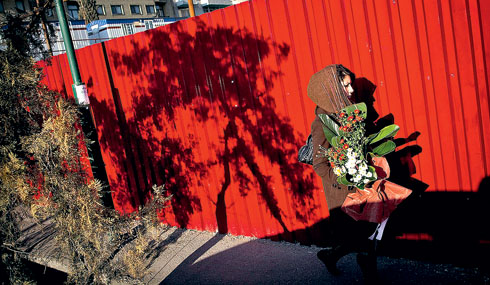
«Единственная возможность громко высказать свое мнение — футбольные матчи, — смеется Тахсин. — Мы там скандируем антиправительственные лозунги, можем даже развернуть баннер с надписью «Смерть оккупантам» — и ничего нам за это не будет. Жаль, что вы не приехали неделю назад, когда играл наш «Трактор», посмотрели бы, как у нас «любят» персов».
Впрочем, в 2009 году, когда Тегеран охватили антиправительственные манифестации, Тебриз хранил спокойствие. «Боялись», — говорит Калима. «Не видели смысла в демонстрациях», — предполагает Мехди. «Вряд ли и в следующем году что-то случится, — сомневается Тахсин. — Вопрос нашей автономии не поднимается оппозицией. Какой нам смысл бороться против одного режима за другой такой же?» «А-а, — отмахивается таксист, везущий нас, корреспондента The New Times с Калимой, в аэропорт. — Кому охота идти в тюрьму из-за этих персов в Тегеране? Красивый у нас город, правда? — переводит он вдруг разговор на другую тему. — Лучше Москвы?»
Тебриз и правда кажется красивым в лучах заходящего солнца, играющего в окнах многоэтажных зданий. «Скажите, а бигмак вкусный?» — вдруг спрашивает шофер и смущенно замолкает. «Говорят, так себе, — отвечает за корреспондента The New Times Калима. — И не очень полезный. Но мы его еще попробуем!»