
Translated material
Brussels bazaar
Brussels bazaar. It was already more than three in the morning, when the Chancellor of Germany Angela Merkel appeared in front of cameras in the European Council building in Brussels. “The Banking Union will not begin its activities on January 1, 2013,” she said. Actually, the EU summit on October 19 was dedicated to the creation of such a union 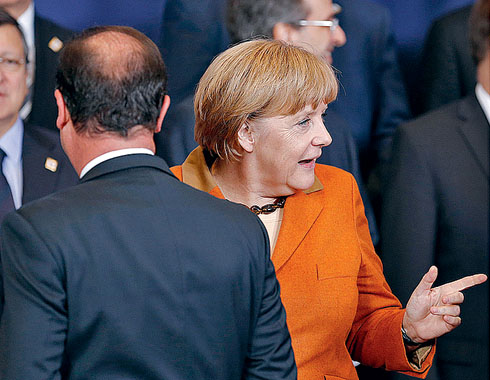
Merkel achieved its own: she slowed down the zealous partners from the “southern flank” of the European Union, who, as they were sure of Berlin, who wanted to trample the financial field of the eurozone almost uncontrollably.
The idea of creating the Banking Union was voiced by EU leaders back in June, one of its first and key elements should be a single system of supervision of banks. It was even assumed that the EU countries that are not part of the Eurozone will be able to join the unified system of banking supervision. The new “supervisory council” was supposed to act within the structures of the European Central Bank, while the ECB itself was to divide the functions of the supervisory authority with national financial regulators. In the current summit, Germany put on a vague idea in a very harsh form: why, they say, to invent a bicycle, to invent some new structure, let's better introduce the position of “European Super Commissioner” on finance, which would have the right to audit, and if necessary, then disavow national budgets with too high internal expenses. But what the observers saw at the current summit literally looked like bargaining. The past times were gone when Germany and France stood shoulder to shoulder. Today they look at the problem of European duty through different glasses. The owner of the Champs Elysees, Francois Hollande, proposed almost immediately (by the New Year) to introduce a bank control system (which is not yet) and extend it to almost all credit institutions (more than 6 thousand banks) in 17 eurozone countries. This would mean that any bank could contact the ECB and get “fresh” money, which not so long ago, without looking back at the huge risk of inflationary processes, was generously promised by the head of Mario Draga. Actually, this was the crafty of the French president.
Chancellor Merkel insisted on establishing control not for all banks, but only for system -forming ones, and it was for them to provide controlled access to ECB loans. And at the same time create not only the overseering body, but also formulate a rigid system of responsibility. In a word, Germany, in contrast to the “quick” decision, categorically advocated “careful”. But this did not suit Hollande, since the financial situation of France was seriously shaken and the money is already needed. And if we take into account the huge debts of Greece and Spain to French banks, then the reason for this haste will become clear.
By agreeing to a delay in creating a banking union, Hollande tightly blocked the idea of creating a “supercomissariat” on finance (which would lead, as experts on the Rhine, to a more reasonable fiscal policy). In this case, Hollande insisted on the introduction of Eurobonds, that is, the division of financial responsibility between debtor countries and creditors. And such an approach for the German government as a red rag for a bull, which Chancellor and Finance Minister Wolfgang Shoible more than once frankly declared. Thus, the score in the Franco-German duel was 1: 1. The “game over time” has already begun, the expert from the Berlin Institute of Economic Conjuncture Stefania Bolzen has begun. Everything, as it happened more than once in the past, ended with calls.
So, the banking union, which has been talked about so much recently in European power corridors, never took place. The contradictions between those who want to receive money and those who should pay were too deep. As for the so -called southern EU countries, then, according to the economist, Jan Hageland from the German reconstruction bank, they do not care how and how money will come to them to save their “dilapidated” banks. If only sooner. " And therefore, they all took up arms against the Chancellor of the Federal Republic of Germany, since it was she who covered the immediate path to easy money without a clearly formulated responsibility system.
Whether the banking union will begin its activities on January 1, 2014, as stated, is not completely clear. In any case, Sweden has already preferred to refrain from participating in it. But one thing is clear: the case will not move until the main German principle is fully implemented: first control, and then mutual responsibility.