
Translated material
Smuggling
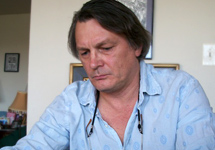
When the arrested opposition activist Leonid Razvoszhaev, using a minute contact with the press, says that he was stolen and tortured, one cannot help but believe him, even if the video was shot by a journalist of the despicable Lifenews. And there is no reason to believe the Investigative Committee, which claims that he himself appeared with a confession.
The version of the abduction is confirmed by the Kiev office of the UN Supreme Commissioner for Refugees. According to the UN UN Councilor Alexandra Makovskaya, Leonid Razvoszhaev disappeared in the middle of the procedure for registration of papers and the office officers turned to the police.
The absence of bodily injuries in Razvozhaev , after a meeting with the prisoner, “Public Observer” Anton Tsvetkov, whose reputation , is mildly , is doubtful .
However, damage may be really absent. In an institution that abducted Razvozhaev, they can not leave traces. Now, even if Razvozhaev in front of the cameras states that he was not abducted and not tortured, we will have the right to refer to the precedent of Nikolai Krestinsky, who, in the open process of the "anti -Soviet right -traction bloc" in March 1938, dared not to admit guilty, but the next day he said that he did this "under the influence of a minute acute feeling of false shade caused Barks of the defendants and a difficult impression of the announcement of the indictment. "
The question is now only in one thing: did the Ukrainian authorities know about the abduction operation? Kyiv is still silent, and it is clear why: if they knew and, therefore, contributed, then they allowed egregious lawlessness; If you didn’t know what they know at all? That is why the abduction of Razvozhaev at the Yanukovych meeting with Putin was not discussed, there was no joint press conference, and the press secretary of the President of Russia does not even know such a surname.
The Convention on the status of refugees clearly states : “Contracting states will not in any way send or return refugees to the border of the country, where their life or freedom is in danger due to their race, religion, citizenship, belonging to a certain social group or political beliefs” (Article 32 of paragraph 1).
Ukraine did or allowed this. Thus violating their international obligations. Earlier, Russia has already tried to achieve from Ukraine Extradition of the National Bolsheviks of Mikhail Gangan and Alexei Makarov , artist Denis Solopov . Without special problems, Ukraine provided asylum to the activists of “other Russia” Olga Kudrina and Anna Ploskonosova , journalist Alexander Kosvintsev . Now the commendable tradition, apparently, has come to an end.
As for the Lubyanka, she has a long -standing tradition of abduction abroad of political opponents of the regime under the protection of international law. In the 30s of the last century, the executor of such special operations was a special group under the head of the OGPU-NKVD under the leadership of Yakov Serebryansky-the Yasha Group. In January 1930, in broad daylight on Paris Street, she abducted the head of the Russian All -Vevoinsky Union General Kutepov. He was either lured by deception, or he was put in the car by force. As for the further fate of the general, there are various versions. According to the FSB, the general was either assumed by chloroform, or the morphine was injected and in an unconscious state was taken on board the Soviet steamer. But the weak heart of the general could not withstand anesthesia, and the prisoner died almost on the Raid of Novorossiysk. According to another version, Kutepov resisted in the car and was killed.
Seven years later, the Yashi Group prepared in Paris the abduction of the son of Trotsky Leo Sedov. It was planned in the same way as Kutepov, to capture on the street and transported to the USSR by sea or by air (the plane was at the disposal of Serebryansky), but Sedov died after the operation of appendicitis. It is possible that Serebryansky agents are involved in his death in the clinic.
Meanwhile, the group under the leadership of the Deputy Head of the Foreign Department of the GUGB of the NKVD, Sergei Spiegelglass, successfully carried out the abduction of the successor of Kutepov, General Miller. Under deep anesthesia, he was packed in a box and loaded under the guise of diplomatic baggage to the Soviet ship "Maria Ulyanova", waiting in Gavra. When the French Prime Minister Eduar Daladier demanded to return the ship, threatening to send a warship in pursuit of Ulyanova, the Soviet ambassador to Paris Jacob Suritz calmly replied that Miller was not on the ship. Probably, Daladier understood this as a threat to Miller’s murder. In any case, he abandoned the thought of pursuit. The fate of Miller is again unknown. If he did not die during the transportation of a box from Paris to the Havre and did not die on board Ulyanova, he was most likely to be taken to Moscow, was kept in the internal prison of the NKVD and was shot in 1939.
Both generals were refugees, stateless people. Their legal status was determined by the Nansen passports - identity certificates issued by the Commissioner of the League of Nations for Refugees of the Refugees of Fridtiof Nansen.
In December 1975, the KGB General Oleg Kalugin, who headed the KGB Office (external counterintelligence) in the First Glavka of the KGB, led the operation of the abduction of a double agent Artamonov-Shadrin. The officer of the Soviet Navy Nikolai Artamonov was in the west in June 1959. He sailed by boat to Sweden from Poland. With him was his Polish friend Eva Gola. Behind the ocean of Artamonov, who became Nicholas Shadrin, after the check began to work in the intelligence department of the US Navy. The Soviet agents managed to turn it over, showing him letters and photographs of his wife and son and promising forgiveness in the Soviet Union. Over time, however, Moscow stopped trusting Shadrina. It was decided to deliver him to the Soviet Union for intensive interrogations. Artamonov was appointed in Austria a meeting with the new curator. In Vienna, employees of the KGB residency either lured, or pushed him into the car where they made an injection of the sedative, and, apparently, they did not calculate the dose - Artamonov died on the spot. Nevertheless, according to Kalugin, the head of PSU Vladimir Kryuchkov was delighted. He offered Kalugin to choose from two orders - the October Revolution and the Battle Red Banner. Kalugin chose the latter.
As you can see, Lubyanka does not change his tested techniques.
I have only one question for Ilya Ponomarev, whose assistant Leonid Razvozhaev works and who voted for the new version of the law on stateisms and espionage, and then awkwardly justified : now he realized why these amendments were needed? After all, not to fight spies, in fact!