Translated material
"Trial by jury is a disgusting thing"
.jpg)
Former justice of the peace Yulia Sazonova is one of the most famous in Russia. Several years ago, she condemned oppositionists to administrative arrest for participating in protest events, and today a rare protest event takes place without her participation. A former favorite of the head of the Moscow City Court, Olga Egorova, Sazonova today is one of the harsh critics of the judicial system.
Yulia Sazonova came to court as a law college intern at the age of 17 and almost immediately agreed to keep minutes of court hearings. A year later she found herself in the Moscow City Court - first in the office, then in the chair of the secretary of the court session, worked as an assistant to the judge, and finally, seven years later, she became a justice of the peace.
A day after the head of the Moscow City Court, Olga Egorova, praised and recommended the young magistrate Sazonova as a federal judge at the qualification board of judges, another protest took place in Moscow, and Sazonova had to condemn the detained oppositionists. The young judge gave Kasparov 5 days of arrest, for which she incurred the wrath of opposition supporters and persecution on social networks. However, she failed and did not have time to convict all the detainees in one working day, after which the attitude towards her by her superiors worsened, and she did not receive an appointment as a federal judge. Soon after this, Sazonova quit and went to work for Russian Railways, and with the start of protest activity she joined the people on Bolotnaya.
Sazonova gave her first interview to the magazine "Bolshoi Gorod" anonymously, and a year later she revealed her name and told how she dropped her pen at Khodorkovsky's sentencing and how she sincerely believed that the world chess champion deserved to be arrested because he did not comply with the demands of the police.
When Konstantin Lebedev was arrested last week in the “Anatomy of Protest” case, Sazonova went out with a single picket in his defense. Ironically, she demanded the release of the very man who at one time stood outside her court with a poster “Judge Sazonova is a loyal Pekingese of the regime.”
“We were just informed that the Basmanny Court arrested a man accused of preparing a rebellion on the basis of the dubious quality of the videotape shown in the dubious quality television program. A man who was actually kidnapped from the territory of a neighboring state by unknown people in civilian clothes. How do you, as a former judge, feel about this?
The whole story with Razvozzhaev gives me a feeling of despondency and bewilderment. The sense of reality of what is happening is completely lost. It seems to me that this is impossible - these abductions from the building where he was going to submit an application, then the fantastic transfer on some kind of plane, then the crazy filming of Lifenews, where he quite calmly says that he was tortured, and the correspondent asks with interest: “How many days were you tortured?” Then this story with the arrest, which no one knew about, and - what finally finished off - this confession and statement that he himself had come. This smacks of some kind of scary fairy tale and there is no feeling that this is actually happening, because it is not clear how a person can be detained on the territory of a foreign state without an extradition procedure, how he crossed the border with those who detained him.
There are a lot of questions about this confession, because in essence the confession is a message from the opposition: look, he himself came and told everything. But in a criminal trial, a confession is when the investigation does not have any facts, and the guilty person himself confesses to something that the investigation does not know about. I don’t know whether there was torture or not, but even the story itself with his insane detention, after which he admitted everything, is somehow far from a confession.
— And yet, your former colleague, the judge of the Basmanny Court, according to reports, in a closed trial after all this, makes a decision to arrest. Is it possible to arrest a person like this, who was brought from nowhere, and without even allowing a lawyer to attend the trial?
I don't know the details. I know from the press that before considering the application for a preventive measure, he was interrogated in the presence of a lawyer, that is, he had a lawyer, most likely on purpose - from a formal point of view, there was no violation of the law. By and large, if we ignore emotions and if we assume that this was legalized and covered up with some documents (although it is still difficult for me to understand how his strange detention can be legalized), then, in principle, the choice of a preventive measure is logical from a formal point of view - given such an article and the alleged desire of a person to hide from the investigation.
“But the judge must find out how he was detained and whether everything was observed during the arrest?” Moreover, in the Basmanny court they could not help but know everything that preceded his delivery to court - everyone was shouting about it.
It is unclear what he responded to the judge. I can’t even imagine what they could have written in the arrest report, how they could have processed it. The information that is on the Internet is all outside the legal framework, but it is very difficult to discuss this situation as a lawyer - except for Markin’s crazy statements, all publications begin “as so-and-so wrote on his Twitter” or “as so-and-so wrote on Facebook.” This is a crazy situation that is not like anything at all.
A story about a Georgian man who approaches strangers on the street and offers to watch high-quality CDs. This sounds very strange, but from a formal point of view it well legalizes the recording, which was most likely made without a court order.
— But can the judge accept such a video? One Georgian here gave me a full HD film...
For operational recording, you need a court order authorizing such recording. Therefore, most likely, they will choose option number two: law enforcement agencies are required to check all information published in the press. Journalists are protected by the media law and have the right not to disclose their sources. From a legal point of view, this is formally normal.
— You went out with a picket in defense of Lebedev, who was arrested in the “Anatomy of Protest Case.” Will you go to a picket in defense of Razvozzhaev?
Most likely yes. I have absolutely no regrets that I came out to support Lebedev. I expressed my position. This is really some kind of irony of fate: a few years ago Lebedev stood with a poster “Judge Sazonova is a loyal Pekingese of the regime” and now I stand with a banner asking for his release.
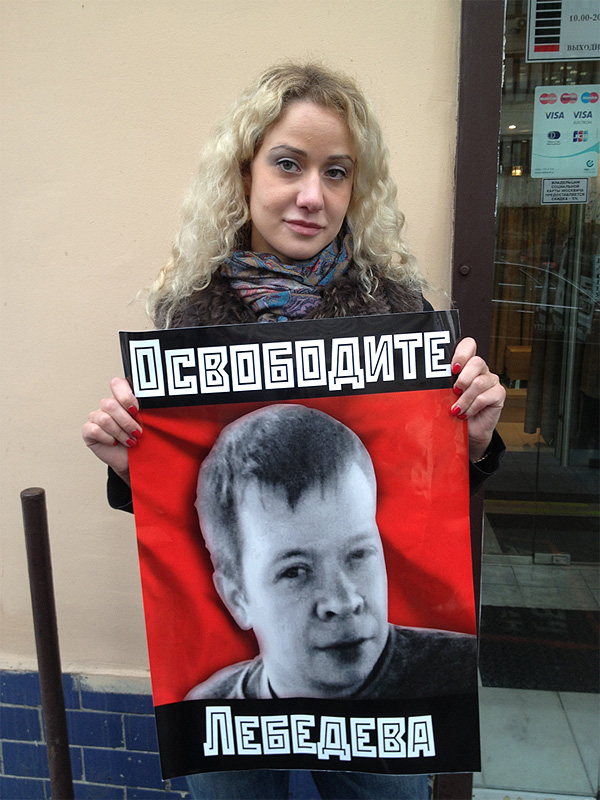
— Did you have any desire to address the poster to the judges who conduct trials in this and other political cases?
I am against getting into the personalities of specific officials. This is somehow undignified. The purpose of the picket is probably to draw attention to the problem. Taking the “Freedom for Lebedev” poster in my hands, I want to say that I and society care about what is happening, and that I do not agree. And poking a specific judge is the same as saying: “Your legs are thick.”
- What about personal responsibility? After all, the judge will deal with the case. What impression did the protesters against you make personally?
The poster “Judge Sazonova is a loyal Pekingese of the regime” was humanly offensive, but it was the same as it becomes offensive for 5 minutes when they call you a fool on public transport. This doesn't get the message across.
— What message can be conveyed to the addressee? What is the best way to write on posters so that there is a chance that the judge will hear and think about it?
I'm not such an experienced picket participant.
— But you are an experienced participant in the judicial system.
Don't know. “Free Lebedev” or “Free Razvozzhaev”, in my opinion, normally conveys the meaning of what we demand.
— There are judges who quietly retire, there are those who leave for good, for example, to become lawyers. Far fewer of those who leave criticize the judicial system. Your path - from the favorite Olga Egorova, who readily condemned the opposition, to an active participant in protests - seems unique today. At least I can't remember anyone else repeating it. What is the reason for such a radical transformation? Are you something special?
Stupid, probably. In fact, I truly believe in everything I do. Just as I believed in that system then, I believe in another now. There are probably few such impetuous people. There are a lot of the same type of people there. Maybe not everyone there is such an enthusiast.
— Young secretaries and assistants come to courts. Are there any enthusiasts among them, at least at first?
My life is such that I am always the youngest. And there in court everyone was 5-10 years older than me. Everyone had already worked in this system, hated it, but continued to work because they understood that no one needed it. And all the conversations were mainly about this. At first you are eager to be appointed a judge in order to somehow realize yourself, and then you realize the meaninglessness of your existence. And everyone hates you - both the leadership and the citizens. And you start to hate everyone. And there is nowhere to go.
— Is it true that most judges are single?
Yes. That's why I don't have children and I'm not married. Everyone thinks “later, later,” plus you have to choose the right men.

— And who, from the judges’ point of view, are the right men?
Well, policemen - no, of course, bandits - no, of course, lawyers - no, of course. And there is no one else if you sit at work from morning to evening.
And here you sit, you hate everything, you understand that you are not doing your job, but you are a judge! You have been working towards this career - in my case - for 7 years. Where to go? You have highly specialized knowledge that no one needs. Now I’m not afraid - I can find a job: become a lawyer, do something else...
“We really need good lawyers now.”
Adequate. Not like Pussy Riot's. They didn't do anything. According to Khodorkovsky, for example, the lawyers did everything! Another thing is that I dealt with them - with these 17 lawyers. But they did everything beautifully. They wrote an endless number of complaints, 500 sheets each, and I got up at six, came to work at seven, and photocopied these complaints like hell. And by the way, they included all the examinations. They didn't do anything. Well, why didn’t they conduct their linguistic examination? This is obvious - any experts will sign a conclusion that there was no religious hatred there. They had a lot of money in their Yandex wallet, and they would have done everything for free. And they said there was no point in it. Why then represent interests if you don’t see the point in it? If you work, you must give it your all.
— What was the point of doing everything “beautifully,” as you say, in the Khodorkovsky case? He's still in prison.
Losing if you did everything you could is normal, but losing because you did nothing is completely different.
— Do you remember your first trial?
I remember the trial where I attended for the first time as a secretary. Some people were tried for robbery; they stole someone's phone. And one of the defendants, a fat one, testifies, tells how he approaches the victim and, with sudden intent, takes his phone away. I sit and listen with all my ears, and suddenly the judge shouts: “And the secretary is writing the protocol!!!” I was so ashamed, I probably smoked three cigarettes in a row afterwards. I stood in front of the Tagansky court with a player and thought: “Lord, let me sink into the ground from such a shame!” It was a shame that I was entrusted with writing the protocol, but I listened.
- Were they guilty?
I think yes. They spoke very convincingly.
- And then?
And then a feeling of belonging came to me: I am helping to fight evil. All these people are guilty, and I contribute to the process of punishing the guilty, I fight evil with these protocols of mine. I sat in this court until 10 pm, copying everything by hand. God, I was so happy when I came out of there! It was already dark, but I felt that today I wrote such and such a protocol, and this helped in the fight against evil.
— At what point does this feeling of how “correctly” one should judge come? That all the accused are evil?
Maybe it comes with mother’s milk, or maybe after you come to court and see how they treat lawyers, prosecutors, and defendants. And if you trust the people around you, then you begin to treat all this the same way. This is a terrible professional deformation. From the first experience you absorb it all. I began to understand everything, and everything came together in my head only three years after I left the system completely. Therefore, there is probably a point in lustration. As they say, only lustration, only hardcore.
“Have you never felt at least sympathy for any defendant?”
I remember one boy, he was 18, and I was 17. He was imprisoned for drugs, and I introduced him to the case, and we spent five hours together in the guard room - he read very slowly. And we started talking, and suddenly he said: “I have AIDS, I will die soon. We have an AIDS cell, they keep us separately.” And here sits a guy, my age, and tells me that he has AIDS and that he will soon die, and he sits handcuffed to a bench, and he has absolutely no future. I was very upset for him then. I don’t remember either his first or last name, but in a prison environment this disease is a death sentence, so it’s unlikely he’s alive now.

—Where does this bias towards lawyers come from? I remember you told how some of them shouted and made trouble, and you perceived them as an irritant or even a threat. Well, some lawyer can be annoying, but they are different and behave completely differently during the trial.
Lawyers want to deceive you, lawyers want to help this bastard who killed someone, for example, evade responsibility, lawyers file stupid motions, lawyers try to lie to you and tell you all sorts of nonsense: you need to write a report, and at the same time they tell you how “the boy grew up.” So what if he grew up? He handcuffed a newly pregnant woman to a radiator and kept her without food for three days, and they tell you how he picked dandelions.
- Really, not a single lawyer could convince you? Didn’t give any particularly fiery speech that would inspire you to believe?
No. I even looked at Reznik with contempt: ugh, lawyer! And at Padva, who during our meeting kept looking into my neckline. It's indecent with lawyers. Generally indecent. I had a lawyer court me when I was a judge. But it was still perceived as something forbidden. The business he led - I believed in him. And he ultimately acquitted his clients. But that's one thing. And so you usually think: these (accused) are guilty anyway. Here, for example, is the same case of Khodorkovsky: the investigators did not work properly, but Khodorkovsky still committed a crime, and I have the task of pushing this process through to a certain date, because if he were elected in some constituency, then the verdict would have to be overturned. Therefore, I will get up at six in the morning and come to this court, and I will photocopy these damn complaints, and I will only eat in prison - the girls in the special unit fed me - but I will do it. Well, that's what you think. And you don’t perceive lawyers at all.
“Can you even perceive a defendant in some situation, but not a lawyer?”
The defendant is treated as a job.
— What about the boy with AIDS?
This was at the very beginning. And then this humanity is no longer there, you become callous, every day you see those who tortured someone, and then come and tell you that everything is wrong.
— Maybe it’s worth introducing jury trials everywhere? They are more human.
I am against trial by jury.
- Why?
Because I did it in Moscow. We were told: in a couple of weeks we will launch a jury trial. Here are three folders for you - lists of voters - you can recruit us for the first board. There were names with addresses and phone numbers, and so I called them all: “Hello. Moscow City Court. Would you like to participate as a jury with us?” - “Fuck you!” I have never heard so many “fuck” words in my life as I have this week. We have wonderful citizens.
- It's strange that you called. I was also a juror, but no one called me. For example, I received a piece of paper...
This came later, but we recruited the first board this way - on the phone. We urgently needed to gather 50 people who would come and from which we could choose. That's how they called: who will come. There was no time to send these long letters. This was the very first process, and I was responsible for the board. And I followed them everywhere.
— The task was set, as I understand it, to find a certain number of people?
And then monitor this board so that the process goes correctly.
- How do you “make sure it goes through correctly”? In what words was this attitude expressed?
None. You yourself understand: if a case has been brought to you, then the person is guilty. After all, you still communicate with the investigator, for example, as if you were one of your own - you can call him and reprimand him for not doing something. For example, you call and say: “Secretary Sazonov is worried. Your witness Petrov does not go to the trial - if you are worried about your case, then ensure his attendance.” And the investigator ensures the appearance, brings the unfortunate Petrov, and Petrov is an alcoholic, and you tell him: “Listen carefully! Until you give evidence, you won’t go anywhere.”
— Didn’t they do this with lawyers? "Where is your defense witness? Make sure he appears!"
No. Because the defense witnesses did not come - and thank God. And without prosecution witnesses, the judge will not write a verdict.
- So what's the problem with jury trials?
Trial by jury is a disgusting thing. We conducted the first trial as it should, no one put pressure on the jury, and they returned a guilty verdict. And the second trial was a darkness: they tried a man who had recently been released from prison, I don’t remember why he was in prison. He was probably 35 years old. And he was drinking with some young boy, they went to a night store where a former Vokhrovets worked as a security guard. There they quarreled, and when it turned out that the guard was a Vokhrovite, this man, who had previously sat there and disliked Vokhrovites, stabbed him to death with a knife. The case came to our court to be considered by a jury - I was then the secretary of the court session (I was no longer working with the jury at that time). And this man - the defendant - was in a suit, so handsome and spoke very well. And the boy whom I transported from the Mordovian zone, where by that time he was already in prison for some kind of theft - he probably hadn’t slept for two days, arrived in sweatpants and slippers, smelled, spoke very poorly and did not make any impression on the jury. And this elder said that the boy killed, although in the case that I read, it clearly turned out that it was not the boy who killed, but he himself. And now the jury announces the verdict of “not guilty”, the cage opens, and I understand that he will now go home, but he killed. And I stand, and my tears flow, but nothing can be done. And all because the boy looked bad and did not make an impression.
- Well, you see, you cried. This means that humanity has not completely gone away.
I cried because he killed and was going home.
“Didn’t watching an innocent person go to prison bring tears to your eyes?”
There was one case: a man met a woman - both were about 40 years old - and allegedly forcibly took her somewhere, kept her in his apartment for a day and raped her. But it was clear from everything that she herself agreed. It’s just that when she left him, she met her partner and was forced to say that she had been kidnapped and raped. And the man was given eight years, I think: there were articles on “kidnapping” and “rape.” I remember that I fought with my judge for a long time, convinced that this man was innocent, to which my judge told me: oh well, stop it, well, maybe everything, of course, is so, but what can I do? And in two weeks I broke him (the judge), convinced him, and at the presidium the article “kidnapping” was removed from this man and he was given three years off.
- This despite the fact that the person is innocent?! And, I suppose, the judge also perceives it like this: “What a humane I am, I’ve lost three years.”
Yes. I considered this my victory. Didn't write to cancel, didn't write.
— What do you mean “not written”?
Well, there was nothing to write about from the actual circumstances of the case; no significant violations were found. When I worked as a judge, there was this principle: make a decision that you can write. This is a cynical position, but in any case, the judge must motivate his decision; in any case, this is an assessment of the evidence: whether the judge can, from the factual circumstances, formulate the logic for an acquittal or an accusation. It is always easier to face charges because the indictment has already been written.
— In your previous interviews, you talked about the trial of a man who admitted to storing cartridges in a cigarette pack, but judging by the number of cartridges, it was clear that they would not fit there, even if they wanted to. Didn't any questions arise about the system after this?
I will, of course, never forget this story. But this was one such case in my practice.
— Were there other stories that made you, if not doubt the system, then at least think?
There were conductors who carried passengers for 500 rubles without a ticket, and this is an article: causing property damage to the owner through deception and abuse of trust. The conductor was entrusted with the carriage, and she transported it for free and received a material benefit of 500 rubles. And you judge them, and you try to say: “Dear, you misunderstand something, you will now have a criminal record.” And they say: “You know, I don’t care, we don’t have any work in our village at all, I didn’t take that much, it’s just that we have such a system - we are handed over once a month. They need to give a “stick” - so they catch us once a month. So let’s quickly write me a fine, I’ll take out a loan to pay the fine of 5,000 rubles, but I’ll work it off, nothing.”
And this is not the worst thing - the worst thing is when they bring you half-dead people who were taken at the station with approximately the same bottle of "Ancient Armenian Avshar" cognac at a price of 1,250 rubles - as I remember now. Allegedly, each of them entered the store, put a bottle under their clothes, tried to leave and was detained. And all things are the same. And so you start asking: “Do you plead guilty?” They all say, "I admit it." And I have 15 such cases with the same bottle of “Ancient Armenian Avshar” cognac - this bottle is already all worn out, but at the same time they still admit that they stole it. It was only when I talked to the store director that such things stopped.
- Why did these people admit their guilt?
During the presidential elections, I was at one polling station in Moscow as an observer with the right to a decisive vote. Everything was perfect for us - no violations. But there were EIRC dormitories nearby, and they were all told: vote for Putin. And so they came like sheep and threw these ballots, it didn’t even occur to them that they could cheat: say at work that they would vote as they should, but do it differently in the booth. And when I stood and counted the ballots: Putin, Putin, Putin, I thought: “I’m in Chechnya, I’m in Chechnya, I’m in Chechnya.” And the secretary of the commission, a simple girl, comes up and says: “You’re so cool, we’re so sorry that you’re upset, but we were all told to vote like that.” People don't have the self-respect to say, "Who are you to dictate how I should vote?!"
And those people were not outraged that they were being kept in a cage for a crime that they may not have committed. And this is so scary! And people who consider themselves shit - they provoke the police to such (illegal) behavior. He is humiliated, he is sent to prison for the fact that he may not have stolen this bottle. I tried to find out what really happened, but they all admitted guilt. There was only one person who said that he was just passing by. And the police officers stood by during the trial, blushed, but confirmed their testimony, and confirmed all the reports, and in the end he himself admitted guilt. He simply said, “Your Honor, give me less.” And I gave less. I gave them all less, almost all of them according to the time they served. And then I told them: stay, I will hand over the sentence to you, and they were waiting for me - already released - and I gave them 1000 rubles and said: go home and never appear here again. But they went to drink again at the station, and then they were caught again, and again they confessed everything. Only in this case they had already relapsed, and I couldn’t give them credit for the time they served.
— How do you feel about your colleagues now?
I still empathize with many people from there, they simply have nowhere to go.
- There are those who leave. You eventually left.
I had somewhere to go. But before I found a job, I posted my resume on HeadHunter: zero. Zero responses. Well, the market is oversaturated with lawyers.
It is very difficult to leave this system - because, really, no one needs you. You can get a job as a lawyer at a bank, but how can you psychologically go for it after you sent decisions “in the name of the Russian Federation”? So how? That's why everyone stays. They spit, but remain. Many people hate this system, but they remain.