
Translated material
Revolutionary
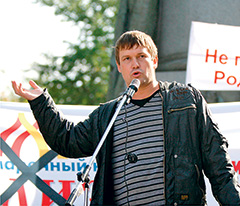
“Professional Revolutionary” - as Leonid Razvozhaev outlined his position on the Facebook page. The 39-year-old politician coquettically designated the place of his work as “Russia pregnant with a revolution :-)”. Born in Angarsk and graduating from vocational schools with a degree in Gas -Electroster, the future revolutionary began his journey with trading fur caps. In the mid -nineties of the Razvozh, together with the business and civil wife, Yulia Smirnova moves to Moscow. “In the 90s, banditry was very well developed in Siberia, Leonid was threatened, and he had to move. Everyone was threatened, and he was even accidentally shot - one bullet in the spine still remained. He has nothing to do with it, forever all his life he is unlucky, ”says his brother Viktor Razvoszhaev. In the early 2000s, Leonid met Ilya Ponomarev-he worked as a driver for him, and when he became a deputy from the Communist Party, and his assistant. According to Viktor Razvoszhaev, a few years ago Leonid plunged into politics with his head, and left his wife to the trading of fur caps: “Both family and everyone told him to deal with his wife’s wife, but it is useless, he is already like a fanatic. It’s like Lenin to dissuade the revolution. ”
When the Cherkizovsky market was closed in 2009, Razvozhaev was one of the main organizers of the protest. “Lenya, in my opinion, is the most law-abiding person. If people were simply gathered spontaneously, he immediately said that the unauthorized rally was obtained, we must submit an application and then collect. He always wanted everything to be as it should, ”recalls one of the colleagues of Razvozhaev on this campaign Vera Aldoshin. “Recently - about five years - he was engaged in organizing trade unions among small business workers,” says Daria Mitina, a member of the executive committee of the Left Front.
In the Left Front, Leonid was almost since its creation in 2005. According to one of the leaders of the organization Alexei Sakhnin, there he was mainly engaged in organizational work, but “for public politics he did not have thrust and data,” but he did not seek to. Julia’s wife says that recently he began to disappear-he only ran to visit the children, an 8-year-old daughter and a 16-year-old son. In September, he told her that special services were following him. Fearing the arrest, Leonid did not appear for the first interrogation of the “Anatomy of Protest”, appointed on October 11. The prison he preferred the escape. Further is known: Kyiv, abduction, more than two days without food and toilet, interrogations, threats, a confession, "I was tortured!" - He abandoned when he was taken out of the building of the Basmanny court, where he was taken under arrest on October 21, Lefortovo, finally, a refusal to confess, which was announced on October 25 by his lawyer Mark Feigin.
Leonid Razvoszhaev told human rights activists that investigators recorded his “confession” to the video. It is possible that in the near future the record will appear on the body-from the experience of television repentance of the times of KGBVITOR KREIN and Peter Yakir, by the beginning of the 1970s, became ideological leaders of human rights defenders. In 1972, they were accused of propaganda aimed at undermining the Soviet system, and ended up in the Lefortovo insulator. Under the pressure of the investigation, they testified against their comrades in the dissident movement, wrote a repentant letter to the boss of the KGB Andropov and made grateful testimonies at a press conference for foreign journalists. “Andropov kept his promise - I received freedom in exchange for betrayal,” Krasin later wrote. In his book, he spoke in detail about how representatives of the special services pressed them. In particular, Krasin was constantly inspired that if he does not change his position, he would “be shot as an example”. Only being in exile in the USA, in 1976 Krasin abandoned his testimony.
Zviad Gamsakhurdia, one of the leaders of the struggle for the independence of Georgia, was arrested in the spring of 1977, after the defeat of the Helsinki group. In the summer of 1978, Gamsakhurdia publicly repented. The KGB photographed it on the film, which was then broadcast on local television. In repentance, Gamsakhurdia spoke about his contacts with employees of the diplomatic representations of Western states in Moscow, from which he received anti -Soviet literature published abroad. Repentance predetermined a soft sentence - in the summer of 1978, Gamsakhurdia was sentenced to two years (according to other sources, three years) links in Dagestan. In June 1979 he was pardoned. Subsequently became the first president of independent Georgia.
Priest Dmitry Dudko was first arrested in 1948 and sentenced to 10 years in camps for anti -Soviet propaganda. After leaving prison, he served in the Moscow temple of Peter and Paul, who was later blown up. Dmitry Dudko was transferred to the service in another temple, and then he was temporarily forbidden to read sermons. On January 15, 1980, the priest was accused of anti -Soviet activities and arrested. After 5 months of imprisonment, he made public repentance on television. He urged everyone to follow his example, since the Church and Soviet power have no contradictions in the struggle for morality. After this performance from Dmitry Dudko, many of his friends turned away. But already in 1981, the criminal case against him was closed. Later, in the article “The West Sensations”, published in the newspaper Izvestia, Dudko stated that he had never opposed the Soviet regime, and as a priest, he only fought with godlessness.
Prepared by Irina Chevtaeva