
Translated material
The “high -speed“ ship ”Progress started from Baikonur: it will reach the ISS in just six hours
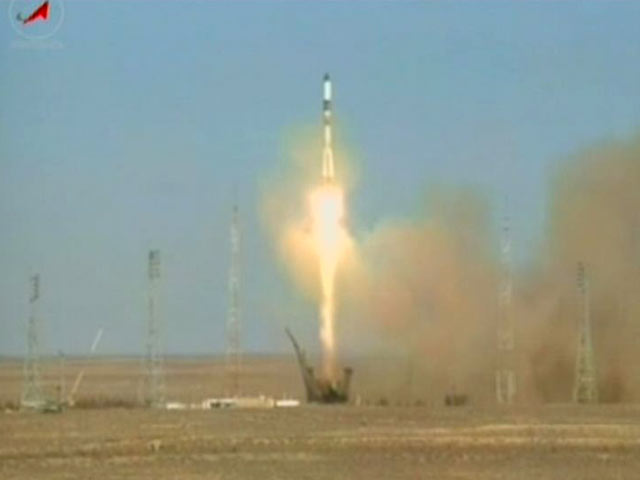
The Russian High -Extension Ship Progress started on Wednesday from the Baikonur Cosmodrome to the International Space Station (ISS). He will deliver goods to her for the ISS and the crew. The joining of the "truck" with the station this time will be carried out according to an accelerated scheme, according to which the ship will fly to the ISS in six, and not 48 hours after the start, as was done earlier.
The launch of "progress" was held as usual. "The launch of the Soyuz-U launch vehicle with the ship's ship M-17M was produced exactly at the planned time- at 11:41 Moscow time," Itar-TASS said at the flight control center near Moscow.
The ship successfully separated from the third stage of the launch vehicle and entered the intermediate orbit, Interfax was told in Roscosmos.
The Central Department Store noted that the "truck" is cooked with the ISS after six hours - at 17:40 Moscow time. "Progress M-17M" must moor on the aggregate compartment of the Zvezda service module automatically.
The technology of a six-hour flight was first successfully worked in August of this year on the "truck" "Progress M-16M", which is currently attached to the station. If this time it will not work out in six hours this time - Russian astronauts will try to "pull up" it manually using the Torah system (teleoperator control mode). If they fail, the ship will be sent according to a two -day scheme and attach to the station on Thursday, November 2, at 10:56 Moscow time.
On board the “M-17M progress” more than 2.5 tons of different cargoes to ensure the life of the station and crew, including fuel and equipment for the station, oxygen, water, clothes and products for astronauts. "Truck" will also deliver parcels from families and gifts for the crew to the ISS.
With the next "opportunity" from the Earth, in addition to standard diets, as always will receive a portion of fresh vegetables and fruits, as well as sweets and other sweets from psychologists and relatives.
Currently, the orbital shift on the ISS is carried by three Russians - Oleg Novitsky, Evgeny Tarelkin and Yuri Malenchenko, as well as NASA astronauts Sunita Williams, Kevin Ford and the Japanese astronaut Akihiko Hoside.