
Translated material
Autumn jazz is not in our opinion
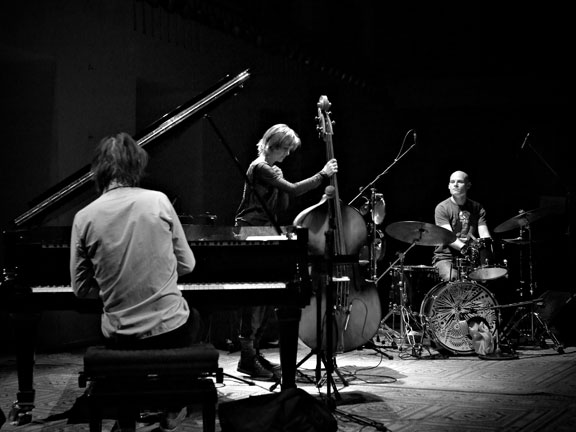
The center of world jazz has long moved to Europe and firmly settled there. This is no secret for fans of improvisational music. However, perhaps not all lovers of jazz know something else: the European trends of this music are set not only with the calm course of the ECM record in certain circles. Yes, many artists, especially from the Scandinavian and Baltic countries, are trying to swim along the waves of the “Isaem” melancholy and slight sadness, waltzing on the verge of jazz itself and local folk traditions. But with a slightly more detailed examination, European jazz turns out to be completely heterogeneous, albeit united by a common thread.
Germany in this regard is no more and no less than, for example, Italy-that is, it looks quite a representative cut of mother Europe. Which was heard by Muscovites who attended four concerts of the Jazz autumn festival, which took place as part of Germany in Russia on the stage of the Moscow Theater “School of Dramatic Art” (October 25 and 29, November 1 and 3).
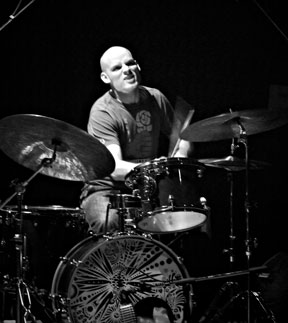 [em] trio. Photo: Dmitry Ermakov
It is difficult for a visitor to the festival to get rid of the thought: our domestic jazz is also different, but at the same time some same. The American jazz is very homogeneous today, and this indicates a certain cultural stagnation on the other side of the Atlantic. In the States, Jazz for the most part returned to his initially entertaining mission, as if there was no broken path of the 70s with their difficult creative search. But Europe is now much less conservative than the USA. And her jazz has long turned from entertaining music into a sonoristic phenomenon into a principle that is completely different from the Negro blues the principle of expression of emotions through musical instruments.
The secret of this principle lies, apparently, not in jazz and classic heritage, but, oddly enough, in electronic music. By the way, it is recalled here that the German school of this very electronic (or, as it was called the founding fathers, “cosmic”) music at first was not aimed at warming up young bodies on dance floors, but at the search for new forms. Not composite and not even sound - primarily inclined. The permanent leader of the legendary Berlin team Tangerine Dream, Edgar Freza stated in this regard that synthesizers allow him to convey feelings that cannot be expressed by means of rock and blues.
The musical "electronics", as you know, entered the mass scene in the other way, dance. Of course, this is also an act of meditation and connection with the spiritual world - but in a different form. The Germans, by the way, succeeded in it, but did not forget about intellectual searches. In the end, the inhabitants of Germany have always been true to traditions: if they take up something, then it can be difficult to stop them.
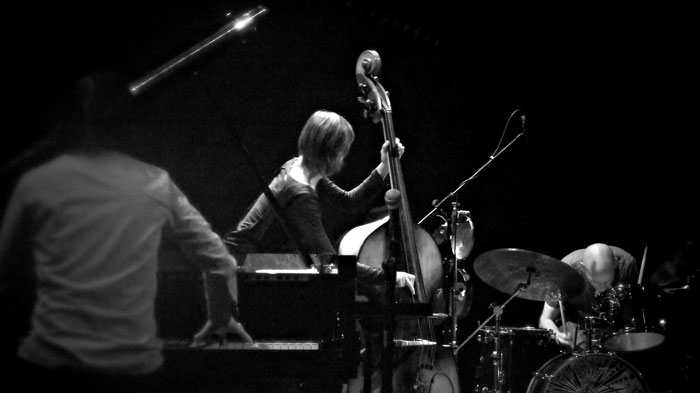 [em] trio. Photo: Dmitry Ermakov
The Germans are a very romantic people. Examples on the surface: Bach and Beethoven, Nietzsche and Schopenhauer, director VIM WIM WETERS. Even Hitler, who dreamed of changing the world order, was once just an unrecognized Austrian artist (by the way, not bad until he changed his rag canvas to the fabric of the real world). The formal and technical side of the issue for the Germans is very important, this is a fact, but reproaches for dry prudence and burgher philistinism come from people who are poorly familiar with this culture. It is enough to see how the Germans behave in numerous resorts. Very direct and in a good way wild in manners.
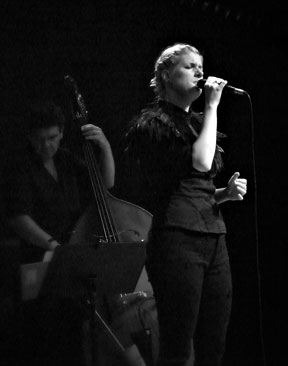 Christina Tuomi. Photo: Dmitry Ermakov
Returning to the formalness and technique: the relevance of any project for the German has always been at the forefront. This is why German perfectionism is manifested: the idea should work . With regard to music, this means that if retrograde is permissible, then only to the extent that is potentially interesting to today's listeners. In other words, we live in the 21st century with his new music, and traditional jazz is cool, but from somewhere in the archive, with a vinyl plate in a dusty envelope.
But the continuity of the German jazz presented on the Moscow stage in relation to early electronic symphonies is obvious. At the same time, however, there was no electronic tools at the festival at all - although in jazz they took root for a long time and in various forms. Perhaps this was the will of the organizers who decided that synthesizers were enough at other concerts held as part of Germany in Russia. But most likely, the reason is different: the choice of instrumentation reflects the fatigue of modern musicians, including jazz, from a rich synthetic sound of the 90s, from which the roots and the current stage grow. Longing for living sound - akin to such fashionable trends as a rampant hobby for yoga, peasant traditions and ideas of “green”. This is the fatigue of a modern person from a rattling metropolis, from the virtual world, from the corporate-commissioned theater. From the ears of the industrial roar.
Against this background, a combination of living sound with modern musical ideas gives the listener a sipping sip of freshness. Even the openly strange project of Christina Tuomi, who caused a slight amazement for the public by the fact that the vocalist is better to speak between songs than to sing - and he sounded on a modern and relevant wave. Jazz of Europe and Germany, including - demonstrates the complete opposite of what is in the minds of the Russian masses - played by our musicians mainly in taverns, it is perceived as a background for vodka or absinthe. “Jazz in the fall” is completely different: it emphasizes the abandonment of ostentatious theatricality, a complete departure from Gershwin’s traditions, a game of emotional waves that imitate the sounds of the city, wind, ocean that are missing through the perception of musicians ... This is a musical nude, perceived by us not all, because it is not represented in the usual form. Perhaps that is why concerts took place on a small site of the theater, and not in a club or concert hall.
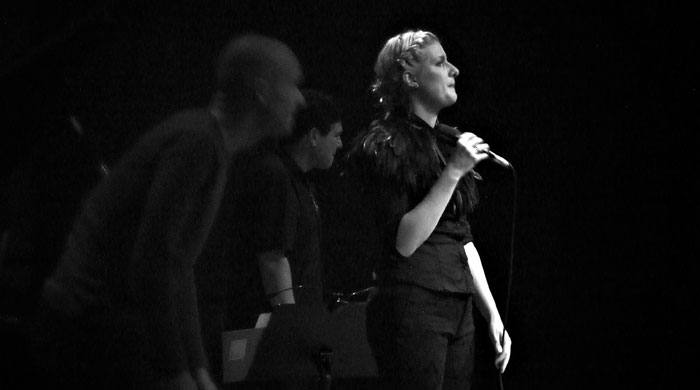 Christina Tuomi. Photo: Dmitry Ermakov
And another observation, confirming the relevance and even some mainstream of the new European jazz: at the festival at the School of Dramatic Art, young musicians sounded more fresh and innovative than senior colleagues. Even Honored by Maestro Joachim Kyun - and then against the background of the [EM] group, Trio seemed very old -fashioned, playing in the excessive channel of the academic avant -garde of the 20th century (which, of course, does not detract from the depths of his game, due to remarkable talent and perennial experience). The young people surprised the mood with contagious ease of mood, even with sometimes complex forms of composition. The already mentioned [EM] Trio, for example, claims that they want to hear a punk in Jazz - and this turns out, although there is no punk in form. A singer Jens Thomas accompanying a royal on a piano, pleased the audience with a range of vocal play in the spirit, if not Bobby MacFerrin, then at least his compatriot Peter Fessler, who performed in Moscow in 2008. By the way, Jens is also looking for rebellion in jazz-but not a punk, but rock: he quotes AC/DC in his songs and even performs a cover version of their compositions.
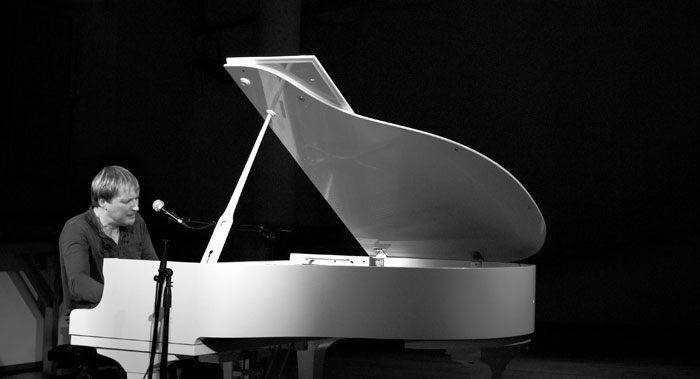 Jens Thomas. Photo: Dmitry Ermakov
It would seem that in Russia for jazz sonorism there are also all the conditions: megacities, and nature, and dull, depopulated cities, and difficult living conditions. Here, by the way, punk is nearby: some domestic jazz groups admit love for this style. But it turns out completely different, not like the Germans.
Living in Germany and doing creativity there is probably easier than ours - you do not have to think about road traffic jams, bandits and just survival. But not a hard life prevents us from making good music. The point is not in the imaginary Russian craving for melodism. If we play jazz and avant -garde, then there is a need for them, and this is in dust with the arguments of the defenders of the “song mentality”. We had Stravinsky, in the end, even though he went to exile.
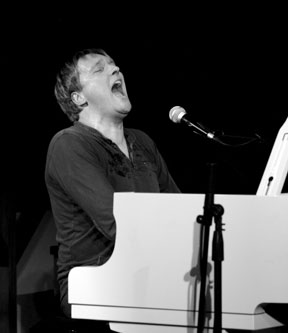 Jens Thomas. Photo: Dmitry Ermakov
A very good saxophonist Alexei Kruglov, a clear adherent of the Coltrane school, at the final concert “Jazz in the fall” went on stage with Joachim Kyun - and sounded against the background of the maestro ... It’s not that bad. Alien. Alexey put on the technique of the game, pseudo -Slavic instrumental phrases and a pseudo -Russian outfit. And Kyun - on emotions. Like Jens Thomas, like [em] trio, he went on stage as freedom, as a vacation. And I did not hear from them the notorious German verification. But I heard a wild and wildly filigree game, which our jazzmen (with all due respect to many of them) has not yet been dreamed of.
After all, what is the difference between Russian music and European, with their explicit relationship? And not only music - this is the way of life: ours, carried away by the concept , put it above all. And Europeans - they just play, just do their job well and with love. The concept comes along the way itself, there is still no getting away from it. Only for such an understanding of both life and art we need at least forty years, like the people of Moses in the desert, to live free. And in the end, we will still have the Europeans from studying - our whole story is talking about this.