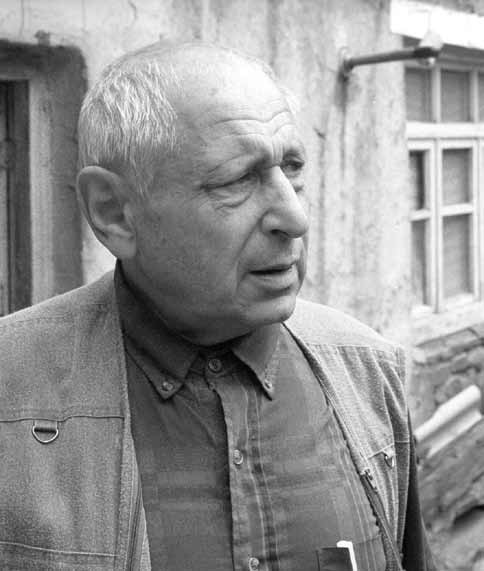
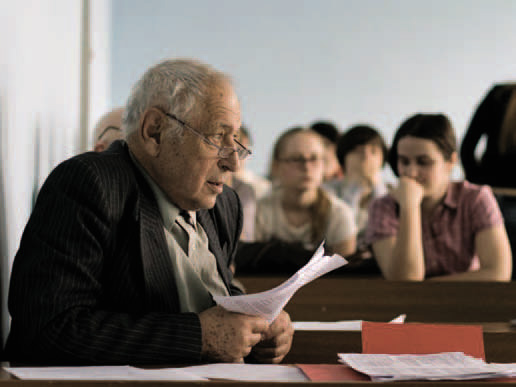
Alexander Evgenievich Kibrik (March 26, 1939 - October 31, 2012)
- Head of the Department of Theoretical and Applied Linguistics of the Philology Faculty of Moscow State University,
-Corresponding Member of the Russian Academy of Sciences, Doctor of Philology,
- Professor, member of the British Academy,
- Honored Worker of Science of the Republic of Dagestan.
A.E. Kibrik was born in Leningrad in the family of artists E. A. Kibrik and L. Ya. Tymoshenko, graduated from the department of classical philology of Moscow State University; linguist, specialist in linguistic typology, theoretical syntax, field linguistics and languages of the Caucasus; He stood at the source of the department of the structural and applied linguistics of the Faculty of Philology of Moscow State University, and since 1992 he was his permanent leader and, in the context of our reality, a desperate defender. A.E. Cybrik made a huge contribution to modern theoretical and field linguistics, determined the key problems of syntactic typology, organized dozens of linguistic expeditions to the Caucasus, the Far East, Altai and other regions of the Russian Federation, prepared fundamental descriptions of many small languages of Russia. Main works: “Methods of field research” (1972); “Fragments of grammar of the Hinalug language” (together with S. V. Kodzasov and I.P. Olovyannikova, 1972); “Experience of the structural description of the Archinsky language” in 4 volumes (together with S. V. Kodzasov et al., 1977); “Comparative study of Dagestan languages. Ch. I: verb. Ch. II: Name. Phonetics ”(together with S. V. Kodzasov, 1988–1990); “Essays on general and applied issues of linguistics (universal, typical and specific in the language)” (1992); “Language and folklore of Aluratsev” (together with S. V. Kodzasov and I. A. Muravyeva, 2000); “Constants and language variables” (2003). A.E. Kibrik is the founder of a new scientific school in a linguistic typology, a teacher of several generations of Russian typologies. Dozens of famous Russian scientists consider themselves students of Cybric. Dagestan expeditions by Cybrik will forever remain for them not only with an invaluable scientific experience, but also by the brightest life impression. A three-hobby brings deep condolences to the relatives, relatives of Alexander Evgenievich, his students and colleagues.
In recent months, Alexander Evgenievich has been seriously ill, we knew about this, but, of course, continued to hope against everything. The news of death is difficult to be prepared, it is always a blow and always sudden. But the fact that Alexander Evgenievich is no longer among us is especially difficult to imagine and accept. People of science are of different temperaments, many prefer to engage in their research, if possible without contacting with a noisy and vain world. Alexander Evgenievich was not the same, his life was so closely intertwined with the life of our entire small linguistic community that his departure seems not just a loss - he is perceived as the shock of the foundations of our professional existence. It seems that some very important supporting structure collapsed at a large, carefully built building.
Several days have passed since this sad news appeared, and the reaction of people is still acute. This is clearly visible on the Internet - in several leading electronic publications, very emotional obituary appeared, new responses from various cities and countries arise on social networks, people are divided by spontaneous memories, especially often placed photos (many are very long -standing, the romantic period of the first field expeditions, from which our “structural linguistics” began, as it was called).
The scientific merits of A.E. Kibrika, undoubtedly, are very significant, the understanding of this was always present in that unofficial, but accurate “Table about the ranks”, which is available in each professional community. The official confession to the cybrick was not in a hurry, for the Soviet chiefs he (although he was not an open rebel) always had an unreliable reputation; After graduating from the university, he, one of the best students of his release (by the way, was S. S. Averintsev), was not accepted into graduate school, but already being widely known, for almost twenty years he worked at Moscow university in a modest position of an assistant professor.
The situation began to change only since the 1990s, and in recent years this late official recognition nevertheless came to Cybrik: there was both the election as a corresponding member of the Russian Academy of Sciences in 2006, and various other honorary titles and positions. But among all the posts that Cybrik held in different years, one was the most important, and it best explains the role that he played in our professional life. Exactly 20 years - since 1992 - A.E. Kibrik led the Department of Theoretical and Applied Linguistics of Moscow University, the very one that he came to a senior laboratory assistant a year after its creation and loyalty to which he retained until the end of his life.
The department-and the separation of theoretical and applied linguistics associated with it (until the end of the 80s it was called the separation of structural and applied linguistics)-a unique phenomenon in the history of Russian science and, paradoxically, in the latest Russian history in general; At least if the story is understood not only by material, but also by spiritual history.
They wrote about the department - and they will probably still write - many and many; Now, I think it’s enough to say that this small educational and scientific unit (and in the best years had no more than a dozen full-time employees and who studied 25-30 students in each course), founded on the initiative and direct support of university mathematicians in cooperation with several independently thinking linguists, carried out a unique experiment: the possibility of existence in the conditions of Soviet society of the 60-80s An island of independent scientific thought and free search for truth.
The fact that at the department all these years there was an advanced school of modern linguistics, with many achievements and wonderful names, is a direct consequence of this, in my opinion, the most important circumstance. True, the authorities only suffered and ultimately achieved the closure of the department - but this happened only in 1982, on the eve of the death of the regime itself, and in 1988 the department was restored. A.E. Cybrik has been at the department all these years, without leaving it in the most difficult period of the actual semi -germ (which he himself wrote in detail in his notes dedicated to the history of the department). After the liquidation of the department in 1982 and the death of its first manager, V. A. Zvegintsev (in 1988), it was he who turned out to be the person who was able to take on the leadership of the revived department and, in the new conditions, to continue all its traditions brilliantly. Under the Cybrik, the department already developed as a full -fledged scientific organism, realizing much of what failed or could not be done in the first, “romantic” period of its existence. The fact that Cybrik was at that time in that place was a huge historical luck. Probably, there was no other remotely suitable candidate for this role then; At least, it is absolutely impossible to imagine the department of the last twenty years without a cybritic - and without a department and separation of theoretical and applied linguistics it is impossible to imagine and modern Russian linguistics as a whole, where it is the most important role that its graduates play in almost all relevant areas.
The uniqueness of the Cybrik was precisely in the fact that he combined the gift of an outstanding scientist, allowing him to pave new ways in a number of linguistics, and a brilliant administrative talent. These words may be banal, but everyone knows how rarely these two qualities are connected in one person. Cybrik, of course, loved the department very much (like all of us, whose fate came into contact with her), but his love was always not contemplative, but active. He arranged it literally as his own house - and everyone who knew it remembers that economicity was characteristic of him in the highest degree.
In some other life, it was easy to present him with some famous petition merchant, of those who were turning into millions, relying only on the honest word of the companion, and throughout Russia they arranged not only the most modern factories, but also museums with picture galleries (by the way, Alexander Evgenievich came from the family of famous artists, whose memory, Lydia Yakovlevna Timoshenko, was poorly estimated. He was always touchingly devoted).
Maybe the simple secret of his success is that Alexander Evgenievich generally somehow knew how to combine very different qualities, which are rarely connected in one person. For example, in ordinary life, despite the merchant's darkenness and love of economic order, he was a very kind person and willingly forgave people their imperfections - and every person who tried to be a boss in this life knows how amazingly a lot of concentrated imperfections is suddenly discovered from our subordinates ...
Cybrik endured all this meekly and with unchanging optimism, which somehow involuntarily infected the most inveterate misanthropes next to him. There was a lot of childhood in it-and this uncomplicated uninhabited and constant openness and curiosity for the new miracles and curiosity of a great motley world and even love for sweets, which, that sin to hide, were slightly laughed, especially on expeditions, where 18-20-year-old students, of course, saw ourselves harsh pioneers and conquistadors, who were completely superior Curses in a backpack ...
But, on the other hand, this kind and such “domestic” person was able to uncompromising and stubborn - many would even say stubborn - when the matter concerned his scientific views and what he considered his principles. Choosing the path that seemed correct to him, believing in some kind of theory or system of views, he defended his case without the slightest half-tones. Like a real deep scientist, he was in no way a dogma, and he happened after painful fluctuations to change his scientific priorities quite radically. But what he considered faithful, he defended to the end with amazing courage, regardless of the political conjuncture, nor with scientific fashion, or with considerations of benefit or comfort, nor - maybe the most difficult - with skepticism and misunderstanding of even the nearest colleagues and employees. And, as a rule, sooner or later he convinced of his innocence - if not all, then very, very many.
I think this amazing combination of such different character traits explains well why the cybrick chose the path that brought him to the department of theoretical linguistics, and what contribution he ultimately managed to make to science. At Moscow University, he studied at the department of classical philology, but, despite the fact that he retained love for classical languages for life (and at lectures, it used to be quoted Latin authors) was too independent and too passionate for the new, alive and modern to choose a career of a classic philologist. And it is no coincidence that the department of structural and applied linguistics was barely opened at Moscow State University, it turned out to be among the most reliable guardians of his spirit - the spirit of independence and novelty. Without going to graduate school, he got a job as a senior laboratory assistant (in excess of his main duties, teaching the Latin language at first) and consistently passed all the long stages of the scientific career, until he became the person to whom the fate of the department was entrusted.
In science, his choice also turned out to be unexpected for many: he became the actual founder of our modern field linguistics. This is such an area that is completely contraindicated in cabinet theorists: the field linguist climbs into the most dull corners (where there are often no roads, no mail, no electricity) in order to describe languages that can be said, only in one or two villages, and describe, following the facts of these, as a rule of the most complex “exotic” languages, and without regarding, without considering it without considering that How these languages should look in accordance with the accepted theories. And in this area, where Kibrika’s love for novelty and independence found the perfect application, he had no equal.
He visited Pamir, in Southern Siberia, Kamchatka, in Abkhazia, Svanitia and in different other places, but he gave the most time and effort to the languages of Mountain Dagestan. Dagestan languages are considered one of the most difficult on Earth - in wealth and sophisticated disagreement of phonetics, grammar and vocabulary. Cybrik is a real classic of Dagestanism, after which the examples from the Dargin, Lezginsky, Lak, Cesky and other languages began to appear in the articles and books of the leading linguists of the world, with which the trouble -free Sasha Kibrik has always generously shared everything he could. One of the senior achievements of Cybrik was the four -volume grammar of the Archinsky language, on which less than a thousand people speak in the only one lost in the mountains of the Northern Dagestan of the village of Archie over the Hatar River.
After its publication, it often heard that the tiny Archinsky language became one of the most fully described languages of the world; This grammar is interesting not only in itself, but also as the experience of the theoretically consistent and strict description of the “exotic” language, which many later followed. Cybrik retained interest and love for Dagestan until the end of his life, although in recent years large expeditions with students have become unsafe and had to be abandoned. I think that someday witnesses of these recent trips will be able to betray several episodes when only the amazing composure and personal courage of Alexander Evgenievich, who alone went to negotiations with armed robbers, saved the whole expedition; The main character of these stories did not like to remember them and did not encourage stories about it.
The best professional (and everyday) school than these annual expeditions could not be presented for students. All the students of the cybritic (and their dozens) certainly went through these expeditions starting from junior courses, and many continue this activity still as professional researchers.
Of course, touching such a diverse and rich linguistic material, Cybrik could not help but think about the imperfection of existing linguistic theories, including those that during his years of his youth were considered advanced and to which he honestly tried to follow in his early works. And here, as in everything, his independence and courage showed themselves: making sure that he was right, he began
The struggle for the approval of fundamentally new ways to describe the language in which the laws of language would be inseparable from the laws of thinking and human behavior. Then it was new, and Cybrik had to face a misunderstanding of many colleagues, starting with bewilderment and ending with ridicule.
Now what is stated in his articles of that time (for example, in the well-known “linguistic postulates” of the early 1980s) is actually a common place and is considered an indisputable basis for the direction that most often calls itself cognitive linguistics; The ideas of Cybrik was ahead of its time for about ten years. I think that many of his work in recent years are still waiting for attentive reading: experience showed that Cybric was almost never mistaken in his forecasts.
Alexander Evgenievich Kibrik was a man who loved the future, was not afraid of anything in the present and united colleagues and students around him as a good master of a large, noisy and cheerful house. He left-and only now we really realized how we orphaned, left alone with that world, from the disorder of which he so carefully and devotedly defended us for many years.
We will try to remember him - these are happy memories. We will try to be at least a little similar to him, although it is difficult.
Grigory Kreydlin,professorRSU:
Without any exaggeration, we can say that my whole life went side by side with Alexander Evgenievich Kibrik. At Osipl Filfak, Moscow State University, I was his student, under his leadership was a practice. A.E. Cybrik was one of the opponents of my thesis, and then the candidate dissertation, then the doctoral ...
And all these years I thought and continue to consider myself his student. He taught me not only, as it seems to me, the right attitude to science and scientific work, but also to people, good and bad, to those whom you have to face. In difficult life situations for me, he always sought to help, and not only with advice, but also by business. And if this did not always succeed, then he still delicately apologized!
I was always struck by the depth and breadth of scientific interests by A. E. Kibrika, his cultural and purely human range. Чем бы он ни занимался — от профессиональной и организаторской деятельности до участия в студенческих вечерах и дружеских застольях — был лидером, окруженным коллегами и учениками. Мне его будет очень не хватать…
Для нашего небольшого сообщества, связанного с Отделением структурной и прикладной лингвистики, Александр Евгеньевич почти всегда был патриархом — даже будучи сравнительно молодым человеком, еще задолго до того, как стал заведовать этим отделением. Именно он был хранителем осипловских ценностей и особого осипловского духа. Его не стало, и мы осиротели.