
Translated material
Comrade in the Gulag
A literary critic in civilian Vladimir Vladimirovich Putin achieved the impossible. He made Solzhenitsynsky relevant “One Day of Ivan Denisovich”, which turned 50 this November. And it’s not that we failed in 1937 or in the post -war Stalin dashing times, which hunters love to hyperbole and metaphors so love to talk about. Let Solzhenitsyn read and compare the then “will” with the current and Stalin camps with the current. Even the Chekists cannot turn time back for half a century, and we should not be afraid of each other, stimulating the premature appearance from the guilty of the whole society to the committee. What is the investigative at least the investigative, he holds the first, classic - KGB.
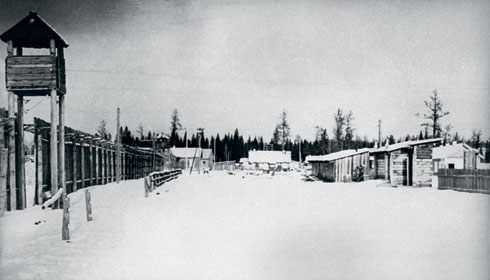
Lagpunct - the smallest cell of the Gulag
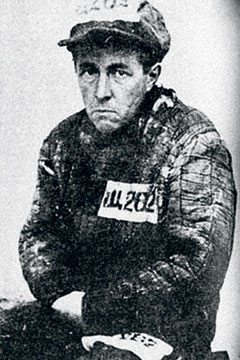 |
| Prisoner Solzhenitsyn (ShH-262) |
|
Society should not write down an indulgence with a discount on a large terror. It is very convenient to nod to this misfortune to the teacher, who agrees to “chemion” with ballots in the school polling station, an actor campaigning Putin in the elections, a talented director, cleansing the money from this power, the scatter of the theater, who makes a “first person”. Although it is clear that in case of abandoning unworthy behavior they would not have been on the rack or near the wall, they would simply lose some material wealth or creative possibilities.
But fear in society is sown, and everyone is waiting for the devil knows what. The authorities adopt laws, according to which half the country can be planted, because fear has great eyes, and power is also scared and promises that it cannot and does not dare to carry out.
“Point plantings” work, they create a panic atmosphere for “creative”, that is, the thinking class. The atmosphere of lawlessness does not give guarantees of survival. You will get hostage - the native government will grass you with fatal gas or burn you with tank fire. The terrorists will leave or not is unknown, but you definitely will not leave.
And for business, one thought of Ivan Denisovich is very suitable: “So the whole life is at the prisoner ... just look for that you don’t rush on your throat.” What are the members of the Rus Sitting organization? What are the loved ones and friends of the Yukos Sitellites? It seems to me, in the Solzhenitsynsky vein: "The Duma of the Prisoner - and that is not free." More and more about parole. Will they finally let Alexei Kozlovo? Mikhail Khodorkovsky? Masha and Nadia from Pussy Riot? And will they hit anyone with a club, like Zaru Murtazaliev? In the camp, Ivan Denisovich was in use.
Putin Russia is already perceived as a large zone, and everyone who can go into escape. Through the taiga called Sheremetyevo. So Ivan Denisovich is not an outsider, but a salager. And there is something to learn from him: not to be a "jackal." Do not believe, not be afraid, not to ask. And do not knock the "kuma".
"
In 1968, my father laid a small book of small format on the table. It was one day. The book decided everything for me. It immediately became clear what, how and why to live next
"
I am absolutely sure that at least one drop will remain from the Solzhenitsyn ocean, and one tear that has incorporated the simple truth of the peasant soul and the great lies of the Soviet era, from the streams of blood and tears, falling through its compositions. Allowing Khrushchev to print (and, most likely, Twardowski himself, who later decisively rejected Shalamov) did not understand that this is not about the “individual flaws” with which the XX and XXII congresses committed, that this sentence, the idea, and the way. They realized only then and did not give the promised Lenin Prize in combustion.
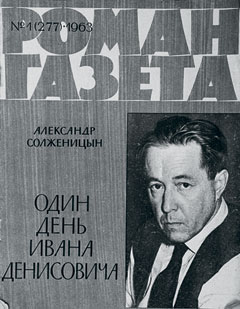 |
| “One Day of Ivan Denisovich” was published in the “New World” (No. 11, 1962) and followed by Roman Gazeta (No. 1, 1963) |
Young poets who read their poems on Mayakovsky Square, the future triumphal, understood better. Especially the one who wrote about “one day”: “The steam with a star will dawn in the night of the casemates and the flashes of the futility of human hopes, frozen in Siberian snow” ...
In 1968, my father put me on the table with a tiny little book of a small format of the publishing house, it seems, a “Soviet writer”. It was one day. The book decided everything for me. I saw a white blinding snow road, the red sun of despair, shepherds, escort with machine guns, a column of frozen and hungry prisoners: “... and a column came out into the steppe, directly against the wind and against the blushing sunrise. Naked white snow lay to the edge, right and left, and there was not a single tree in the whole steppe. ” And immediately it became clear what, how and why to live next.
There was also the number of “Roman Gazeta” for 1963, where grandfather-the old Bolshevik-put a mark on the cover, as he put it on all magazines. The mark was 5+.
After Czechoslovakia, after 1968, literary criticism on the topic of “one day” was not in fashion. But to withdraw it on searches only after the exit in the west of the Archip (“Archipelago”) and the expulsion of the author. After 1974, the “one day” was removed from the libraries. Many librarians did not put magazines in a black bag and did not give the KGB couriers to burn in the Chekist crematoriums, but distributed according to their acquaintances.
And “one day” is held at school, and it is printed many times: separately, in the anthology, in the collected works, and the “gulag” has long been released, but the name of Stalin is still the “name of Russia”, this piercing vaccine did not work, there is still no immunity. "Yadu me, poison!" - As Bulgakov wrote.
Ivan Denisovich Shukhov, an illiterate, but honest and pure peasant, who did not lose in the camps neither dignity, nor humanity, nor even hard work, did not create theories, like intellectuals, he did not even understand why? And from this his wordless and grave suffering is even worse.
One day, as in the kidney, already contains a tree of the "Archipelago". For captivity, Ivan Denisovich was thrust. Baptist Alyoshka received 25 years for prayers. The gopchik, a sixteen -year -old clap, gave an adult term only because he wore milk in the forest Bender, and Pavllo fought in the UPA against the NKVD. We will learn about how we drove from the army of the foreman Tyurin, the son of a “kulak”, and how he later, having learned that his commander and commissar were shot in 1937, crossed himself and said: “You are, the creator, in the sky. You endure for a long time, but painfully beat. ”
And we learn about the Estonians - that Ivan Denisovich did not see bad people among them. And we learn about that that in the post -war village it was impossible to feed, the men, who survived, leaned in painted; And about the hungry city of Sevastopol, before the Yalta meeting, we will find out how for foreigners one store was opened with white bread, butter and sausage, and in half an hour the entire population escaped there.
50 years in the prison system, under the machine guns, half -starved peasant Ivan Denisovich Shukhov develops immunity in us to socialist terrible utopia. The end is not visible. It ends like this: “Shukhov fell asleep quite satisfied. At the day he had a lot of success today: they didn’t put him in the punishment cell, the brigade was not expelled on the social city, he spent porridge at lunch, the foreman closed a good interest well, the Shukhov wall did not get fun, he did not get a hacksaw on Caesar in the evening and bought tobacco in the evening. And he did not get sick, grinded. A day passed, not overshadowed by anything, almost happy. There were 3653 such days from the call to the call to the call. Due to the leap years, three days were added for three days. ”
“One day of Ivan Denisovich” is held in schools in literature lessons. The New Times publishes excerpts from the works of high school students
“In this work, nothing surprised me. It depicts a hard Stalin regime. At this time, labor was needed for roads, dams. Prisoners, without opinion and right to word, is such an optimal labor force ”(Misha Ivanov, 9th grade). “I still have the phrase“ Prisoner “Prayer” in my head. I imagine this very well: prisoners standing in rows, the monotonous voice of the head of the guard ... The phrase “Step to the right, a step to the left is considered to be a escape”, even to imagine how a person can live under constant control, in constant pain-physical and spiritual ”(Polina Vedenyapina, 9th grade). “... I rather expected that in my thoughts there would be more sorrow, despair. Most of all I was struck by the fact that I.D. I could calmly think about those letters from the relatives that he received; how, thinking about them, he did not spare himself, did not complain about fate; The letters did not catch up on him-he talked about the collective farm, gruntly a little, but objectively ... receiving rare letters, he thought that there, behind the walls of the camp, and not about how sorry he could not see it ”(Arina Efanova, 9th grade). “The camp is the house of death and madness. Here everything is aimed at destroying people (quite often innocent, kind and talented, convicted only for their point of view, or even just like that). People cannot stand these terrible torment, mockery and go crazy, and then kill them like old dogs (after making you dig a grave!) ... I think that these people who have kept a person, in spite of everything that died innocently, need to be proud of. We must remember them ”(Maria Gladysheva, 9th grade). “Their (prisoners) life, orders and customs, what the authorities did with them was a edification for those who were at that time at that time ... It scares what power can do, the government when disobedience to the people” (Ekaterina Mohereva, 8th grade). "
I imagine this very well: prisoners standing in rows, the monotonous voice of the chief of the guard ... The phrase “Step to the right, step to the left is considered to be the escape”, even to imagine how a person can live under constant control, in constant pain - physical and spiritual
“And how good it is that such harsh and cruel times go and comes the real life, human life” (Nastya Potashchenova, 8th grade). “When I read it, it became difficult for me to breathe ... Perhaps people deserve this suffering, but who allowed a person to solve fate and punish for sins?! This question is very controversial and remains open to this day” (Dasha Vilova). It is possible to survive only by the peasant, honest attitude to work, although war, conclusion, collectivization influenced his fate ... However, Ivan Denisovich does not grieve about fate: he is not sure whether he needs freedom. For example, carpets (Nastya Kolesnikov, 11th grade) . (Elena Lenson, 11th grade). “If you try to objectively evaluate the work of a particular writer, then the key criterion for assessment should be considered insolence. No, not at all, street, but insolence is literary; In other words, the ability to encroach on the mechanism of the universe with your insignificant pen. And Solzhenitsyn with his story is an excellent example of the same insolence ”(Alexander Zlotnikov, 11th grade). 
The New Times thanks Russian literature teachers Evgeny Ablyuk (Lyceum No. 1525 “Vorobyovy Gory”, Moscow), Svetlana Belokurova (gymnasium No. 405, St. Petersburg), Svetlana Rukavishnikova (School “Marina”, Moscow)
Photos: Itar - Tass, Astrdr.com