
Translated material
100 years of the first Ossetian film studio
It is generally accepted that its own film production in Ossetia appeared only in 1943, when the North Caucasian newsreel studio was evacuated from Rostov to Vladikavkaz. The role of the studio cannot be diminished, it certainly became the center of the cinema for the entire North Caucasus and largely played the role of the link between its regions. And what is happening with Sevkavkinochronics is a great trouble to the whole region. But were the directors of the operators of the newsreel studio are the first to start making their own cinema in Ossetia? Now this question can be answered quite definitely - no. No, no and no.
By the beginning of the 20th century, there was an unprecedented boom of cinematography in Vladikavkaz. By 1910, there were five stationary cinemas in the city, not counting countless mobile symptographers. But who was the first to take up a movie camera in Ossetia? The first in the history of Vladikavkaz will be filled (or rather, as many as two cinemas) with an accurate geographical binding was removed in Ossetia in 1911 and captured the funeral of the mayor of Vladikavkaz.M. Orel (October 11, 1911), as well as a demonstration of models of women's clothing, received from Paris to one of the city stores.
It is reliably unknown who was his author, since he was made for the Pate-magazine. The usual practice of those years consisted in the fact that under the brand of the PATE magazine there were plots collected around the world and filmed mainly by local operators by order of PATE. But we can still afford some guesses about authorship.
Recall that the funeral of M.M. The eagle took place no later than October 13, 1911, which is reflected in the plot, which, incidentally, has been preserved in the RGACFD funds. And in the same 1911, famous Vladikavkaz photographers brothers Khmara submit a petition for the discovery in the city of cinema in the Circus of Yaralov. Unfortunately, whether the cinema was allowed to open or not, it is impossible to understand from the documents, because only three pages have been preserved from the case. However, already in 1912, we find a mention of filmings entitled "Types of Vladikavkaz" and "Types of the North Caucasus and Crimea", where the Lira cinema is standing as manufacturers, operators - br. Khmara. This gives us the opportunity to suggest that the Khmara brothers not only received permission to open their cinema studio and the Lira cinema, but also express an even more bold assumption that the first plots for the Pate magazine were also removed by them. Otherwise, why would such expensive experiments with the shooting of your own products? Unfortunately, after 1912, I could not find any other references to the Lira cinema and its owners. Nevertheless, 1912 can be considered the year of the birth of the first film studio of Ossetia.
Unfortunately, almost nothing is known about Sergey and Prokofia Khmar himself. And only about one of the brothers I can tell something.
Prokofiy Timofeevich Khmara was born in 1876. It can only be assumed that his family did not stand out with special income and they were most likely from the Cossack villages nearby to the Vladikavkaz. At the age of 20, he became an assistant to the famous photographer and artist Grigory Nikolaevich Ozhe, who worked in those years in Vladikavkaz. With Ozhe Prokofiy, Khmara worked for 4 years, apparently, comprehending photographic science. And then, after the teacher, he also moved to Vladikavkaz to Nizhny Novgorod, where they worked until 1903-1904, when the completely blinded Ozhe did not leave Nizhny, moving to the roll, where he soon died. Prokofiy returned home. And already in 1905 in Petrovsk Port (the current Makhachkala), the atelier of the brothers Khmar was opened.
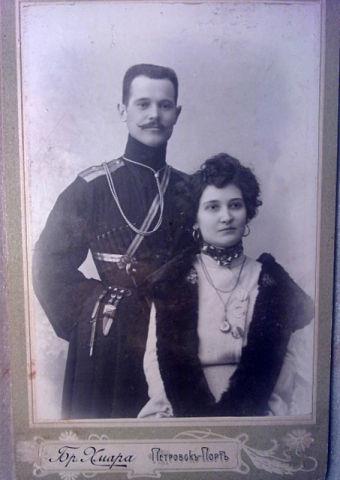
Whether Prokofiy and Sergey opened a photograph in Vladikavkaz immediately, or a little later, or, conversely, a little earlier, remains a mystery so far.
But absolutely definitely we can say that they entered the history of Vladikavkaz not only as beautiful photographers, but also as newsreels who left behind one of the earliest filmmakers of Vladikavkaz.