
Translated material
Life on "Mars"
The first Russian team will go to the Martian desert research station next April. For two weeks, an out of six people will live in conditions close to Martian, in the desert in the state of Utah (USA). These expeditions are organized by the American Martian Society, about which the participant of the future expedition, our permanent author Alexander will tell Khokhlov [1].
Martian Society (Mars Society [2]) is a public organization that set itself the goal of mastering and terraforming Mars (i.e., bringing it into a state suitable for the habitat of earthly animals and plants). Founded in August 1998. Now about 4,000 people from 50 countries of the world are members of the Martian Society. This year, the branch of the Martian Society was opened in India, which in 2013 plans to send its first interplanetary apparatus to Mars. At the beginning of the "zero" branch of the company was in Russia, but it was closed due to a lack of interest.
The president of the Martian society was one of its founders - aerospace engineer, author of books and articles on the development of Mars Robert Zubrin. Back in 1996, his book The book was published CASE for Mars (with the participation of Richard Wagner, Richard Wagner). The authors proposed a plan for the colonization of Mars, listed the necessary technologies for this and described the future of mankind on the Red Planet.
The flag of Martian society is a red-green-blue tricolor. It reflects the future story of the planet: the red strip symbolizes today's Mars, and the green and blue - the stages of mastering the planet by humanity. The flag was invented by NASA engineer Pascal Lee in 1999, and the idea is based on the famous fantastic trilogy of Kim Stanley Robinson, Krasny Mars, Green Mars, Blue Mars.
Martian society works in several directions. By tradition, in August the annual International Congress is held (or, using Americanism, “Convention”) in the USA. This year it took place on August 3-5 in Pasadena (California) [3] and was timed to successfully land on Mars of Curiosity Rover. The participants were Lori Garver, Deputy Head of NASA, Peter Diamandis, founder of the X Prize Foundation Foundation and co -founder of Planetary Resources, Elon Musk, SpaceX co -founder and executive director of the Falcon Heavy missile for future interplanetary missions.
Conventers of the Martian Society regularly take place in Europe. Members of the society write books about Mars, publish the quarterly magazine The Mars Quarterly [4]. In addition, information about the research of Mars is collected, which is posted on their website and on friendly resources. The society supports a number of experiments, annually arranges a contest of praises constructed by students (University Rover Challenge). Often, Martian society directs petitions to the government and the US Senate on various space issues.
In addition to educational projects, society is engaged in practical things. Of the most important areas - the work of two research stations. On the Canadian Arctic Island of Devon is the Flashline Mars Arctic Research Station (Martian Arctic Research Station Flash-Line, FMARS), and in the Utah (USA) desert-the Mars desert Research Station (Martian desert research station, MDRS).
The first in 2000 was built in Canada. The island of Devon was most likely chosen by chance: it is there that NASA experts are testing Martian and lunar equipment. Since 2001, the crews of “space expeditions” began to work at this station - people lived and worked in conditions close to the Martian. In 2002, the MDRS research station in UTA opened [5]. The third and fourth stations were also planned in Iceland and Australia, but because of financial difficulties they have not yet been built.
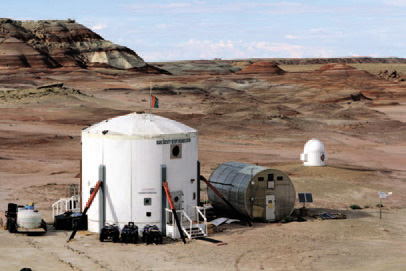
Due to Arctic weather at FMARS station, you can only work in the summer season, and the MDRS station, on the contrary, is operated in winter and spring (now expeditions come only to the second of them).
Who can become a member of the crew of stations? First of all, volunteers of the Martian Society, of which national teams are recruited. There are teams of national representative offices of society - for example, in the 2012–2012 season, teams from Australia/New Zealand, Europe, Belgium and the Russian Federation participate. Teams of various US institutions were also organized: NASA, Armed Forces, Universities, Colleges, etc.
During the expeditions, various experiments are carried out, medical, scientific, mining are used. Usually, the team is formed from six people: commander, geologist, biologist, doctor, sorcerer, astronomer. But, as a rule, each crew member combines two specialties. Someone may also be a journalist- his additional duty will be the coverage of a two-week expedition at various electronic sites, maintaining photo and video reports.
Life at the station is unpretentious. The abode of the Marsonauts is a cylindrical two-story residential module The HAB with a diameter of 10 m, there is an auxiliary module-orange and a separate module-volume (on MDRS). Tiny personal cabins are intended for relaxation, in each - a table and a hard bed with a sleeping bag. For physical exercises - simulators. There are food refrigerators, a water supply system, electric generators, a first -aid kit.
The tasks of constructing a closed life support system on MDRS are not yet put, but sometimes some of its elements are worked out. In any case, the station has everything for the autonomous life of a crew of six people for two weeks.
Each crew must include people with the necessary experience in an emergency, as well as a doctor. In case of emergency, for example, in the event of a life threat, the support service can intervene and evacuate the victim. And the dangers in the desert can be different: there they met PUM, and local scorpions sometimes made their way inside the station.
An important component of the life of the Marsonauts is an extraordinary activity. The station has spacesuits, geological equipment and ATVs. Of course, the spacesuits perform a decorative function rather, but this is enough for the purpose of the expedition. The area in the mountainous desert of Utah resembles lifeless Martian landscapes.
For two weeks, the crews are in touch with Tsupu, write network diaries and reports, perform experiments on their scientific program (compiled independently), make sorties on ATVs for geological samples, experience various equipment, and pass medical and psychological tests. Several webcams are installed on MDRS, so those who wish can familiarize themselves with the life of the next crew [6].
For several years of operation of the stations, hundreds of specialists, scientists, and students visited them. Someone was returning more than once, and in the end, a student-practical student became the commander of the next expedition. And in the 88th expedition on MDRS (January 2010), Italian biologist and engineer Diego Urbina participated. In June of the same year, he became one of the six testers-Mars-500 experimental testers at the Institute of Biological Problems (Moscow), having experienced the hardships of prolonged insulation. In the experiment, “Mars-500” Diego participated in “Planting on Mars” and worked in a spacesuit on its “surface”. One of the future participants in the NASA Hi-Eas [7] experiment with a 120-day insulation of the Martian Crew, which will be held in 2013 in Hawaii, Oleg Abramov, also previously worked on an expedition to MDRS. Thus, the Martian Society station became a successful project, which initially “amateur”, but who became in demand over time and professionals.
In general, the crews at the Martian Stations are selected very interesting - to make sure of this, it is enough to read biographies on the company's website. Often, women become the commanders, and in general, the crews usually form 50 to 50. In addition to the direct benefits of experiments, this is an excellent psychological training that is important for personal growth and rallying of participating enthusiasts. Of course, there are very few hopes that one of them will ever make a real flight to Mars, but with their own hands they create a culture of the future, a kind of cosmic humanity, boldly going to the new front-Trams of the long-range space.
Next year, for the first time in ten years of the existence of the Mars desert Research Station, the Russian team (Team Russia) will participate in its work - crew No. 129 [8]. The expedition is scheduled for April 20 - May 4, 2013. The research and educational program is in the formation stage. Questions and proposals can be sent to the address of the crew commander Nikolai Dzis-Vovarovsky [9].
The main goal of the team is educational and propaganda. We want to draw attention to the astronautics of young people. In order for new specialists to come to the space industry, only material support alone is not enough. People should understand why their work is needed, what civilizational issues it can solve in the future.
1. This article is a processing of an article published in the journal Chemistry and Life, 2012, No. 4
3. Videos from the 15th Convention of the Company-www.youtube.com/playlist?list=pl57b8d5FFF555A62
4. Http://content.newmars.com/tmq/
5. Http://mdrs.marssociety.org/
7. Http://manoa.hawaii.edu/hi-seas/
8. Http://mdrs.marssociety.org
10. TRV-hunger No. 58, round. 10- http ://trv-science.ru/2010/07/20/na-lunu-s-Chastnikom/
11. Trv-hunger No. 101, round. 7- http ://trv-science.ru/2012/04/10/samim-prikosnutsya-k-kosmosu/
Participants Russian crew on MRDS -129
Nikolai Jesis - Voinarovsky (crew commander), a graduate of the Faculty of Aerophysics and Space Studies of the Moscow State Medical University of 1999. He worked in the missile and space corporation "Energia" named after S.P. Korolev. In 2001, he graduated from the faculty of the Faculty of Applied Political Science of the Higher School of Economics. Since 2000, he worked as a journalist in various publications. From May 2009 to the present-senior correspondent for economics and innovations of the Internet portal Slon.ru. Rocket -modelist. Founder of the Google Lunar X Prize-“Selelenum” [10]
Alexander Khokhlov (Deputy commander), graduate of the Penza Technological Institute of 2002. Currently, a design engineer at the Central Research and Development Institute of Robotics and Technical Cybernetics (RTK TsNSI), St. Petersburg. Earlier (from 2002 to 2010) he worked in the RSC "Energia" named after S.P. Queen. Graduate student. Foreign Correspondent of the magazine "Cosmonautics News" and the newspaper "Trinity version - science."
Marianne Ivanova (doctor/biologist), graduate of the faculty of fundamental medicine of Moscow State University named after M.V. Lomonosov 2007. Together with the Department of Extreme Medicine of the FFM of the Moscow State University at the course “Cosmic Physiology and Medicine”, she carried out work to assess the state of the main life support systems in the conditions of the baroacer. In 2008, she was an internship at the Church of the Krozga of the Detroit Medical Center (USA) for the treatment of retinal diseases and eximer-laser surgery. Since 2006, on the basis of the brain research department of the Scientific Center for Neurology of the RAMS, she was developing a cortical visual prosthesis, and defended the dissertation on this topic in 2010. Currently, a practicing ophthalmologist.
Ilya Czech (sorcerer), student of the St. Petersburg National Research University of Information Technologies, Mechanics and Optics, writes a dissertation on the topic: "Analysis of the useability of a balance sheet suspension for planetary planners." Since 2011, Ilya has been working at the Tauras-Fenix engineering plant engineer. It consists in the GOGLE LUNAR X Prize-"Selelenum" team.
Peter Romanov (geologist), graduate of the Faculty of Geological Faculty of Moscow State University named after M.V. Lomonosov 2004. The field of interests: hydrogeology, geoecology and engineering geology, has publications in scientific journals. Hobbies: active sport, tourism, shooting at plates.
Alexander Ilyin (journalist), graduate of MGTU named after N.E. Bauman 2006. He worked at the State Civil Code. M.V. Khrunicheva. Currently, the editor of the journal "Cosmonautics News", is also published in the magazines "Science and Life", "Knowledge - Strength", "Earth and the Universe" and in the newspaper "Trinity version - Science". Member of the Union of Journalists of Russia. Scientific consultant of the documentary "The next stop - Moon" of the Studio "Center for the National Film". It consists in the GOGLE LUNAR X Prize-"Selelenum" team. Rocket -modelist [11].
Spare participant Teams :
Ivan Sobolev (duplicate sorcerer), graduate of MSTU named after N.E. Bauman 1994. Candidate of Technical Sciences. Currently, the chief specialist of the Department of Pre -Procedure Studies of the GKNPC named after M.V. Khrunicheva. Foreign Correspondent of the magazine "Cosmonautics News". It consists in the GOGLE LUNAR X Prize-"Selelenum" team.


