
Translated material
Loss of interest in reading
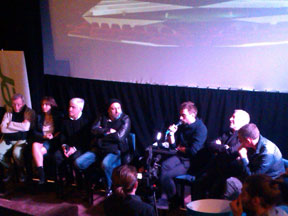
“Society mutated,” the participants in the round table decided “Why do people don’t want to read books?” It was organized as part of the Builders contest , which is held by the BURO17 Production Agency and the Federal Agency for Press and Mass Communications. The discussion was attended by musician Andrei Makarevich, writer Viktor Erofeev, publisher Oleg Novikov, PR Director and Microsoft corporate communications in Russia Marina Levina, adviser to the President of the Skolkovo Foundation Alexander Turkot and others.
Before the discussion, Alexander Voropaev, head of the department of book exhibitions and propaganda of reading the Federal Press Agency Imas communications in Russia , with the help of statistics showed that the problem was not invented. “In the Soviet years, our country was considered the most reading in the world ... In the late 80s, more than 50% of the population of our country considered themselves active readers. These are those who read fiction. But since the 90s, the percentage of reading people began to fall rapidly. And the state realized this problem quite late, only by the beginning of the 2000s. By that time, only 30% of the population considered themselves actively reading themselves, ”he said.
Now, according to Voropaev, our government has been worried about why people began to read less. As a result, they came to the conclusion that the problem in teachers who work with children of the 20th century. As one of the measures to correct the situation, a competition of bookmelles was organized-video trailers to books. Voropaev hopes that they will become just the “breakthrough technology” that will make the youth sit behind the books.
During the event, some of the bookmarians were shown to the participants in the discussion, but they evoked mixed feelings. It seemed to some that they were too simplifying the meaning of books.
I must say that a single discussion did not work. Firstly, the question was not fully determined, what is still understood by books-texts in any form or precisely book publications. Secondly, it turned out that not all participants in the discussion believe that not reading youth is flawed.
Andrei Makarevich noted that in his time the books were one of the few accessible “outlets” for man. But now people are reading less. “The process is planetary. Humanity is mutating ... Books, for sure, will go into the past, but we are able to delay this process. ” And Alexander Brener, head of the Brener agency Communications , noted that his daughter reads little books, but at the same time she does not fall so much, since she simply draws information from other sources. In general, many agreed with the fact of the "mutation" of the society.
But the participants in the discussion are different in this fact. Victor Erofeev clearly does not like this: “In today's generation, the culture ended in the form in which we imagined it for many centuries.” The writer perceives the refusal of reading as a “stunning” of the planet. He complained that the topic of existence is no longer interested in modern readers. According to Erofeev, they are more interesting to “rzhaka”.
Publisher Oleg Novikov noted that the Internet and modern technologies do not carry anything bad - they simply change the reading format, but do not destroy it. It is the Internet, according to Novikov, that can help make reading "fashionable". He believes that there is nothing wrong with the fact that people first read the popular literature of low quality, since then they often switch to high -quality literature.
Marina Levina, like Novikov, believes, modern technologies do not destroy the need for reading. She also noted that they give rise to a new type of literature, bringing blogs as an example.
As a result, it was recognized that the Internet is not such a competitor to reading, but for novice authors, an ally is more likely. In a conversation with the Polit.ru correspondent, after the discussion, Oleg Novikov also mentioned this moment: “The Internet helps not only read more, but also write your works and represent them. And we, publishers, see that people read, and this is information for us that helps to find potential new authors. ”
The question is, whether the planet is caressed if the books are a thing of the past, and readers-on the Internet, still remains open. As well as the effectiveness of bookmarians to improve statistics.