
Translated material
New types of crop
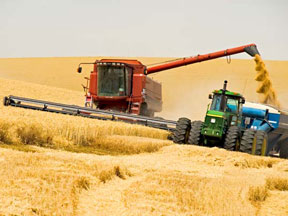
In the last agricultural season, the agrarian sector has grown a crop, which is usually called medium - only 72 million tons against normal 75 million tons and super -high 100 million tons. True, it should be noted that this relatively modest collection of grains will not produce large perturbations in the country's food market, since in the prevailing order of use of the resulting harvest, it should be enough for all our needs.
The procedure for using the gross fee, which developed after 2001, when we began a series of relatively high yields, and grain imports were replaced by their export, it is watching. First, the internal needs of the Russian economy in grain are covered from the gross fee. Then the state purchases part of the grain to create public reserves. The rest of the collection is sent for export.
It is clear that exports and stocks are balancing (or compensatory) articles. If in this agricultural year there is a crop failure, then exports can be limited or even completely discontinued. If export restrictions are not enough, then grain reserves can be used. Further, if the grain reserves are lacking, internal needs can be covered due to imports, since with foreign exchange reserves, due to which it will be paid, everything is fine with us. And, at the worst end, you will still have to reduce domestic consumption.
True, the line is unlikely to ever come to a thin end, because the internal consumption of grain in the Russian economy is quite stable, and it is almost always less than even the most “mediocre” crop. The reasons for this relatively low stability are the topic of a separate conversation, now we will only indicate that over the past seven years, domestic consumption has been an average of 69 million tons, with fluctuations around this number in plus/minus 3 million tons, depending on whether a yield year or lean.
Although in our country it is still customary to evaluate the harvest from the perspective whether it is enough to eat people to the next harvest or not enough, we must admit that this approach is outdated for a long time, and the crop should be evaluated by another criterion: is it enough to feed livestock or not? But this criterion, unfortunately, has not yet entered the consciousness of the wide masses of consumers. For some reason, it is still believed that the human body is more interested in bread, cereals, pasta, sugar and ethyl alcohol than in meat, milk and eggs. Therefore, interest in the crop, if it exists, is mainly reduced to grain crops suitable for food production. There is practically no interest in grain, suitable for the production of feed. And in vain.
If a crop is received, which is enough by cattle until the next season, then you can no longer worry about people. But if the crop is weak, and the cattle of food resources will not be enough, then people's consumption will be reduced. To contract, because part of the cattle will have to be put under the knife due to a lack of feed. This will, of course, give a temporary increase in the supply of meat, but then it will immediately lead to a fall in the production of milk and eggs. And then, when additional meat is eaten, its consumption will also be reduced, since you will have to wait for a while until the number is restored. And only then the population will be able to reach the previous size of the consumption of meat and milk products.
Another thing is if, due to a weak crop, it will be necessary to reduce the consumption of bakery products, pasta and cereals. There is nothing wrong with this, but for many people it will be even useful. However, this consumption has long been reduced, and in the first place in the consumption of grain we have only cattle - and with horns and without them.
If you look at the structure of domestic consumption of grain over the same last seven years, then at the feed (both grain, and in the form of waste processing, and in the form of compound feeds) it goes 55%, for food purposes (production of flour and cereals) - 25%for seeds - 15%. That is, grain for food purposes (this is 16-18 million tons per year) we occupy a completely insignificant part of the total production of grain crops, and in the total volume of their consumption. Therefore, repeating, we can say that the main thing for consumers of food products is the availability of resources for the production of feed. And by resources for the production of bread, pasta and porridge, we are careless in full.
Given these circumstances, we can consider the question of whether the 2012 crop grain is enough to satisfy internal needs. If the crop is 72 million tons. With an internal needs of 69 million tons, it is obvious that these needs are completely covered. True, practically nothing remains for export. And this is very bad, since it is advisable to take out our traditional 10-15 million tons to the external market. This is necessary in order to earn money and retain the previous buyers, and not to repeat the 2010 scandal, when export contracts had to break out due to the embargo.
So far, apparently, the government will not introduce an embargo for export, as it did in the truly lean 2010, when only 61 million tons were collected. Apparently, the food authorities so far believe that the crop of the current year, together with the overhead reserves of the year of the past, is quite enough to provide internal needs and allocate the necessary resources to grain exporters. At the beginning of October 2012, the reserves amounted to 35.8 million tons, which, together with a crop of 72.2 million tons, gives 108 million tons. common resources. They will be enough to satisfy both internal and external demand. True, the transitional reserves are still less than last year, when they amounted to 48.5 million tons (at the beginning of October 2011), but this difference is uncritical. Yes, and, in the end, you can always introduce certain fragments for export (restrictions, not the embargo!), Especially since 11 million tons were already sent for export in the first half of 2012. Thus, both domestic and external consumers of Russian grain will be satisfied, although the latter will not receive it in full.