Date
Author
Израильский блог на русском языке
Source

Preserved copy
Translated material
Israel: panic and rage
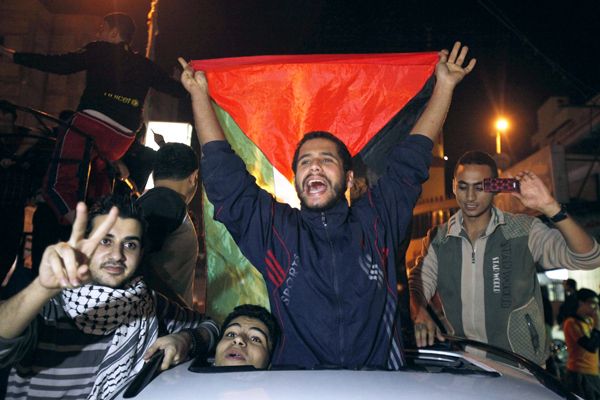 Photo: Reuters
At nine o’clock in the evening, an agreement on a truce entered into force. After 1000 missiles launched through the cities of Israel, and more than 1,500 Air States of the Israeli Air Force in the gas sector announced the ceasefire.
The agreement, which caused a storm of dissatisfaction in Israel, has become a real holiday in Gaza, where thousands of people entered the streets. Echoes of the festive firing in the air using the already familiar “tasams” were clearly audible in the cities of the south of Israel. The system of early warning also recorded them, continuing to turn on the air anxiety signal in border settlements. However, the missiles were launched not only into the air. The Iron Dome Air Defense System intercepted a missile released along Ashdod. Another 13 missiles exploded in open areas.
The cessation of a military operation, which at various polls supported from 75 to 90 percent of the population, was perceived in society with misunderstanding. If the south of the country was not in martial law, demonstrations of protest would immediately begin. But the rear service for another day prescribes to stay near the shelters, the children do not go to school and prohibits any type of gathering. Therefore, criticism of the government is still spilled onto the pages of social networks.
Around midnight, several dozen residents of the Odrot still went out into the street with anti -government slogans. On the posters it was written "Bibi - Home" and "The people requires a ground operation." Mini-demonstrations took place in Kiryat-Malaahs and Ashkelon.
Not only ordinary citizens, but also the heads of regional councils of the south of the country and mayors of cities are perplexed. Rubik Danilovich, the mayor of Beer-Shva, many times stated that they want complete calm in the south and would not even agree to single missile shelling. In his opinion, the ceasefire was declared before this goal was achieved. A similar opinion is shared by his colleagues from Ashkelon, Deerot, Ofakim and other cities of the south of the country.
The fact that the agreement on a truce was signed on a day that began with a terrorist attack in Tel Aviva added indignation. To the right of the exploding bus is the General Staff, on the left - the museum complex, opera and chamber theaters, nearby - the district court. In several tens of meters-three Azrieli towers, a symbol of Tel Aviv, nearby offices and studios of the GOSTELEDIO and Hospital "Ichilov". There were 28 victims in a terrorist attack.
Zion Amir, a well -known Israeli lawyer, whose office windows overlook the place of attack, says: "This is a crazy, absurd picture. We saw this in the past, but today it does not fit in the head. A very heavy sight." Amir says that all the windows in the office trembled with the strength of the explosion and for a moment the inhabitants decided that the rocket had fallen, and the early warning system simply did not work. “I went downstairs and realized that this was no rocket,” he says.
Meanwhile, the degree of panic in the city began to go off the way. Residents reported the second explosion, but this information was not confirmed. In the city, driven by social networks as a fair wind, a rumor crawled about a terrorist with a suicide belt, walking around the city in search of a place to carry out a terrorist attack. The police blocked the streets adjacent to the avenue where the bus exploded. However, instead of a transport collapse characteristic of such cases, silence reigned on the roads. "Like Saturday," was the first association.
In public transport, tension was especially acute. Passengers of buses (and on this day there were also much less than usual) were stared at everyone who came in. The appearance of the Arabs caused a nervous fidget. "Is this so guarded us?" - Young people grumble at the entrance to the shopping center, after the guard is not enough, in their opinion, carefully studied the contents of the girl’s bag. At the same time, police cars, motorcycles and scooters stood in Tel Aviv at almost every intersection and in all public buildings. A police helicopter wrote out circles above the city.
“I remember how 10-15 years ago my mother did not let me go to the street, and then at the discos,” recalls Liat, the 27-year-old administrator of one of the office buildings. Her childhood and youth fell at the height of the second intifada, when the explosions rattled several times a week. Now she is most uncomfortable to go outside, and she prefers not to think about the need to return home by bus at the end of the day.
Puzzled Russian -speaking tourists walk around the city. “Well, you give,” says Sergey, only yesterday arrived from Yekaterinburg. He is not going to shorten his visit to Tel Aviv: “Nobody canceled the sun and the sea,” and carefully admonents: “You stay here.” He seems to be sure that bombs and missiles intended for the Israelis are not threatened for everyone else.