
Translated material
The Kazarka flew
Kamchatka ornithologist "resurrected" the extinct species of birds
The work on the rescue of the rare birds of the Kamchatka ornithologist Nikolai Gerasimov in Russia is known much less than about the glorious affairs of Vladimir Vladimirovich Putin, who taught the Red Book Cranes (Sterhov) to fly correctly. But Gerasimov is well aware of, for example, in Japan. After all, he, in fact, committed the impossible: he returned to life the population of the Gusini detachment - the Aleutian Canadian Kazarka that disappeared in Asia. For the sake of saving geese, he had to sacrifice twenty years of his life. But today he does not regret it
The work on the rescue of the rare birds of the Kamchatka ornithologist Nikolai Gerasimov in Russia is known much less than about the glorious affairs of Vladimir Vladimirovich Putin, who taught the Red Book Cranes (Sterhov) to fly correctly. But Gerasimov is well aware of, for example, in Japan. There they even released calendars and souvenir medals with the image of a Russian scientist. After all, he, in fact, committed the impossible: he returned to life the population of the Gusini detachment - the Aleutian Canadian Kazarka that disappeared in Asia. For the sake of saving geese, he had to sacrifice twenty years of his life, a unique collection of brands, almost all the savings. But today he does not regret it.
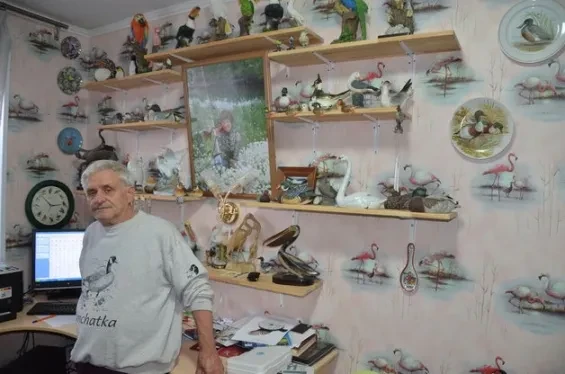
This story began in 1989. Nikolai Gerasimov first ended up abroad - in Japan. In the zoo of the city of Sendai, he saw miniature and surprisingly beautiful birds. “I looked at them for a long time and could not understand what force prevents me from leaving,” the ornithologist recalls. “Did I know that at that moment my fate was determined for many years?”
I will add that it was then that the fate of the barracks, which previously developed very tragically, was determined. For centuries, these birds lived peacefully on the islands in the northern part of the Pacific Ocean along with the cormorants and cows of Steller. Probably, they would have lived there today, if one day a rational person had not stepped on the commanders. At first, people destroyed the cow, then cormorant. The turn came to the barracks, whose meat was to the taste of sailors. Together with sailors, rats sailed on ships. The rodents moved to land and also began to exterminate the original island inhabitants without measure. In the seventies of the last century, it was believed that no more than a dozen barracks survived on Earth.
However, the incredible happened. On one of the islands of the Aleutian ridge, a miraculous goose flock was discovered. Several dozens of individuals from it migrated to the US and Japan zoos. But it was not possible to revive the population in Asia. Then Gerasimov offered his help to foreign colleagues. “In order for the barracks there is a chance of salvation, you need to settle them in the historical homeland,” he said. “They can live and educate offspring, for example, in Kamchatka, and they will fly to you in the winter - in the warm edges.”
After two years of negotiations, the Americans agreed to provide a scientist from Russia with rare birds. But only if the Kamchatka creates ideal conditions for their content.
Gerasimov took up the construction of the farm. The land and materials were provided to him by the entrepreneur Anatoly Kovalenkov. The nursery managed to build in two seasons. When the first batch of birds was taken to Kamchatka in 1992, everything was ready for their living. But the ornithologist himself was nowhere to spend the night. He had to sleep in a winter house with the barracks.
Over time, the Japanese trusted their birds. True, the money for a joint project was not given immediately. And in Russian customs they demanded three thousand dollars for the transport of valuable cargo. The ornithologist has never held such amounts of convertible currency even in his hands before. But he managed to agree with the customs management. Birds were designed for free - "by temporary import." Gerasimov convinced the customs officers that the cargo arrives at Kamchatka forever - in the fall he would go to Japan again. Moreover, by their own and bypassing customs.
... The first message about the arrival of four cameras Nikolai Nikolaevich raised in the nursery in Japan received on December 31, 1996 - a New Year's gift. But in the winter of 2002-2003, out of 70 geese released, only three flew to Japan. Gerasimov could not understand where the birds disappear? But suddenly he dawned on him: hunters! He did not take into account their danger in the southern Kurils. Sakhalin's hunting experts have confirmed the assumptions of the Kamchatka ornithologist.
But the main danger to the project was still not hunters, but money. Rather, their absence. In difficult times, Gerasimov was forced to sell to speculators the most valuable part of his collection of brands, which he collected for 50 years. Then he lowered the collection of coins for nothing. The proceeds went to feed the geese ... When it became very tight, the scientist succumbed to the persuasion of friends and put a donation box in the farm courtyard.
In early January 2000, a young woman surrounded by security guards and photojournalists appeared in the nursery. Nikolai Nikolayevich was not warned about the visit. But he, as usual, conducted an excursion, spoke about the geese.
- Tell me, who needs all this? The lady suddenly asked.
- And what do you think: mosquitoes are needed in nature? - Gerasimov answered with a question to the question.
- ... Need.
- If mosquitoes are needed in nature, can we come to terms with this beautiful bird to disappear? But you are still young. Over time, you will understand who needs it and why ...
The woman thanked the scientist and left with his retinue.
“What understanding of our tasks and difficulties can be expected from some sniffing officials of Kamchatka, if the question is:“ And who needs all this? ” “The future first lady of Russia asked,” the ornithologist was indignant.
By the way, in the first decade of work, none of the Russian VIPs left a ruble in it - why did the birds have money? Gerasimov says that he was always funny to watch how some tall guest tries to get away from the drawer for donations and his back to him.
... However, not only VIP clients came to excursions.
Once in a nursery, children from a boarding school with slow intellectual development were visiting. Seeing the box in which the banknotes lay, they began to get their coins and tried vied with who before, to throw them into the “piggy bank”. The owner of the farm tried to protest. “Do not stop them,” said the teacher. “They want to help birds.”
Over the years of life with wild geese, Nikolai Gerasimov and his wife Alla suffered a lot - floods, snow blocks, theft of birds from aviary. But they continued to patiently grow the goslings, gave them the opportunity to get stronger, taken to the island of Ekarma of the Kuril ridge - and let them go into the wild.
However, by the middle of the zero, the project once again ended up on the verge of closing. There was not enough food for birds, the money was over, and there was nothing to sell Gerasimov. But once a middle -aged man accidentally wandered to the farm. Carefully looking at the birds, the guest asked what they eat, and added that he would pay all the goose food. As the scientist later found out, it was the director of the Peter and Paul Sea Commercial Port Alexander Ivancha. And soon the World Wildlife Fund (WWF) allocated a grant - 10 thousand dollars. WWF helped the ornithologist both in the future and in 2007 his project was recognized as the best project of the Fund in Russia. It was a well -deserved reward. After all, the extinct population of birds was restored for the first time in the recent history of our country. And since then no one has succeeded like that more.
... For several years in a row, the number of Aleutian barracks has been growing steadily. In Japan, they saw flocks of 60 or more birds. It is known about the wintering of geese on the Korean Peninsula. The most “lazy” barracks, as it turned out, generally decided not to fly anywhere, they winter in the Kuril Islands. Now they do not need the help of Gerasimov. His unique project last year was closed. The goose farm is empty ...
- Do you regret the 20 years spent on geese? I asked the 76-year-old ornithologist.
- Of course, no. I was engaged in my beloved, interesting and very important work. In addition, I was not alone. I do not like it when they say "Gerasimov's project." It was not mine, but our project. Dozens of people led him. My first and most important assistant was the wife of Alya. We were helped by scientists from different countries, businessmen, and sometimes even officials and deputies. I am immensely grateful to all these people. Without their help, nothing would have happened.
- You at one time did not answer the question of one lady: "Who needs all this?"
- This is with you. Every day, the earth irrevocably loses several species of plants and animals. Now we do not notice this process. But our descendants will notice him. When, for example, 100 species of birds remain on the planet, it will be too late to save them. And there is no one. Because people will die out before the birds.
Photo from the archive of Nikolai Gerasimov
P *. S. The material used fragments from the book of Nikolai and Alla Gerasimov “20 years with wild geese”. *