
Translated material
Kopeisk as a special case
Zeka in rubles, kopecks and other currencies
What is the benefit of the principle of inevitability of punishment, why there are so many prisoners in the United States, and in Russia there are so many jailers
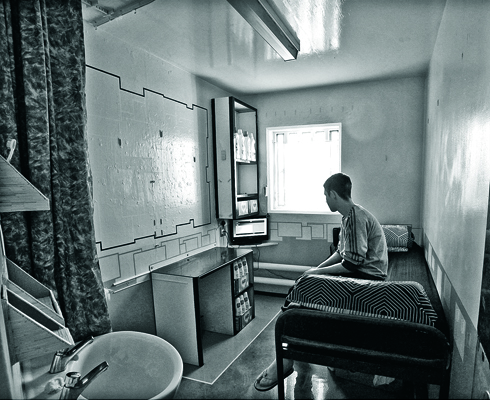 |
| Camera in Donkaster prison (UK) |
Paradise Conclusion
In many European countries, prison compared to Russian seem to be paradise. The number of prisoners (per 100 thousand inhabitants) in them, as a rule, is small, and the crime rate in Europe relatively low. Thanks to this, Europeans have the opportunity not only to keep criminals behind the barbed wire, but to purposefully engage in rehabilitation.
Here, for example, Kat Jones, creative director of the Second Shot Production film studio. This is a small social enterprise working with the inhabitants of the prison in Donkasters (Great Britain). Jones teaches prisoners to shoot and mount films - she is sure that after the prison they do not have to work as builders or gardeners. Criminal dramas, comedies with black humor and other film products of the studio are successful at festivals. The film studio is full -time, in the state - 20 prisoners and two recently freed.
A similar project in Liverpool, only Paul Maloni teaches prisoners to make educational radio. Ten prisoners produce 12 hours of radio programs per week, take an interview with their guards, and two after the conclusion they got a job on a commercial radio. All this activity is financed by grants of numerous funds that help the rehabilitation of convicts. There is such a project in Russia - media manager Alexander Lyubimov teaches computer animation of the inhabitants of the colony No. 32 in Perm. But this is a single project, but in Europe there are many.
In Denmark, says Olga Romanova, who recently studied the penitentiary system of this country along with the delegation of Rus Sitting, there is a violent discussion: should sexual services be provided in prisons, and if so, who should pay for them - the state or convicts? Everything else except freedom - comfortable cameras, TV, Internet and mobile phone - Danish prisoners already have.
The price of the issue
| Prison in California (for a year in terms of one prisoner) |
| Prison safety and maintenance costs - 56.7% |
| Administration - 7.4% |
| Expenses for prisoners (medicine, food, clothing, rehabilitation programs) - 35.8% |
| Source: The Legislative Analyst's Office (data for 2008-2009) |
But European budgets are already hardly cope with high standards of prison life. In the UK, for example, the costs of the law enforcement system reached 2.3% of GDP (even higher than in the USA and the EU), more than a third of this amount falls on prisons. The cost of annual maintenance in a prison of one prisoner is £ 39,600 (almost 2 million rubles), which is one and a half times higher than the average annual salary (after taxes). And if we also take into account the value of the trial and investigation per prisoner (£ 30 thousand), it turns out that these expenses
| Prison in Russia |
| Reason for jailers - 70% |
| Content of prisoners –19% |
| Ensuring the activities of prisons - 11% |
| Source: FSIN, Materials to the report of Anton Tabakh |
Exceed the average earnings by 2.5 times. Specialized justice is even more expensive, including juvenile and for women with children. Hence the criterion of effectiveness to prisons: it is evaluated by the number of relapses, and for private prisons that contain 13% of the prisoners, and their share is growing, a special formula for paying their services is provided: 10% of the fee are paid only if the “graduates” of these institutions, having gone out, demonstrate the desire to follow the law.
For those who have committed not too serious crimes, British justice prefers not to give a prison term, replacing it with public work or a conditional term. This not only reduces prisons, but also reduces the percentage of relapses.
In hell
When the conditions in which Anders Breivik, who killed 77 people (a camera with a simulator, a computer, and so on), the head of the Department of the FSIN Valery Boyarinev, was indignant, became known. “I do not understand this humanly. There should be no excesses, ”he said.
The logic of Boyarinev is understandable: what kind of punishment is this if a person is just imprisoned, and much more - as in the wild? It is this logic that explains all the horrors of our prisons, a pre -trial detention center and colonies, notes Elena Panfilova from Transparency International: It is believed that imprisonment is nonsense, this is no value.
To improve, the offender, according to this logic, must suffer, and in prison there is something to suffer from: bullying, household restrictions, the impossibility of dates. Interception of parcels, lack of library, Internet and phone. Lack of sanitary amenities, a ban on using audio and video equipment. Made of bunk grilles. Restrictions on the amount of clothes and bedding in the cell and the like. While the freedom of movement and the choice of habitat will not be considered independent values, it is unlikely that you can change something in the penitentiary system, Panfilova concludes.
The Russian prison built in this logic cannot and does not even try, unlike the British, to return the criminal to normal life. 30.6% of our prison “contingent” sits for the second time, 30.1% in the third and more and only 39.3% - “first -time”.
On the other side - three -room Danish cameras, where each prisoner is given a set of keys from their “number”. And the social responsibility of society: people in the will, for example, specially buy furniture made by prisoners in order to contribute to their return to normal life. “You must fulfill exactly the same functions that you performed in the wild, and the punishment is only in limitation or deprivation of freedom,” says Svetlana Bakhmina, who visited Danish prisons with the “sitting Russia”. This principle applies to mothers with children - instead of creating orphanages, Denmark prefer to create conditions for the child’s living in prison with their mother (including the playground) and pay for the child’s trips to a taxi to school and back. It turns out both cheaper and humane.
The FSIN system is not only inhuman - it is still monstrously ineffective. 70% of the costs of expenses that are attached to the prison system showed at the recent seminar “Prison Economy” in the Sakharov Center, economist Anton Tabach, goes to “Payments of Personnel”. 330 thousand people (for 717 thousand convicts) work in the FSIN: this is the second employer in the country after the “Russian Post”. One jailer we have on conditional 2.3 prisoners, while in the UK one for three, and in private prisons - one by 3.8. Actually, 19% of funds are spent on the maintenance of prisoners. Instead of using prison time in order to instill new skills to the prisoners (the main reason for the first crimes is a low salary), they, on the contrary, have a desire to work honestly, according to a note of the businessman-losing Alexei Kozlov, sent to this seminar.
Creating the visibility of employment for reports to the authorities, the prison administration satisfies any number of applications for hiring (the average salary for man-day, according to the Federal Penitentiary Service, 140 rubles). But in fact, “one salary and work will be sawed between several convicts, creating the appearance of employment,” Kozlov notes: the zone will receive good performance, paying the prisoners of a penny. When the jailers need to increase the indicator “The number of prisoners displayed for paid work”, they give work to a larger number of prisoners, while underestimating their payment. And when it is necessary to increase the indicator characterizing the earnings of prisoners, the number of employees is reduced. Since the labor force is very cheap, the prison administration can be enriched with the impulse of the convicts, and receiving a “rollback” from the buyer. “It is not very clear why this is called a zone, not a gang,” says Kozlov.
Film VS term
A little less than half a century ago, the Chicago economist, the Nobel laureate Gary Becker for the first time applied an economic approach to the crime problem. And he found out that state and private expenses for the prevention and investigation of crimes, the maintenance of criminals, etc. Only 2.5 times lower than direct damage from crime. And except for the “consumption of prohibited goods and services” (prostitution and drug use), then these expenses are approximately equal. And these segments, minus drug trafficking, experts believe, must be decriminalized. It turns out that society spends as much as it loses from it to fight crime.
Becker showed that for criminals - people with a very strong tendency to risk - the “profitability” of criminal activity is determined not so much by the severity of punishment as the probability of being caught (that is, the same inevitability of punishment). If a serious punishment threatens for a crime, but they are unlikely to be caught by a criminal, he can feel relatively calm.
The punishment for most crimes is usually harder (which is rational) than the crime itself. For example, the theft is punishable by a fine, an order of magnitude exceeding the stolen amount. The murder obviously falls out of this series, because in this case (if the death penalty is canceled in the country), the punishment is disproportionately less than the crime. From the economic analysis of crime, it follows that the introduction of the death penalty for the murder will lead to a reduction in their number, the economist of the Higher School of Economics Rostislav Kaplyushnikov notes, not calling, of course, to this step.
Bekker's study proposed to politicians several conclusions, which, however, they are in no hurry to use. Firstly, with a deficiency of resources, it is better to spend them on an effective system for preventing and identifying crimes than for the extra years of the content of those who have stumbled behind bars (if we are again not about encroachments on life and health). Secondly, when it comes to minor crimes, it is unreasonable to send the name for bars: it is more efficient to oblige him to pay a fine-the victim receives compensation, and the company does not spend funds on the maintenance of the criminal in places of imprisonment. At the same time, fines should be such as to more than compensate for the victims of the crimes of costs, and the company - the cost of detaining and condemning criminals.
It is striking, it was in the USA that Bekker did not hear - now they occupy a stable first place in terms of the number of prowls of the population: 730 by 100 thousand (considering those under investigation). Russia in eighth place (498), nearby - Belarus (438) and Ukraine (432). In 221 countries, information about the prison systems of which is collected by the International Center for Prison Studies, on average this figure is almost three times lower than ours - 174 people. The more convicts in prisons, the more naturally, you have to spend more on their maintenance. And most importantly, the worse conditions for their content.
The giant prison population of the States (2.2 million - as the population of Houston) of many researchers is at a dead end. In countries with which the United States can be compared, this indicator is about 6 times lower. In the United States, the level of crime is relatively high. But, for example, the number of murders over the past 30 years has fallen from a maximum (10.2 per 100 thousand people a year - approximately like in modern Russia) to 5.5. And the number of prison prisoners is growing, despite a decrease in crime. Costs are growing. Since 1987, expenses on prisons, according to the Pew Center, have grown 4.3 times, to $ 52 billion even faster, according to Justice Policy Institute, the costs of police and courts grew. Together with expenses on prison, they now amount to $ 228 billion, while 30 years ago - $ 36 billion. Becker gives an explanation of this riddle: excessive criminalization of minor crimes and waste of law enforcement system to combat them - 48% of prisoners in the United States are sitting for crimes, one way or another associated with drugs. While to plant, the great economist believes, first of all, the crimes associated with violence follows, especially since the tendency to violence in the United States is higher than in Europe and Asia. This logic is 100% true for Russia.
The United States is going to this, but very slowly. In November, simultaneously with the presidential elections, the States of Colorado and Washington legalized marijuana. The legalization of mild crimes will reduce the number of severe, because the police will not “scatter”, and the risk of being caught will increase. Russia is moving in the opposite direction: an 8-year prison term for Taisiya Osipova is a visible example. Meanwhile, the disclosure of serious crimes, even according to official figures, is a little more than 50%. In the dry balance: neither human rights, nor economic expediency, nor security.
Photo: Reuters