
Translated material
The thin world
Israel. Gas. Report on both sides of the conflict
On November 21, at nine in the evening, Israel and Hamas signed an agreement on a truce. After that, another 20 more missiles were released from the gas sector for Israel
Text: Andrey Kozhinov, military analyst, Israel
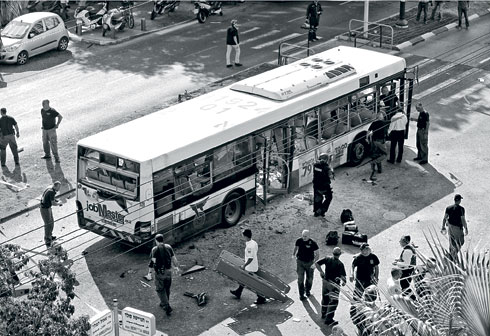
Tel Aviv, November 21. In the place of the attack
The Operation "Cloud Pillar" began on November 14. And already on the 18th in Cairo, Egyptian President Mohammed Murcy unequivocally made it clear that negotiations were underway. Egypt had previously played the role of an intermediary between Israel and the Palestinians. But if Mubaraku in 2009, during the operation of the IDF, “cast lead” in Gaza, it took 22 days to reconcile the sides, then Mursi was enough for eight. Mursi, unlike Mubarak, is able to influence both the army and Islamists. True, both Mubarak and now the main negotiators from the Egyptian side are intelligence leaders: then - General Suleiman, now - Rafat Shhat. He is a military man, but he has many years of ties with the Mossad. Ramadan Shalah, the head of the Islamic Jihad, Khaled Mashal, political leader Hamas, as well as an anonymous Israeli representative, apparently, who exactly was, in Israel, participated in Israel, participated in the Palestinian side.
Mursi showed himself as an honest intermediary: immediately after the start of the negotiations, the Egyptian army took control of all possible channels of smuggling weapons to gas. It became clear: in the event of an exacerbation of the situation, Egypt will not help the Palestinians with military means. Mursi, although sometimes resorts to Islamist rhetoric and even defiantly sent one of his ministers to Gaza as a sign of solidarity, he is actually a pragmatist. Israel believed Mursi for a word when during the negotiations the question arose that Egypt and the United States should make every effort to continue to stop the smuggling of weapons through the Sinai. No written obligations were required. On the other hand, Israel understands: Mursi needs $ 1.5 million American assistance annually, which is all tied to the Camp-David agreements. Therefore, Mursi will not revise the legacy of Sadat and Mubarak in regard to relations with Israel. An additional impulse was given an emergency visit to the US Secretary of State Hillary Clinton - after President Obama supported the efforts of Mursi.
The order to nominate to the borders of the Gaza, the elite parts of the ISAL received twice, and then suddenly the authorities commanded the hang up. This is a usual example of psychological pressure, to which both sides resort to: Hamas, seeking concessions, fired at Tel Aviv and Jerusalem, Israel threatens the introduction of troops.
When a bus in Tel Aviv was blown up at noon on the 21st, the draft agreement on the ceasefire was already ready. Public opinion was against a truce. What to do - to introduce troops into gas or signing under an agreement? Netanyahu decided not to increase the victims. The thin world is the smaller of evils. Conducting a ground operation, you achieve military goals. But from the point of view of strategic, state consequences, negative: increasing pressure of the international community, new victims, etc. And as a result, there are much worst positions when concluding a truce, which will still have to be concluded. Let us recall the operation “cast lead” in 2009 in Gaza: Israel introduced troops, then withdrew them, announcing a one-sided ceasefire. Recall the second Lebanese war: the entry of troops only worsened the situation. If you can agree without entering troops on acceptable ceasefire conditions, it should be done.
What do we have now? Hamas undertakes not to shell Israel with missiles and not initiate attacks from the gas sector. Israel - not to engage in point liquidations in the territory of the Gaza, do not introduce the troops deep into the sector, unlock the checkpoint on the border and facilitate the movement of people and goods from Gaza to Israel and vice versa. Of course, obscenities remain. What checkpoints are opened is incomprehensible. It is clear that the checkpoint between Israel and gas will not be completely unlocked. And Egypt does not need crowds of Palestinians in Sinai.
How much will the truce last? Maybe a week, or maybe six months ... Nobody will give accurate forecast. It is only clear that the next round of confrontation will certainly be, and maybe even more tough than the current one.
In June 2008, a truce was concluded for six months. But already in July, Palestinians launched eight missiles on Israel, in August - seven, in September - three, in October - four, in November - 148! In December, military operations began. And at the end of the year - the operation "cast lead". And after it, a truce and four months of relative silence again ...
How ordinary people lived these days - in the reports of The New Times on both sides of the conflict
15 seconds for salvation
Text: Anna Kogan, Tel Aviv-Ashdod-Speer.
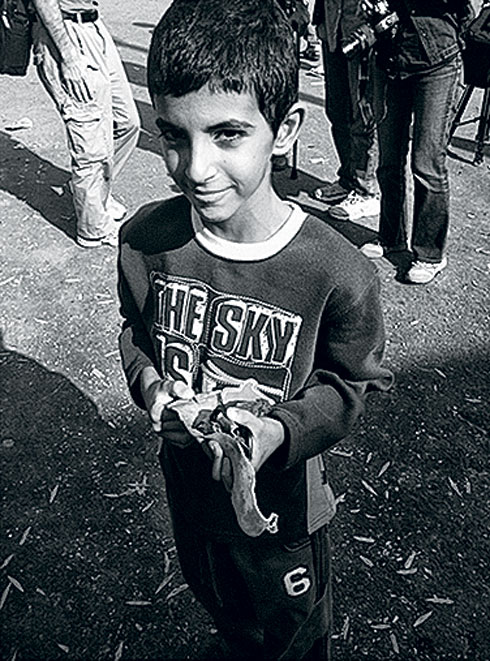
Deer. Ten -year -old Amitai holds in his hands a fragment of Kassama, which fell near his house
At noon on November 21, a bus was blown up in Tel Aviv: 21 people were wounded, one is hard. The next day, director Elena Mishuris wrote on her page on Facebook: “Last night I found out that my girlfriend had a son in Tel Aviv’s bus ... He was easily from the wounded. This means - it will live, as it is no longer important ... There is such a thing - the level of patience or suffering ... So, here it is monstrously high !!! / .../ Yesterday Egypt stopped the eyeliner of a new batch of rockets in gas ... The people are silent. Everyone understands that in two months everything will return. A feeling of hopelessness, hatred and fatigue ... "
November 15, Big Tel Aviv, Rothschild Boulevard . The center of life. An eternally buzzing, never sleeping city-holiday. Nobody believed that no one believed that rockets from gases are able to fly there. The first Air alarm in the last 20 years on the boulevard Rothschild shocked the hanging youth in shock.
“I just drove here,” says the driver of the taxi Alon, “when I heard the siren, I jumped out of the car and lay down directly to the ground.” The guys in the cafe rushed around where ... "
On the first day of the confrontation, the Israeli rear service issued special instructions: how many seconds people need to run to bomb shelter. On average - only 15 seconds.
November 16, Ashdod, "sleeping district" . On the exit from the city is a huge traffic jam, the inhabitants are leaving. There is not a soul on the streets. Long pure avenues, well -groomed flower beds. Almost all institutions in the city are closed. Residents are sitting in the cafe, nearby-a bank, at the entrance-a guard girl Nina.
Suddenly a strange growing sound is heard. “Come on here,” Nina shoved me into the bank building with a sharp movement. People silently and quickly went to the already open door of the office room, to the underground garage. We are fifteen people. No panic, no screams. For the inhabitants of Ashdod, Siren is a familiar thing. The people chatting about their own, smiles. Explosions are muffledly heard. “It's not scary at all,” I think.
Then I hear on the radio in the car that six missiles were released from the territory of Gaza in the direction of Ashdod. Two of them fell on the wasteland, four are shot down by the Iron Dome system. Five of these batteries are standing throughout the country. They are able to intercept missiles with a range of 5 to 70 km. Therefore, the most dangerous is considered to be at the disposal of Hamas Iranian rocket Fajar-5, capable of flying 75 km. For seven days of the war, the Iron Dome was malfunctioning several times: the effectiveness of the system entered in 2011 is estimated at 87%. In most cases, the missiles “lay down” outside the residential area. But one blunder turned out to be fatal: on November 15, in the town of Kiryat-Malahi, a direct hit of a rocket in a residential building cost the life of three Israelis.
November 19, Deer, 4 km from Gaza . The territory of the Gaza is visible from the hill on the outskirts of the city. Here the people live under constant shelling. The city is equipped with special outer bomb shelters, similar to bus stops. They are at every step. Siren sounds - running to this booth. Inside, almost nothing is heard what is happening from the outside. The structures are very durable and are able to withstand the direct hit of the projectile. It turned out that one of the missiles fell near the rural center and a small synagogue, the other turned the stone sidewalk, forming a small funnel. Very nearby residential buildings. Safety services, firefighters are already working here, an ambulance is standing. Although there is no fire or wounded.
Local boys always manage to arrive at the scene of the explosion first. Ten -year -old Amai lives in the house opposite. He proudly demonstrates today's trophy - a fragment of the Kassam rocket.
- And how many such pieces of iron do you have?
- Yes, twenty pieces ...
The sector of fear
Text: Taer Abu Oun, Gas
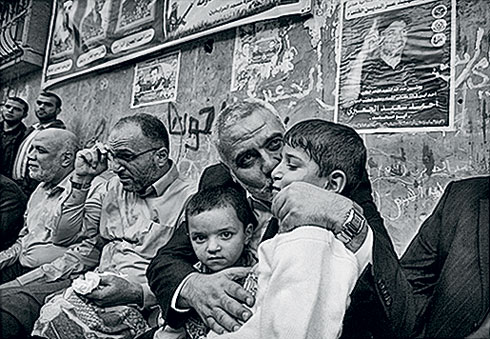
The head of the Gaza government of Ismail Khapiye consoles the children of Ahmed Jabiri, the murdered leader of the Khamas combat wing
November 16, gas . Two days have passed since the beginning of the war. The bombing does not stop either day or night.
Apartment buildings, mosques, gas stations - there are no logic of impacts. According to Israeli's statements, the main goals are Hamas military bases and movement leaders. But together with the Hamasovites, their families die, and sometimes unlucky neighbors. Hamed Alall complains to me: “At night, the Israeli F-16 fighter released a homing missile through my neighbors Aldala, who had nothing to do with Hamas. They died with nine children. What danger did they pose? "
November 18, gas, the area of an unknown soldier . Israeli fighters calmed down, an unusual silence hung in the air, violated only by the distant howl of the alarm of the forgotten car. The sun is hidden in the gray haze that enveloped the city: something is constantly smoking here. The blinds on the windows are omitted, schools, police areas do not show signs of life: gas has turned into a city of ghosts. People if they leave shelters, then in the most urgent matters: get some food in the office of a humanitarian organization or to run away to a market open for a couple of hours. In attacks - hide in the basements. In Israel, the house is equipped with special rooms in case of shelling, there is also a warning system, but nothing is in gas: they are hidden at the first explosions, in the same basements they die.
The silence does not last long. Shadows from rattling aircraft appear on the ground, rush to the ground, and a couple of meters explodes a car. The planes fly away, the car burns, black smoke covers his eyes, some kind of person runs up, asks if everything is in order, I feel myself, like yes, it is safe, only the elbow sads: I hit the asphalt.
November 19, gas . Most residents left the border areas, leaving for relatives. Three or four families were filled into apartments. Osman Abel lost two days ago his wife: “My house was next to the police station, so we left sin away. My wife and I distributed ten children from friends. The wife decided to return to the house to pick up some toys and baby food. Only she closed the door behind her, as Israeli planes blew up a police station, and a roof collapsed in our house. The wife died under the ruins, three children who were together with her managed to save. ”
November 20, al-Shifif, the largest hospital in Gaza . The wounded lie everywhere: in the corridors, in the lobby. Some groan, others are crazy, children's and female crying is heard from all ends, it smells of dirty bandages and death. “Hospitals cannot cope with such an influx of wounded,” explains the doctor and representative of the Ministry of Health Ashraf al-Kubra. - We have no doctors who could operate. There are not enough medicines, even bandages, not to mention anesthetics. We get medicines from Egypt, but they simply do not have time to bring the required amount. Electricity is constantly turned off, so that surgical operations have to be postponed, and it happens that patients do not live until the morning. ”
“We urge the world to make sure that Israel specially shoots at children and the elderly, like me to make our government make concessions,” says 60-year-old patient al-Shifa Ali al-Alem, to whom shelling was worth his hands.
Near Ali his ten -year -old grandson. “I am not afraid of the Israelis, I hate them,” the boy exclaims: the new generation of the Palestinians is ready for war.
November 22, 9 o’clock in the evening, the area of an unknown soldier . Gas is not recognized. The bombing, intense after the explosion of the bus in Tel Aviv, ended exactly five minutes before the signing of the truce. And after another five minutes, tens of thousands of people who shout, laugh, scolding into the air from machine guns, chanted: “The resistance won!” Founded, hug and waving flags. Residents of Gaza are sure: this is a victory! Is there a victory?
Photos: Reuters, Elena Shafran