
Translated material
Three Chechnya Jonathan Littlela
The publishing house Ad Marginem was “Chechnya. The third year ”is the second book of the author of“ Goodwriters ”, laureate of the two most prestigious French literary awards translated into Russian.
Jonathan Littlel is known for his dislike for interviews and makes rare exceptions only to talk about politics. The New Times managed to meet with the writer
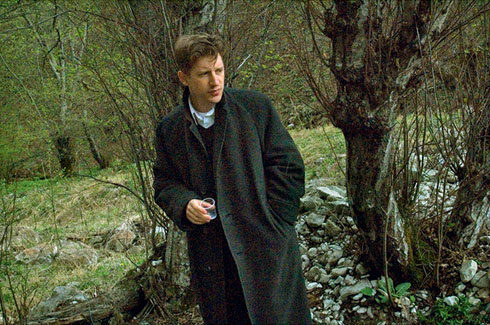 |
| Jonathan Litell in Chechnya |
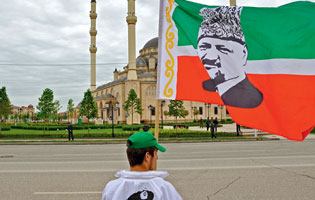 |
| Terrible: Kadyrov Sr. in Chechnya and today in the authority |
In 1994, Jonathan Littlel began working in the “Movement against Hunger” organization in Bosnia, and next decade this work brought him to a variety of hot spots in Asia, Africa and the Caucasus, where he returned repeatedly, where he fell under the shelling, was easily wounded by a fragment of his own car and barely avoided the abduction. In 2006, he published his first big novel by the "goodwriter", who immediately became a bestseller-due to a lack of paper for him in France, the seal of Harry Potter was suspended. The book brought him the Goncorov Prize and Grand Prix du Roman to the French Academy, and at the same time money and glory, but did not change either the way of life or the sphere of its interests. In recent years, Litell has been engaged in journalism - he made reports from the Georgian war, walked in the wake of the "Lord of the Resistance Army" in the Jungle of the Congo, and, reproaching his hair in black, illegally made his way to Syria to make a report from Homs seized by the rebels. In his free time, the writer lives in Barcelona, here we met with him.
How did you first find yourself in Grozny?
After I worked in Bosnia for two years, in early 1996 I was sent to Chechnya. I could refuse, but this was not accepted - we were sent to where help was needed, and Chechnya at that moment was considered a rather calm place. It was a period of lull, February, when constant demonstrations near the presidential palace were in Grozny. About a week after my arrival, the Russian army blew up the palace to deprive people of a place for fees, and in March the city attacked Gelaev - this was the first big attack on Grozny. Not an offensive even, but a rehearsal: the militants prepared the August capture of the city, experienced the Russian defense system.
For the first time I lived in Grozny for six months, I even had registration. Our organization distributed food - mostly abandoned Russian old people, there were about 30 thousand of them. We did not distinguish them according to the ethnic principle, we simply tried to feed the most helpless ones, which for the most part were lonely Russians - the Chechens were supported by relatives. Then I started working in the mountains, in the Vedensky district. Permissions were issued without problems, the Russians preferred to pretend that they control the entire republic. Usually, at the last checkpoint, the soldiers studied our papers with undisguised surprise, but let the cars go further - on the road littered with armored vehicles, where they themselves were afraid to stick their nose out.
Have you ever had problems?
The problems happened with Hattab, a couple of days before the death of Dudaev. His people destroyed the Russian column between Duba-Yurt and Chatea, near the village of Yaryshmard. This was the first action of Hattaba, in a couple of hours the Russians lost almost a hundred killed. We made a mistake - we drove along the same road only two days later, when Hattab returned to plunder fuel and ammunition. I never had bodyguards, because the best way to get a bullet is to walk next to armed people. But there was Nissan Patrol with an organization’s stickers, bought five days before $ 18 thousand - they took it away, allowing me to remove the stickers from the car and promised to return the jeep if I provide a letter of recommendation signed by Dudaev, Maskhadov or Basayev. The letter in which Maskhadov asked me to return the car to us, I got it, and after some time I met my own jeep on the street in Avturs. Hattab, to whom I presented this letter, put us facing the wall - he was very angry, and it was clear from the pupils that he was under the high. In general, I was glad that we were generally released - albeit without Nissan. Otherwise, the humanities did not interfere, although the Russians often accused us of conveying products to the militants. We explained that we supply hospitals, where they are treated including Russian wounded - it really was so. In the first war, the Chechens executed contractors, but they usually treated human soldiers humanly.
Different Chechnya
How different were the three Chechnya that you had to see in different years?
The second war was completely different - already because it was much more difficult to get to it. The abductions of people began, we had to be based in Ingushetia. And the war was much more cruel. The bombing intensified significantly, although at the same time there were less people, everyone scattered, no one else hoped that they would not bomb the civilian population. When the country was baptized with the ground, the Chechens were also greatly radicalized.
The third time I arrived in 2009 to write an essay about Ramzan Kadyrov for the French Le Monde. Shortly before that, I wrote about the war in Georgia, the translation was published in Russia - perhaps because it was the only large publication in the French press, which criticized the Georgian authorities. Probably, the Russians liked this, at least, I explain to myself the ease with which I received all the permission necessary for a trip to Chechnya.
The office of the Putin spokeswoman Peskov helped me in organizing the trip, but it was not possible to meet Kadyrov himself, his new spokeswoman, who appeared shortly before my arrival, seems to simply decided to throw it into the basket everything that was started by his predecessor. But we - to me and the photographer Thomas Dvorzhak - did not interfere, we could go where we wanted and meet someone we consider it necessary. In the end, I had a whole mountain of material, and then I decided to write not about Ramzan, but about his system - the task is actually much more interesting. There were so many material that instead of the conceived article, a small book turned out.
In the book you write that your vision has changed sharply after the murder of Natalia Estemirova. What was explained by the initial delight - the naivety of a foreigner or the desire to believe in the best?
On my second arrival in the Terrible city lay in ruins. In 2009, I saw another city, drove the streets and could not find out anything. Friends said that life became much better - it really could not even be compared with the times when the Russians killed the Chechens just like that, in passing, as, for example, Zakhar Prilepin describes this in his book.
The country was rebuilt, life was established in it, but this life also had a dark side, which became especially noticeable after the murder of Natasha. This made me rewrite some parts. Before that, talking with the employees of the Memorial, I thought they were a little exaggerated. I thought that the matter was in the wrong perspective, that these guys have been involved in the problem of human rights violations for too long and did not want to notice the rest. It can be called this naivety, but you can - the difference in points of view. In the same way, some Chechens evaluate the current state of affairs as a victory, and others as a defeat. For those who with Ramzan, life, of course, has become better. But those who are not with him, who do not want to agree with Ramzan in everything or are simply not ready to give his business to him-they were in shit, truly deep shit.
The people you interviewed were intimidated?
No, I would not say that. Most of the former militants are not afraid of anything: they travel to their Toyota Kami with leather seats, play billiards and seem quite satisfied with life. Although Magomet Khanbiev, a field commander who crossed the side of the authorities after the dozens of his relatives were abducted, refused to discuss the reasons with me that prompted him to change the parties. It was an interesting meeting - I had never met Mohammed before, although for many years I was familiar with his brother Umar. I tried to ask him about Ramzan, but every time he left a direct answer. Umar, a very respected person, former the representative of Maskhadov abroad, also returned. He is engaged in medicine, does not intervene in politics, but his return from Europe was so serious for Kadyrov that he personally met him at the airport in Moscow. Umar also avoids conversations about politics: he says that his task is to reorganize the approach to surgery in the republic, that Kadyrov helps him cope with this task. And point.
And with Shaa Turlaev, one of the people closest to Ramzan, you did not meet?
No, I could not. Shaa does not like meetings with journalists, although I tried to meet him even before he was officially connected with the murder of Umar Israilov committed in Vienna, a man whose testimonies confirmed the participation of the Kadyrovsky administration in torture and abductions. I am sorry that this meeting did not take place - the story of the relationship between Ramzan Kadyrov with Shaa Turlaev seems to me very important for understanding what is happening today in Chechnya. At the end of the war, the seriously wounded Turlaev fell into the hands of the Kadyrovites, his deadly enemies. It didn’t fit in my head how they could make friends, until I realized that they met many years before. Ramzan was the head of his father, who often met with Maskhadov for a long time in 1998-1999, when they opposed the Wahhabis together. Turblaev was then the head of the Maskhadov security, and during these meetings both security traditionally waited for their bosses together in a separate room - they had time to talk. When the war ended and there were no political grounds for enmity, these connections were restored - and this is a very good example of how bizarre and multifaceted can be alliances concluded by these people. Relations depend on teip, on financial interests, on marriage ties and personal friendship - literally everything is taken into account.
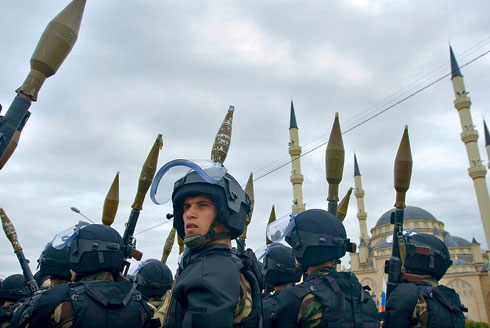
May 9, Victory Day. Army of Chechnya
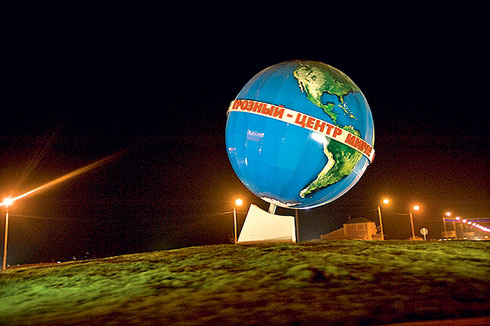 |
| Building slogan "Grozny - Center for the World" |
Destroyed way
Has your attitude to Chechens changed when they began to change allies at such a speed?
I have never evaluated them in the terms “good -plane”, but recently the Chechens have changed a lot. This is a normal process, we can observe it everywhere where military operations were delayed in Afghanistan, for example. The war destroys traditions, and Kadyrov’s policy rests on intentional violence, it was part of the general Russian strategy in Chechnya. This policy destroys the ways that made Chechens with such a kind of people. During the First War, the Chechens for the most part adhered to an incredibly tough code of honor. There were clear rules that regulated their attitude to elders, to men and women, to foreigners, to people from other teips - everything was clearly codified. Chechen youth absorbed these rules since childhood, they were driven into their heads and uncles on the maternal line, and the community exercised social control over their performance. In both wars, psychopaths came across. I do not mean clinically ill, but those who did not obey the rules developed by the centuries, who, without hesitation, killed other Chechens, did not reckon with bloody revenge, insulted the elderly. In the first war, such a man was Ruslan Labazanov, in the second - Arbi Baraev, and now - Ramzan, who was able to publicly beat an elderly person whom his father considered a friend. Today's young guys were five years old when the war began. Many parents and older brothers died, these are young men who grew up in refugee camps, without a hitch. Add to this acute religiosity and radicalization - and you will receive a new model of behavior, in which, for example, it is considered normal to shoot with paintball balls in “incorrectly” dressed women. This is completely incompatible with the Chechen tradition, in which actually it is supposed to kill a person who offended your wife or daughter. A man can be dissatisfied with how a woman dresses - but he should not discuss it with her, he must go to her father or husband and make his complaints to him, and he is already free to listen or send him to the line.
I know the countless number of stories about how the Chechens are faithful to their word, and I myself have repeatedly trusted the Chechens under honestly my life, to some, without hesitation, I trust it now. But now I’ll think about ten times before you believe the word to the young Chechens, about whom I do not know anything. And this is not only a phenomenon, but also the result of a well -thought -out Russian policy to destroy what was the essence of the Chechen society, which made it so difficult to control. Unfortunately, this allows us to talk not only about physical, but also about cultural genocide.
The changed attitude towards a woman - “killing honor”, an increasingly open polygamy, increasingly closed scarves - is it not an attempt to humiliated men to recoup those who did not run into the forest, but faced danger to face face?
During the war, Chechen women gained unprecedented independence. The refugee camps were entirely held on them - the men were paralyzed, women supported families and mined food. During the war, they became strong - perhaps even reached the degree of independence that they never had. In men, this caused indignation, which overlapped humiliation from defeat in the war - and it, in turn, caused a desire to return the woman to her place. But the Ramzan project, upon returning to the old values, is a fiction. The past to which he strives, invented, never existing. Take a look at the photos of Chechens of the 70s: these are ordinary Soviet people. I remember the market in Grozny during the first war-a girl in mini-skirts, underwear shines through the transparent blouses. They could not touch them - but it was possible to look at them. Now Ramzan put them all in dresses to the heels.
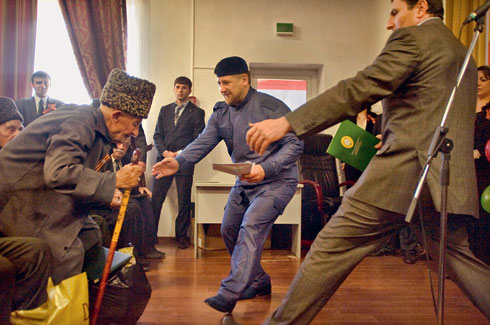 |
| President Kadyrov is emphasized by the elders |
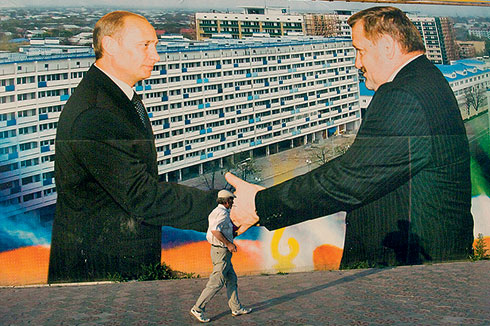 |
| Restored Grozny - a trump card of power |
Islamic map
What gives Kadyrov flirting with Islam?
I think this is not his own idea. He himself claimed that his father had left him such instructions before his death. Something was probably invented together with Surkov, who was deeply engaged in the new Chechen ideology, until other things distracted him. Initially, the idea was to use the traditional Sufi Islam in contrast to Wahhabism. But as a result, the Sufia turned out to be so dependent on the state that they were no longer believed. Young people go to the Wahhabis just because there is no respected alternative around, which is not completely under the Ramzanovsky control. But physically crushing the opposition, Ramzan did not achieve its disappearance - he simply dispersed her east and west. And the greater the pressure, the stronger the society is more radical-we see it in Dagestan, Ingushetia, in Kabardino-Balkaria. This is not a solution to the problem, but creating one problem on the site of one.
However, those who calls for militants to stop the struggle claim just that thanks to Kadyrov, all the goals of the Chechen resistance were achieved.
This is the nonsense that Ramzan is trying to sell to emerging from the forest: "I have achieved all that you fought for." In fact, Chechen nationalism never rely on Islam: it is known that Dudaev, for example, was completely ignorant in religious issues. The ideological base under the requirement of independence was more likely ethical - the Chechens never obeyed Russia, did not want to recognize its superiority and, in contrast, say, they never signed agreements that recognize such addiction. Real independence displays the problem to the international level - the war becomes an international affair, and not the internal problem of Russia. The Kadyrov government did not achieve such independence - this means that the Russians can return when they want or as soon as the situation worsens. And there is no doubt that she inevitably worsens. At the same time, Kadyrov Sr. was a truly authoritative person-that is why he managed to take power. But he knew how to play his cards - while his son was only able to arrange noisy tricks or torture and kill people.
Gifts of Ramzan
Speaking of techniques - how in the West they relate to a recent visit to the Terrible Gerard Depardieu, who shouted from the Slava Ramzan scene and other similar stories?
The West forgot about Chechnya, here they want to hear only good about her, only news that allow you to drown out guilt. The stars get a lot of money for traveling to Grozny to portray anything that do not understand anything, although this does not apply to Depardieu-he is actually an idiot, unacceptable. It seems to me that all these people are just incredibly greedy bastards who do not find the strength to refuse when someone offers them a million for just standing at a party. The same thing, by the way, applies to Russian artists and journalists accepting hours and foreign cars as a gift: Ramzan is generous, especially when it comes to state -owned money. Since we never met, I had no chance to check how resistant to gifts I myself But it’s hard for me to imagine that I would go to Chechnya to Porsche Cayen-this is, in general, not my style. In general, gifts are an interesting question. Насколько я понимаю, подарок Рамзана — это в принципе не та вещь, от которой человек в своем уме может просто так отказаться. Речь, конечно, о местных, на иностранцев это не распространяется.
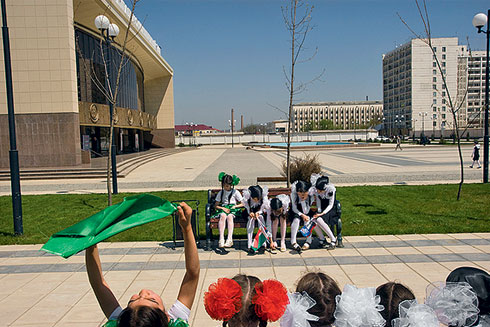 |
| Terrible. Площадь перед новым театрально-концертным залом |
Что вы думаете об отношениях Кадырова и Путина?
О, это похоже на французский детский стишок: «Мы держим друг друга за бороды, и кто рассмеется первым, получит пощечину». То, что Кадыров может дать Путину, стоит гораздо больше тех сумм, в которые обходится Москве его содержание. Но обходится оно в копеечку — Кадыров захватывает бизнес в Пятигорске и других южных городах, создает массу проблем с ростовской мафией и бизнесменами, пытается получить долю в олимпийских стройках.
Власть в России, в том числе в Ростове и Краснодаре, полностью приватизирована. Олимпийские игры — просто еще один способ заработка для некоторых людей. И тут Рамзан создает массу проблем, потому что его жадность почти нельзя контролировать. Он создает проблемы и Сечину — ему ведь тоже нужна нефть, создает проблемы силовикам, пытаясь установить над ними полный контроль. В результате Путину приходится постоянно его покрывать, но в ответ Рамзан дает ему возможность утверждать, что проблем в Чечне больше нет. В этой хрупкой системе ни один из них не может существовать без другого — так же как вся политическая система в России не может существовать без Путина. Уберите Путина — и все в России рассыпется. Уберите Рамзана — и рассыпется стабильность в Чечне.
Многое, конечно, зависит от обстоятельств — если Кадырова убьют боевики, возможно, России удастся обеспечить передачу власти Адаму Делимханову или другому близкому к нему человеку, сохранив баланс клановых интересов. Но если Рамзана попытаются убрать сами русские, сценарий будет другим. Говорят, он сам предупреждает сторонников: если услышите, что я попал в автокатастрофу, бегите немедленно, иначе вам крышка. То есть в случае его смерти 25 тыс. человек могут на следующий день уйти в лес или напасть на российские базы.
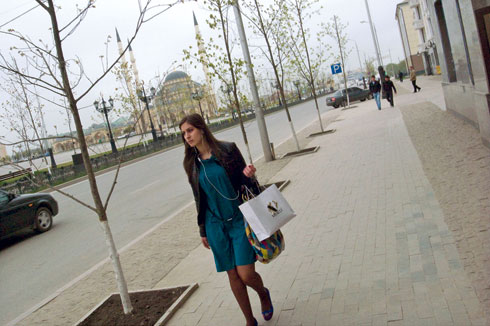 |
| Грозный, проспект Путина |
Суд в Австрии официально связал убийство Умара Исраилова с кадыровской администрацией. Другой нашумевший процесс этого года — суд над Чарльзом Тейлором, впервые в истории добившимся осуждения еще живого президента. Можем ли мы стать свидетелями чего-то подобного?
Во Франции, стране, которую я хорошо знаю, у властей выработалось достаточно верное понимание ситуации: сегодня те, кому Кадыров на самом деле угрожает, могут получить статус беженцев; и люди, бегущие от режима Кадырова, прибывают во Францию постоянно. Но судить Кадырова, конечно, не будут. Тейлора осудил Специальный суд по Сьерра-Леоне. Другими странами занимается Международный уголовный суд, но он может возбуждать дела только с согласия Совета Безопасности ООН — и пока у России есть право вето, ничего подобного не произойдет. Кроме того, Международный суд занимается массовыми убийствами, а то, что сегодня происходит в Чечне и за что Кадыров, как президент, несет прямую ответственность — это скорее индивидуальный террор. Да и Россия его в обиду не даст. В общем, рассчитывать на международное право не приходится. Но стиль Рамзана — это мафиозный стиль, и весьма вероятно, что он и закончит свои дни обычным для мафиози образом. Его главная задача — прожить достаточно долго, чтобы успеть подрастить детей, способных обеспечить безопасность его семьи, но, честно говоря, я не думаю, что у него много шансов дотянуть до старости. Теоретически Путин может оставаться у власти по крайней мере до 2024 года, и Кадыров вместе с ним. Но я думаю, что большие изменения на Кавказе могут наступить гораздо раньше. Олимпийские игры не за горами, а с ними, скорее всего, придут и большие потрясения.
Фотографии: Thomas Dworzak/ Magnum Photos/ Grinberg Agency