
Translated material
Dagestan mosaic
Director Pavel Bardin finished shooting a new multi -part film, part of the action takes place in Dagestan. Preparing for the filming, Bardin traveled a lot around the republic, which has long become a source of bad news. The New Times publishes fragments of his notebook
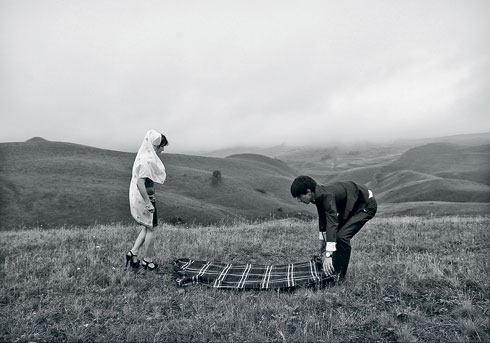
Wedding in the vicinity of the village of Kubachi - groom Zaur Yuharanov and bride Zarina Karizhova
During the Caucasian War, Alexander Dumas traveling around Russia went to the Caucasus. After that, in the genre of notes, the traveler wrote the book of the same name. Thus begins the head of Kizlyar: “It was noticeable that we entered the ground, where everyone was afraid to meet the enemy and, not counting on the help of the authorities, he himself thought about his own security.” We can say that almost nothing has changed. In the news headlines of today, Dagestan appears just this: wild, dangerous, hostile. Almost every day - messages about murders, tenders, special operations. But this is only part of a diverse Dagestan life.
Road
In Dagestan, strange distances. In just five minutes you can get from one climate, culture, tradition, rhythm in another. There is Dagestan Primorsky - Makhachkala, Derbent, Izberbash; South and North. There is a nurse track Moscow Baku, passing through the entire republic from north to south. And there are mountains. The most different - bald and wooded, hoarse, brown, gray, harsh and soft, compulsory alpine meadows. How nature is different, the characters, cuisine, speech, and way are strikingly different.
On the roads - checkpoints. They do not come across often, but they will certainly meet the traveler. These are fortified structures with loopholes, machine guns, sandbags. In sight, a person is 5-6. More often riot police. Here, at the Gergebil’s checkpoint, two groups at once: Stavropol riot police and local, even two flags - Stavropol and Dagestan. But no nationalism: together under bullets, they eat one bread. There are amazing apricots in Hergabile, an entire apricot valley. Delicious juice, jam with bones. They immediately whisper to me: at this checkpoint, a sniper worked from that hill a couple of weeks ago. One fighter died.
| * Standard signs of the Salafis: a beard, there is no mustache, they wear underpants, the pants are a little short - so that the ankles are visible. (It is believed that this is what the Prophet Muhammad looked like.) |
Next to the checkpoint, a halal teahouse, chapel, and I see - from there comes a guy, healthy, 120 kilograms, without a mustache and with a beard. And it is clear that the riot police understood: this is Salafit*. And he knows what they know. Everyone understands everything. In the air - tension. Salafit gets into the car - leaving. Another strong and “bearded” with his wife and children passes past the checkpoint on the “nine”. The car is stopped, the trunk is taken. But everything is very correct and ends without consequences. OMON met me surprisingly polite. I think this is also because many have weapons, and if, God forbid, they can go to today, they can come tomorrow. This semi -native atmosphere teaches good rules of conduct. True, in this riot police were local. I saw an amplification from Kalmykia: the yellowish faces even a little in of fear. Probably just arrived.
"
Gergebil has amazing apricots, a whole apricot valley. They immediately whisper: a sniper worked here a couple of weeks ago
"
There were not very pleasant situations on the road. Not even so scary, but such a sharp sense of danger. Not far from the village of Untsukul, gasoline ended, and pushed the car along the serpentine, at night, in the dark before refueling. The driver under his feet, under the rug - a gas gun, squeezed for combat. This is generally a Dagestan classic, almost everyone has such. And while we pushed our semi -fanned “Beshka” (“BMW”) down, cars drove up to us several times. Mostly tinted. The guys come out and get up so that even I see: they surround us, block the lines of fire, this is a fighting position. I did not understand who it was: “forest” or cops. And the guys with whom I was driving did not understand every time either. But honestly answered standard questions: what are you doing, where are you going, where? Unpleasant. Although there were no insults. As a result, one of these guys even helped the car to cross the car.
Radical democracy
Gubden is a large village, one and a half to two thousand houses. It stands in the foothills. There are soft mountains, beautiful, albeit impersonal-gray-yellow, hoarse. There are many mosques in Gubden - thirty, maybe more. Architectural dominant - minaret.
When you drive up to the village, the first thing you see is trucks. In Dagestan, many work on the Izvoz, truckers - in Russia, Iran, Azerbaijan. They carry anything - experienced drivers know how to place 200 kg in such a way that no one will find.
In Gubden there are no drunk on the streets, there are no smokers, there are not a single open cafe, and there are also few idly staggering people. All courtyards have high walls, large iron gates, most often decorated with forging. Here, as they say, the center of Salafism - renewed Islam, Islam “from the origins”.
I visited the usual mosque in Derbent. Imam is a charming smiling person. He lives with his family in the extension to the mosque. There is a madrasah, and the mosque, and his house. Everything is open. You go into the mosque, go through the corridor, there is his family, all of his eight, it seems, children. You climb the ladder, he eats you tea, everything is very modest. Probably, in Russian rural parishes, something similar. There is no feeling that behind this is some powerful religious organization that is separated, differs from society.
In Gubden Imam younger than me. But the villagers, as I understand it, are satisfied and often consulted not so much on issues of faith as on domestic family problems. In the very religious Dagestan villages of Imama - instead of the chairman of the village council. This is, say, a political instructor that is also engaged in economic activity. It is chosen by the whole village. There must be an adult man with religious education. It is better if you studied in Saudi Arabia or Egypt. As I understand it, after Soviet power, many went there to study. And they brought Salafism including. In Dagestan, Islam since the 16th century, have long been used to it. From the point of view of Salafism, any hierarchy is the advice of muftis, meetings - nonsense, everyone can be Sheikh for himself: observe the canons and you will be the righteous. No, of course, dear people, the authorities are worthy of respect, but the Salafites have no subordination, like in our Russian Orthodox Church. It seems like democracy, only radical.
Guest
Not a single local man cast a bad look at me in any Dagestan village, did not say a rude word. On the contrary, I understood that as a guest they forgive me for the oversights and ignorance of some traditions. This was especially felt in Gubden.
| * Counter-terrorist operation. |
It is Gubden - one of the main characters of the Dagestan military reports. Two weeks before my arrival in the village, another one*ended. Muscovites who sent me to the village, jokingly (in which there was a share of my fears) discussed the amount of ransom if that.
It was worth putting things in the house and going to the rock to admire the look, a tinted car drove up and stood up nearby. Judging by the hints, these were “forest”, who wished to look at guests from Moscow.
There is practically no work in the village. Many men are working as truckers. Women raise children. Girls after fourteen are usually taken away from school and soon they are married. Women are not only on the street, but also walk in the house, dropping their eyes. They don’t sit at the table - they just serve. In the morning, the guest will be surprised to find that his shoes are washed and polished. So it will last three days until the fourth with dirty boots hints - it's time to go on the road. The law of classical hospitality - it lasts three days. In real life, hospitality period is limited only by the arrogance of the guest.
| | | | --- | --- | |  |
| 
Shine with the perspective
A completely different mood in Kubachi: there is a secular order, in local stores and cafes, cigarettes and alcohol are freely sold. Fashionistas go in jeans, without scarves and even in almost short skirts. There are trunk gas, 3G and prospects in the Kubachi. This is the village of Jewelers, the front window of Dagestan from the Soviet regime, the pride and joy of officials.
Amazing: both Gubden and Kubachi - Dargin villages. But these are two poles of the Dagestan world. In addition, at these poles they talk in such a different Darginsky that they do not understand each other. In Gubden is a more classic version of the dialect, closer to the literary “Akushinsky” Dargin. And in the kubachi their dialect, unique - "Kubachinsky".
Kubachinsky men have a mustache in fashion and great honor. Now this fashion has also acquired anti -Salafi subtext. They don’t want to live according to Sharia in Kubachi. And they try to send children to study in Makhachkala, Moscow, Peter. So the style of the young generation is universal-city.
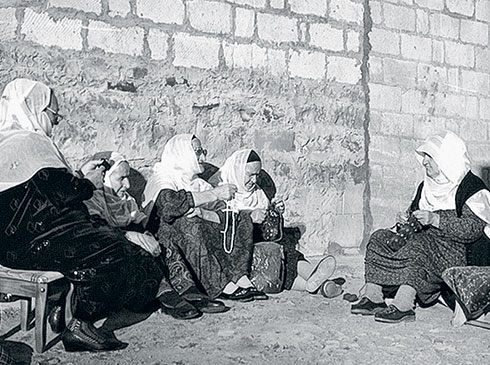
Picture: an elderly tanned Goryanka with an eagle nose, textured cheekbones and a cheerful squint froze at the window, clinging to the eyepieces of a worn zeiss. Even a bent back emits a lively intense interest. A character worthy of a pen of not only Dumas.
"
The most important fear is love, relationships. Will he love his bride, how to choose it: in a modern way or traditionally?
"
Nerve Makhachkala
Makhachkala is not Dagestan. Dagestan is mountains. Brown, gray, yellow, overgrown with fluffy pines. Naked, formidable cliffs and cozy alpine meadows. Makhachkala is not at all like that.
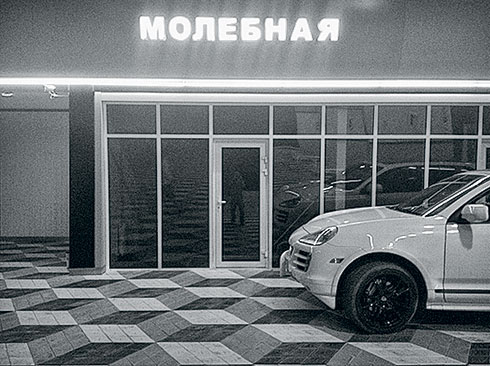
If there is no alcohol in Gubden at all, then in Makhachkala - almost like in Moscow. The difference is that you can trade on this street, but it is impossible on that. And they say that the “forest” take tribute from those who trades alcohol. And if they do not pay, then they come, they say very intelligently that they will explode and explode. They bring explosives, politely ask everyone to go out, honestly wait until they come out, and - Bach! - The store explodes. But this is on the outskirts. And in the center of Makhachkala, at the intersection of Rasul Gamzatov (formerly Leninsky Prospekt) and Dahadaev - a bunch of Kizlyarovskikh branded stores, and without problems you can buy anything: any vodka, cognac, wine. Cognac is cheap: by acquaintance - 250 rubles liter. “Forest” stores do not come to such stores, there is someone else to collect a tribute. But the trend is noticeable - many quit smoking, drinking. Now the most fashionable cafes in Makhachkala are non -alcoholic, and smoking - only on the street, on the veranda.
But the outskirts, microdistricts are another matter. For example, almost all anti -terrorist operations in Makhachkala are carried out mainly in two microdistricts. More often, as a rule, in the gearbox. Such a kind of ghetto: low -income families, working outskirts. There are “forest”.
Mahachkala on the nerve. Around the clock: signals, grunts, sirens, a squeal of tires and brakes, the roar of the engines. On the roads - rudeness. And if the car is expensive, then the owner seems to be in his right. Thieves are held in high esteem. The guys walk hard through the streets. Each second has injuries, every third has a fighting one. But there are few empty conflicts, everything is peaceful and polite: the outcome can be bloody.
Fear of love
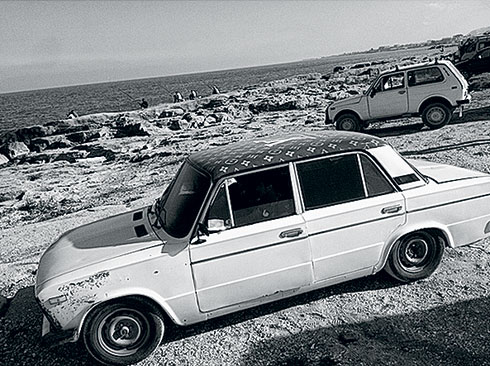
In Makhachkala, the most terrible beach in the world. Wastewater, stones, syringes. But colorful: physical cultures are engaged, children run, women in dresses bathe. Such a mixed Soviet-Muslim color. Evening, the sun is already coming, I decided to stay to see. Some guys, absolute gopniks in appearance, shout from afar: "Hey, come here!" Okay, I think I'll go look. "Where, why, why?" From Moscow, I say. "Well, let's go." We go to the desert part of the beach, to the lighthouse on the cliffs. In Moscow, I would definitely decide that they would take the phone, beat on the head and all that. But here, in Makhachkala, I was the first time, I want to chat. It turned out the guys saw that the visiting one wanted to treat. They themselves escaped from the wedding: bored. We took out a bottle of cognac. I have a glass as a guest. Themselves from the bottle. The guys are a little younger than me, they talk respectfully. One is very colorful, bright, his face seems to be chopped with an ax. They talked about national differences. They are Avars. I say: "Avars, it seems to me, is tough." He answers: “Sorry, I will correct you. Not tough. Thorny. " There are ready -made, adult answers to everything. In the course of political life, they know about everyone, everywhere familiar. Then suddenly we were talking about love, and it turned out that they had no love in life-not physical love, spiritual. And the main fear is not connected with the death, for which they are ready and in Samurai reconciled with its inevitability: she is nearby. The most taboo theme and the most important fear are love, relationships. Will he love his bride, how to choose it: in a modern way or traditionally? And if you fall in love, but not in that? And in general, is love or not needed? You do not expect this from the guys who are used to seeing in the role of harsh gangsters in Moscow.
You have income, which means I have to share. After all, we are waging a sacred war, and we need funds. If you do not share, there will be sanctions
"
Legends about "forest"
Young, as expected, are critical and romantic. The regime - both local and Moscow - despise, militants (or terrorists, or salafites - it does not matter what to call, in Dagestan they say “Jamaat” or “forest”) slightly romanticize. In any case, the image of the cop, in general, any security forces will fade next to the image of the “forest”. They say that even the children of some large officials went into the forest, everyone knows many stories about different “heroes of the underground”, for example: some “forest” hid in a steel bathtub and laid three groups of capture; Many people have a video message of “Jamaat” leaders on phones - they show each other, it seems like they boast of their frontalness; Records of attempts, terrorist attacks are also posted on the Internet, download, show each other.
Dagestan "roof"
In Russia, the term "roof" is clear to everyone. In Dagestan, a different scheme, they do not put the “roof” there, there they send a “flash drive” there. Flashka, unlike the "roof", is real. The flash drive is transmitted or thrown. She has the appeal of someone from the Jamaat. The essence is simple: you have income, and we know about it. So I must share. After all, we are waging a sacred war, and we need funds. If you do not share, there will be sanctions. Up to the murder. And there are such established expressions to “send a flash drive”, “get a flash drive”.
Choice
They say that the “forest” specially hand over young Feesbashniki and cops so that the guys finally go to the forest and they have no chance to return. For example, they give them phones that are listening. The guys fulfill one -time, minor orders, and then they pass them to the security forces, and they have no other road left, only to Jamaat. And vice versa. Like, the security forces themselves provoke the young people so that the statistics are by openness: they recruit, slip some beacons, then find it in the forest and they themselves arrange someone against those whom they recruited. In general, everything is mixed up, intertwined, some work on others, those on these, they say that they all share with each other, “forest” receive from the security forces, the security forces are also weaved from the “forestry”, the administration is also somehow woven ... And in an hour of the combat operation, the riot police receives about $ 100. Therefore, these operations sometimes last for days.
Many front their allegedly involvement in the "forest". They dress like Salafites, they shave their mustache, they put on skulls. This is even a pont among the youth: look, but I'm without a mustache, well, do something with me, otherwise I pray right, and you are all apostates, infidels. The choice of youth is not rich: either in cops, or in the "forest", or in truckers. I once asked my companions: in general, it is known who is “forest”, who is not “forest”, who is a informer, who is not a informer? They tell me, yes, of course, you see, the white “prior” went, so he knocks on the FSB, he remains to live for three months.
Death is nearby
Dagestan has a very acute sensation of life and death. A thief, not a thief, a righteous, teacher, actor-everyone feels that death is somewhere nearby. On the one hand, this is already familiar, no one pays attention to the reports, explosions of riot police. On the other hand, there is a sense of life, it is somehow more precise, sharper and brighter from this danger, from this split, from contrasts, and this is felt in the simplest things. By the way people say toasts, how sincerely they wish peace, good luck, happiness, love. There are few flapping. Even those who live sweetly and oily, a constant sense of danger makes others - more alive, or something.
Photos: RIA Novosti, Pavel Bardin