
Translated material
Three steps Kim Jong -un
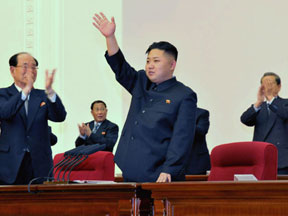
North Korea informed the International Maritime Organization of the Earth’s artificial Earth’s satellite, which, contrary to the warnings of the world community, will have to bring the BBC ballistic missile into orbit, BBC reports.
The satellite will be brought to orbit with a three -stage rocket, which starts in the first half of the day in local time from December 10 to 22. After the start of the rocket, he will go south. According to calculations, the first step should fall into the sea near the west coast of South Korea, and the second - to the Pacific Ocean east of the Philippines.
On Wednesday, December 5, the installation of a high -range missile to the starting site of the cosmodrome was completed.
Earlier, the South Korean media suggested that specialists would take three or four days to install all three steps of the rocket, and the launch itself will probably be timed to the anniversary of the death of Kim Jong Ira, who died on December 17, 2011. In addition, on December 19, the presidential election should be held in South Korea, and it is possible that the “missile trump card” will be played by candidates.
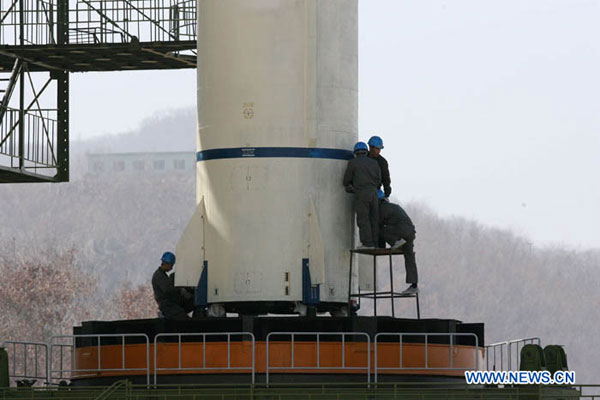 Installation of rocket steps
Earlier, on Saturday, the DPRK authorities reported plans to launch a missile with a research satellite between December 10 and 22. In Japan and South Korea, for their part, they expressed serious concern and announced their intention to achieve the abolition of the launch. The armed forces of Japan was given an order to prepare until December 7 for intercepting a rocket or its debris in the event of a threat to the country's security.
We strongly turn to the DPRK government
The Russian Foreign Ministry with regret took a message about the upcoming launch: “We urgently turn to the DPRK government with an appeal to revise the decision to launch a rocket,” the statement of the Russian foreign policy quotes the RIA Novosti agency.
A senior source in the Ministry of Defense, in turn, told the agency that Russian air defense, in the event of a deviation of the North Korean missile from the trajectory , can intercept it . According to the source, all the paths on which the rocket can fly are calculated, and the military will not allow the falls of debris on important objects in Russia.
"Bright Star" number three?
The planned launch will be the second attempt by North Korea under the leadership of Kim Jong -un to bring an artificial satellite of the Earth into orbit. In April, the launch of the YNHA-3 launch vehicle with a satellite of the landing of the Earth and Meteorology Kwanmesonon-3 ended in failure ─ it exploded about two minutes after the start. The wreckage of the launch vehicle and the satellite fell into the yellow sea. According to experts of South Korea, the launch of the satellite cost the DPRK $ 850 million.
Reference:
Kvanmenson-1 (“Bright Star-1”) -the first of the series of artificial satellites of the DPRK land, was launched by a three-stage Pectusan-1 launch vehicle on August 31, 1998 from the Musudan-Ni Cosmodrome (Tonshae). The DPRK insists that the satellite was brought out successfully and worked in orbit for two years, passing on to the ground the melody of the revolutionary hymns “Song of the commander of Kim Il Sene” and “Song of the commander of Kim Jong Ira”, as well as the alarm of Morze, the phrase “Chucheha, Korea” . At the exhibition of the achievements of three revolutions (analogue of VDNH), a special pavilion is dedicated to the satellite and the “results” of its flight. Meanwhile, the US space command and space control means in Russia could not find this space object in orbit. Moreover, the mentioned radio broadcasts have never been accepted by radio receivers of official services and amateur radio.
Kvanmenson-2 (Bright Zvezda-2) is the second from the series of artificial Earth Earth, the launch of which took place on April 5, 2009. The start was carried out by the Yunha-2 launch vehicle (Milky Way-2). According to the official reports of the DPRK, the satellite was successfully brought to orbit and transfers two songs of revolutionary and patriotic content to Earth. In the United States, it is believed that the launch of the Kvanmenson-2 satellite ended in failure. The Russian Foreign Ministry announced a successful launch, but subsequently, Russian space control means of the North Korean satellite in orbit were found .
Rockets in exchange for food
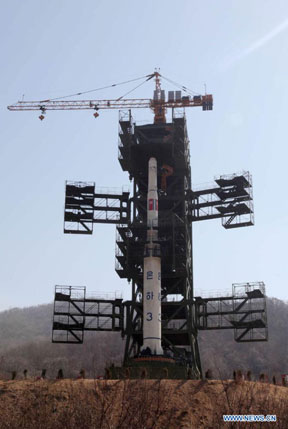 Rocket at the start
The April launch was widely condemned by the world community, called a violation of the UN resolutions and a “provocation”. The United States on the eve of the launch announced the suspension of food assistance to North Korea.
On February 29, 2012 it was announced that the DPRK agreed to curtail its nuclear and missile programs, in particular, refusing to test nuclear weapons in exchange for food assistance from the United States. The DPRK agreed to introduce a moratorium on the launches of long -range missiles, to stop testing nuclear weapons and to curtail the enrichment of Uranus at the atomic facility in Yonben. Pyongyang also agreed to check his nuclear facilities by the IAEA inspectors. In return, the American diplomatic department promised North Korea to coordinate the final details of food assistance and take other steps to improve bilateral relations.
When Pyongyang stated that in mid -April the launch of an artificial Earth satellite will be carried out in the United States, they warned that they could abandon the planned provision of assistance. The official representative of the US State Department Victoria Nuland said that the United States "want to help the Korean people, in particular, of the part that the regime ignores. However, the launch will lead to a break in the agreements. ” The State Department called North Korea’s plans to launch a satellite violation by Pyongyang of obligations under nuclear and missile programs. In connection with this, question was given the possibility of checking and confidence that American assistance will fall precisely to those who need it.
North Korea secretly experiences missile engines
In November, experts from the USA and South Korea, having analyzed data from intelligence satellites, concluded that the DPRK conducts new tests of missile engines. In the photo made in the area of the Tonchkhan-Ni Cosmodrome (aka Western Sabbath testing ground), fuel tanks and burnt vegetation are clearly visible. The cosmodrome is located on the western coast of the country in the Pyhenan-Poom Province in the hilly area near the northern border with China, 200 km north-west of Pyongyang and 70 km west of the large nuclear center in Yonbyon.
It occupies an area of about 6 km2, on which the launch pad is located, a stand for ground testing of missile engines, buildings for checking and adjusting equipment, a launch control point, a complex of staff buildings and a checkpoint. Ecologists, in turn, express concern to the possible negative consequences of engines testing - toxic missile fuel when it enters Earth or Sea, causes irreversible negative consequences.
In early October, the DPRK said that she has a long -range missiles that are able to reach the territory of the United States. This statement followed after the United States allowed South Korea almost three times to increase the range of ballistic missiles - up to 800 km. According to the previous agreement with the United States, guaranteeing the safety of South Korea, the range of missile launches was limited to 300 km. The statement of Pyongyan said that in the radius of his missiles there are American bases “in Japan, in guam and in the continental part of the United States”. In turn, in the new, 800th kilometer coverage of South Korean missiles, both North Korea and part of the territories of China and Japan fell.
The rocket is turning with a slight movement
The international community suspects that in reality the DPRK space program is a disguised test of ballistic missiles that can carry nuclear charges.
An expert in the field of space technology in an interview with Polit.ru noted that such fears are completely fair. The probability that the launches of the “peaceful” satellites are hidden by tests of North Korean intercontinental ballistic missiles (ICBR), which are able to carry nuclear warheads are very large. In fact, the combat ICBR differs from the cosmic peaceful missile only a separated head of the head. If you put a head with nuclear blocks on it, then it will be combat, if you install a satellite is completely peaceful.
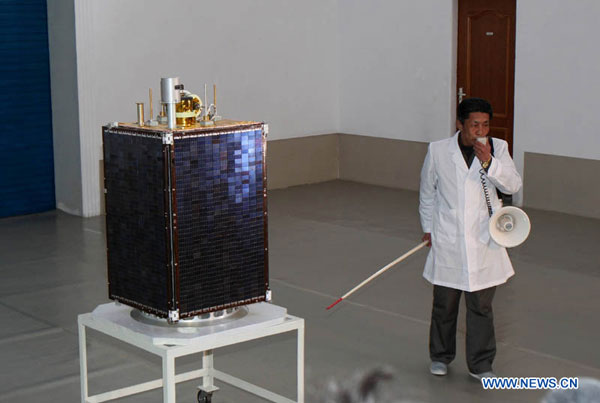 Sputnik "Qwangenon-3"
Note that at the end of March this year, two short -range missiles were tested in North Korea. As BBC reported with reference to the South Korean media, the launch occurred from the western coast of the country. The missiles were probably the Earth-Corab class, which is designed to defeat goals on the water. Then the new rocket activity of Pyongyang caused a wave of protests in Japan, South Korea and the USA. So Tokyo announced that by the time of launch of ballistic missiles, the pro system on the island of Okinawa will be activated .
Above the "star", brighter ... Barack Obama
Kim Jong -un, who is now, presumably about 30 years, was headed by the DPRK after the death of his father Kim Jong Ira in December 2011. With his arrival in the country, no significant changes occurred. The only visible was the appearance of singers in mini-skirts on the stage, and in the public a young leader appears with a fashionably dressed beautiful-born, former pop singer.
Meanwhile, it is the new North Korean leader, most likely, the title of “Man of the Year” according to the version of Time magazine in 2012. This can be judged based on how many people voted for Kim Jong -un on the Internet. His first place in the ranking is more than obvious - from his closest pursuer, Egyptian president Muhammad Mursi, he is separated by one and a half million votes.
It is noteworthy that US President Barack Obama is in this list in just ninth place. In this regard, bloggers asked the question-either the North Koreans, in addition to the mini-skirt, were massively allowed to enter the Internet, or this is another “button accordion”. Earlier, the joke of one American humorous publication that the North Korean leader was called the Sex Simvol of the year, enthusiastically picked up the Chinese press.
There is an opinion
Mark McDonald from the International Herald Tribune expresses the opinion that the launch of the rocket is, first of all, domestic political, although such international events as elections in Japan (December 16) and South Korea (December 19) also fall into the indicated period of time. “If the launch really passes successfully, the new northern leader Kim Jong -un will receive a double bonus: he will receive a victory that he can fully name his own and which will strengthen his imperious position, especially among ministers and generals from his father’s entourage. And the second: he will embody his father’s long -standing dream - the creation of long -range missiles, ballistic missiles and satellites, ”which, in turn, will become a partial sign of the execution of the forecast, according to which North Korea will become a rich and strong country in 2012. If the first is not possible to perform, then the second is quite realistic in case of good luck.
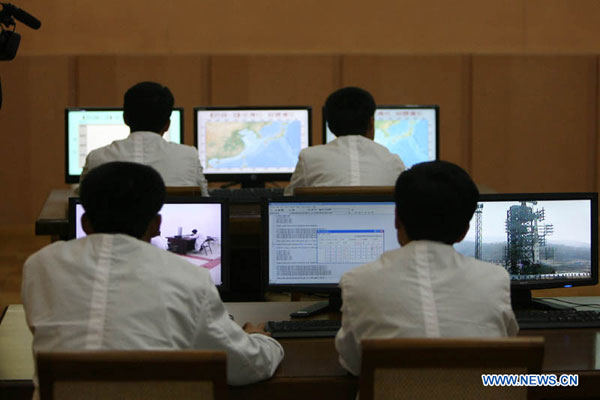 Korean flight control center
The author of the material in The Economist also draws attention to the international context of the announced event . In addition to the elections in Japan and South Korea, as well as with a reservation, that a few weeks after the specified period will be inauguated by Obama, he also mentions the change of government in China. Thus, in this version of Messaj, it turns out to be biparted, although with an advantage towards international positioning: with such a concentration of replacing governments and beginning leaders, it is important to ensure their advisability in terms of providing resources.
Another version (Washington Post): in Xia this story is generally a bluff designed to scare international opponents and rehabilitate after April failure, but in no way implies the actual launch. In confirmation of this option, they refer to the opinion of an expert physicist who believes that in less than a year, Koreans technically could not analyze and correct the mistakes due to which the April start ended in failure. The main addressee of this representation, according to the author, is South Korea on the eve of the elections and the USA as an ally.
In the material published in the Financial Times, the picture is proposed as follows. The time for launching the rocket is extremely doubtful. In winter, such experiments are generally inconvenient, moreover, again, little time has passed after the previous failure. However, the second attempt is coming, and this indicates a kind of desperate state of affairs and readiness to make large bets. The traditional version says that any such demonstrative activity of North Korea is another attempt to extort benefits from rich neighbors and the United States. Another reservation that is often popping up in the media is that experiments with missiles at such a moment saturated with international events will only exacerbate the situation, but will not lead to constructive anything.
In conclusion, the opinion of a South Korean expert is given, who believes that things in North Korea are so bad that there is nothing to lose, and it should be betting on the army. Thus, this launch with the hope of success is an attempt to raise the fighting spirit of the military and increase their trust in the leader.