
Translated material
People against the "pharaoh"
The situation in Egypt, which exploded due to the decision of President Mursi to put himself with superference, reached a critical point. The president’s family was evacuated to a safe place, the tanks took the presidential palace. What next?
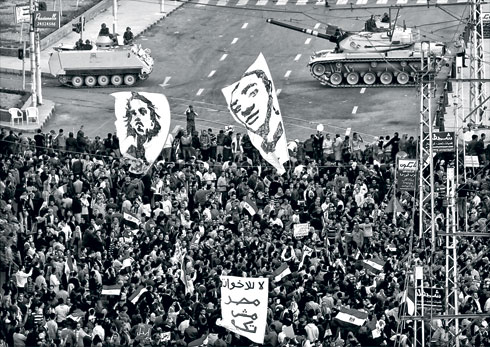
Cairo, December 6th. The area of the presidential palace
December 2012 in Egypt can be compared since February 2011, when Tahrir Square was in the focus around the world. But now the situation is even more dramatic. In the country, in fact, there is a civil war-between Mursi's supporters and the Muslim brothers supporting it, on the one hand, and a secular opposition on the other.
One and a half years ago, both stood on Tahrira against the Mubarak regime. But now again - even more acute and unpredictable - the question arose: which way will go further Egypt, the most important country of the Arab world. Seven people have already died in the clashes, about 400 were injured. And this is probably not the final.
Why did the president do this? Why did he need to provoke an internal crisis, after he so successfully scored points in the field of mediation between Israel and Hamas? There can be only one answer: Muhammad Mursi has too good memory.
| *In the evening of December 7, Mursi delayed the referendum. |
Mursi with all his might was looking for a way to avoid conflict of the latest parliamentary elections. Remember? The elections victorious for the Muslim Brothers were held in November 2011, and in June 2012 the Supreme Constitutional Court suddenly announces their results invalid. Murcy does not want to repeat this scenario. December 15-a referendum on the new Constitution, which was developed by the Muslim Brothers in Egypt with the support of Islamic orthodox-salafites based on Sharia*. The opposition criticizes the project as not guaranteeing fundamental rights and freedoms. But Mursi is not afraid of the opposition. He is afraid of the judges of the KS. Suddenly they again decide to say their last word? No!
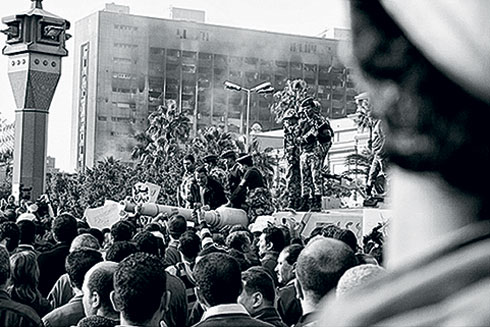
In February 2011, demonstrators on Tahrir Square did not think that they would have to gather again
Superfigurations were needed by Mursi precisely in order to protect themselves from such a script. And when the judges took to the streets, protesting against the decree of November 22, Mursi did not particularly worry. The main thing is that the people support him.
And then Murcy allows a fatal mistake. He makes several statements, addressing them to all his dissatisfied with his decree. “I will abandon the powers,” the president says, “if you, citizens, support my constitution.” Citizens took it like blackmail. Worse - as a harbinger of the upcoming dictatorship. And went out into the streets.
Former Director of the IAEA Oppositionist Mohammed El Baradei compared the president with Faraone, and this metaphor immediately became the slogan of the entire opposition. After that, it became clear: Mursi rallied the ranks of his opponents, the number and determination of which he clearly underestimated. And he himself was in isolation.
For the hasty and conflicting decisions of Mursi, even some of his associates began to criticize. Over the past two weeks, seven of his advisers from among the Muslim brothers have already resigned. On December 4, the four main non -state newspapers were published with the same first stripes, the headlines of which read: "There is no dictatorship." And even the Imam of the Al-Azhar mosque, the largest in Cairo, secretly supported those who believe: Mursi lost the moral right to lead the country.
"
The opposition leaders perceived the presidential speech with the skepticism, although so far they do not require its resignation. In addition, it is not clear how the army will behave
"
On December 6, Mursi turned to the people after some hesitation. He stated that he would abandon his new superfluencies immediately after the referendum, regardless of its result. In addition, he is ready to meet with the leaders of the opposition without preliminary conditions to develop a crisis strategy. True, the main requirement of the opposition - to cancel the draft constitution - he does not want to hear yet. Therefore, the anxiety of those who fear the quick rolling of Egypt on the path of radical-Islamism are quite justified.
The opposition leaders perceived the presidential speech with the skepticism, although so far they do not require its resignation. In addition, it is not clear how the army will behave. On the one hand, Mursi in August dismissed a disloyal minister of defense and a number of generals. On the other hand, it is difficult for him to rely on the loyalty of the rest. Moreover, in the presidential election, the generals supported his opponent Ahmed Shafy. Yes, the army remained neutral during the clashes of the last days. But if the number of dead increases dramatically, then the generals can intervene ...
Photos: Reuters, Ilya Barabanov