Translated material
Jazz is my native language
DS: News come without demand, invading our lives, mixing all the cards, all plans. The script of the “Time of Jazz” was almost ready when the news came that in Noruolka, Connecticut, on the way to the cardiologist, Dave Brubek died. Dave was not just a great jazzman, pianist, leader and composer, he was a icon of jazz and modern music. The present, without Hollywood stories, a cowboy in his youth, he became one of the most refined jazmens of the century. Under the influence of the pianist’s mother, he began with Arnold Schönberg, went through the composition of the composition by Darius Miyo and only then gathered his first jazz octet. It makes no sense to talk about Dave Brubeke with a tongue twister. He will be dedicated to the “Jazz Time” next week.
Dave Brubeck - Take Five - 5:27 (Dave Brubeck - Time Out - Columbia)
DS: - “Take Five”, recorded in 59 by the quartet of Dave Brubek composition (account 5 to 4) Paul Desmond, which became absolute jazz classics. Dave Brubek - piano and leader; Desmond-alt-saxophone; Gene Wright - double bass and Joe Morello - drums.
Everything else about Dave Brubeke - in a week.
And now back to the musical open spaces of the Jazz Time.
DS: In the cold wind, the December Poster Jazz trembles and is going to fly away. Rather, the calendar page, the size of the poster. As usual, the last two weeks of December are occupied by chants and dances around the Christmas tree. Meanwhile, at the poster, even roof a petite, the darkness of the fruits of March love. First of all, in December, a generous crop of pianists. And what! Dave Brubek! Maca Tieiner, Toshiko Akoyoshi, is the same, hello to our listener from the “pharmacy that around the corner” by Yerl Hines, Winton Kelly, Bobby Timmons and at the very curtain of the year - Petruch, Michel Petruchiani. And these are only pianists. Jimmy Smis was born on December 8. Donald Bird-9th. “Blue Eyes” (Frank Sinatra), Joe Willyms, Grover Washington - 12th. Next: Clark Terry, Fletcher Henderson, Bob Brookmeyer, Chet Baker, Kid Ori, Jimmy Hall, Kab Kaloway and John Jones ...
And in stock there are only two, two modest weekends!
Well, we will, as we should - improvise!
For those who listen to us Live or in the podcast for the first time, I will say that this is the “Jazz Time” from the site “Freedom” - www.svoboda.org . The microphone in the promising to become black and white Paris your DS.
Toshiko Akiyoshi - Minor Mood - 4:18 (Toshiko akiyoshi - The Many Sides of Toshiko - Verve)
DS: - “Minor Mood” or “Midnight Lament”, “sad mood, midnight complaint” - the composition of Akhmad Karaba Salim. Toshiko Akoyoshi - piano; Yojin Cheriko - double bass and Jake Hannah - drums. Toshiko Akoyoshi was recorded in New York, on October 4, 57.
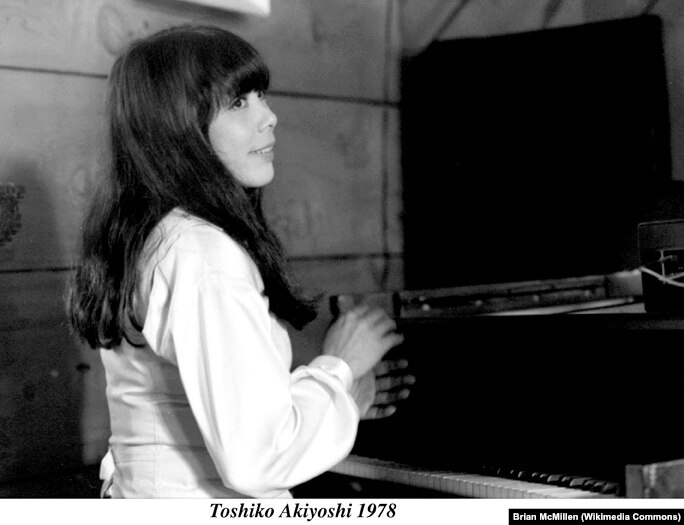
Toshiko Akooshi was born on December 12, 1929 in the regions completely incredible for jazzmen, in the port city of Dyren in Manchuria, which was in the era of a puppet Japanese state. From the age of seven, Toshiko studied the classic piano. She told Lena Lyons that her “the first teacher was very mediocre, but it did not matter, because at the very beginning you still play exercises and sketches of Karl Cherni or Charles Louis Anon. The most important thing is to start early. Otherwise, the music will not become your second nature. Automatic reflexes are also needed, and the muscles of the hands and fingers are needed. ”
In the later years, Toshiko Akihoshi said that the pianist is like an athlete, he needs pumped muscles and a living reaction. When she began to devote more time to composition, composition, she lost a sports uniform and had to make up for, which was not difficult, playing several hours a day.
I note that the case of Toshiko Akooshi is special: this is a fragile little Japanese woman with tiny fingers, whose jazz teacher was already in Tokyo, where the family was forced to move, since Japan lost the war, was the plate Teddy Wilson, and later Bad Powell.
TOSHIKO AKIYOSHI - Softly as in A Morning Sunrise - 4:05 (Toshiko akiyoshi - The Toshiko Trio - Storyville)
DS: “Softly As in a Morning Sunrise”, “Directly, as at dawn” - the standard of Romberg and Hammerstaina. Toshiko Akoyoshi - piano; Paul Chambers - double bass and Ed Sigpen - drums. The record is made for Storyville in 54.
Toshiko's parents Akooshi lost everything that they had in Manchuria and the money for them in Japan became the main problem. Toshiko was fifteen years old when she began to play with a small combo (saxophone, accordion, violin and drums) - on dancing. It was even small, but earnings. Jazz for her was one single record at 78 revolutions: Teddy Wilson - “Sweet Lorain”. She listened to the record and learned to improvise. After some time, she already played in large orchestras, and two years later she collected her own quartet with an alt-saxophonist Sadao Vatanabe. Now she listened to the records of Sonny Rollins and Miles Davis, carefully studied the work of drummers: Max Rouch, Art Taylor and Roy Hinnes. Jazz piano is a percussion tool. Drummers have always been a source of new knowledge for a young pianist.
DS - opened Toshiko Akooshi Oscar Peterson. He was in Japan along with producer Norman Granz on the famous touring, who turned the Granz into a millionaire, "jazz in Philharmonics." After listening to Toshiko Akoyoshi, Peterson called the Granz. Norman shared the enthusiasm of Oscar, and they decided, without putting it off in a long box, to write down a pianist right away. Moreover, the generous Oscar gave her on this occasion, but only for one session, his own: a smuggler and a drummer. This was the first record of Toshiko Akooshi, but she brought her a scholarship at a music school in Burley, Boston, which in turn brought her to the most popular Boston club George Wayne, the organizer of Newport festivals, “Storyville Club”.
In the company of friends, in a family circle or in complete solitude, you listen to the weekly “jazz time” - from the site “Freedom” on the air or in podcast. The address "Time of Jazz": www.svoboda.org . In the microphone in Lutetia, Dmitry Savitsky.
Toshiko Akiyoshi - Tempus Fugit - 4:12 (Toshiko Akiyoshi - Remembering Bud -Conatra's Dream - Evidence)
DS: “Tempus fugit”, “Time flies” - this aphorism originally appeared in the poem of Virgil. Since then, we delicately replace the hint of aging with this air “Time, alas, flies ...” In this case, the composition of the beloved pianist Toshiko Akoyoshi - Bada Powel.
Composition: Toshiko Akoyoshi - piano and leader; Rey Drammond - double bass and Lewis Nash - drums. The trio was recorded by Rudy Van Helder on August 1, 90 in Hakensak.
In Boston, in 59, Toshiko Akooshi married Saxophonist Charlie Mariano, with whom she successfully toured the cities and weights of America and Japan. Her authority grew up, she played now solo or as part of small combo: trio and quarters. She played with large orchestras, although in 71 in Carnegie Hall she played with her quartet.
With the orchestra of the flutist and saxophonist Lu Tabakin, who became her second husband, Toshiko Akihoshi, went into composure. Together they recorded 23 albums. Toshiko and Lou (on Russian sites are called and Lew) moved on the west coast and settled in Los Angeles. It was not easy with work and in the late eighties they returned to the east coast, to New York. They played at Newport festivals, in Europe: in Marsiac and Nice, they regularly recorded, and although they were only relatively successful, they won the prizes of Daunbite critics in the “Orchestra of the Year” category.
Over the years, Toshiko Akoyoshi was freed from the cargo of the influence of Bad Powel. She continued to play with amazing ardor and, did not cease to surprise both the audience and professionals (with her fingers!) - energy and strength. At the same time, the impressionistic lightness and romanticism close to Bill Evans was not alien to her. She introduced Japanese motifs into her compositions, but the film, shot about it in 84, bore an unambiguous name - "My native language jazz."
TOSHIKO AKIYOSHI & LW TABAKIN BIG BAND - ELEGY - 9:13 (Toshiko Akiyoshi & Lew Tabakin Bigun - Kogun - RCA)
DS: - “Elegy”, “Elegy” - the composition of Toshiko Akooshi. The Bolshoi orchestra Toshiko Akoyoshi and Lou Tabakin, them, recorded in April 74 in Hollywood and a twice bonus disk, Kogun. Lu Tabakin played on tenor-saxophone, his wife, of course, on piano.
Toshiko Akihoshi today sounded on the air of Freedom for the first time. In the history of jazz, I hope you agree with me, there should not be white spots.
DS - Donald Burd had two typically New Orleans, like Creole, French names, although he was born in Detroit: Tusan and L'Urtur (all saints and, literally, overture, discovery ...). Donald Burd Trubach Post-Clifford-Brown era, as historians of jazz, sophisticated and energetic jazm hard-bope, who later became a star of Funk-jazz and a music teacher at several universities. It is necessary to clearly divide the creative career of Burd into three periods: the first is hard -bop, Jazz Herald, Sideman with John Coltrane, Sonny Rollins and Eda Garland; Work with Max Rouch, a contract for many years with Blue Note, an alliance with a saxophonist Papper Adams, studies at Nadi Bulange in Paris, the beginning of teaching, a passion for African folklore and the second: jazz-fusion in the footsteps of Miles Davis, Fank, loss of fans in the jazz camp Purists and extraordinary popularity among fink fans; And finally, the third-at the very end of the 80s, returning to the hard bope and an unexpected hobby of jazz-rape ...
If you are late by the beginning of this "time of jazz" - it does not matter! You can download the podcast of this and previous programs from our site www.svoboda.org . Look for "jazz time" under the heading "Podkasta". There you can leave your comments and put up your DS ratings. This is always valuable.
And now Donaldson Bird-Second:
Donald Byrd - Carol - 5:40 (Donald Byrd - Byrd in Flight - Blue Note)
DS: "Carol." Since the name is written with a capital letter, it is difficult to guess that it is a female name or “Carol”, a Christmas chorele, although by rhythm, in sound it is rather a jazz ballad ... Donald Bird is a pipe; Hank Moucul-tenor Saxophone; Duke Parson - Royal; Dag Watkins - double bass and Lex Humphris - drums. Rudy Van Gelder, Inglwood Cliffs, July 10, 60. Of course, “Blue Note”, LP “BYRD in Flight”, although BYRD is written not as a “bird”, but through “y - wow”.
Donald Bird was born on December 9, 32, in Detroit, Michigan. His father was a priest of the Church Methodist and - amateur musician. Donald himself began to play professionally immediately at the end of school. He already had experience - he played in the spiritual section of the orchestra Lionel Hampton.
As we have repeatedly seen with examples of other jazzmen, in the army, more precisely in the Air Force, Bird played in a regimental orchestra. Having demobilized, he continued his studies and in 54 received a bachelor's degree at the Musical Department of the State University of Wayin. In the 55th, already in New York, he receives a master's degree in the Manhattan School of Music. For some time he plays the Combo of Pianist George Wallington, but Art Blake intercepts him, offering the place that his idol Clifford Brown in Jazz Messengers occupied him. Donald Bird did not linger in the Combo of the "messengers" and moved to the drummer Max Rouchu - again in the place of Clifford Brown. It was a fruitful period, during which Burd had a chance to play with giants such as Rollins, McCly, Silver, Griffin and Train.
Donald Byrd - Slow Drag - 9:44 (Donald Byrd - Slow Drag - Blue Note)
DS: - "Slow Drag." The translation option is “slow puff” ..., the composition of Donald Burd, a pipe and a leader. Sonny Red-alt-saxophone; Sader Walton - Royal; Walter Buker - doublebas and Billy Higgins - shock and vocals. Still Blue Note, and therefore Rudy Van Gelder. May 12, 67. Rudy Van performed remastoring in 2001.
Donald Bird as a leader recorded 24 discs on Blue Note, 22 LP on other companies and 91 records, like Sidman. In the eighties, partly due to health problems, he devoted most of his time to teaching, but in 87 he returned to the recording studio for a short time, writing down a disc with Kenny Garret, Malgra Miller, Ryufyus Red and Marvin Smith Smis.
Donald Burd's play style is primarily light mobility, fluidity. His improvisation is discharge; He does not build complex labyrinths, does not disappear in the branches, like, say, Coltrain (who, so that Miles Davis does not speak there, knew how to return, but at a new level, to the topic). Bird is not aggressive, always clear, his fantasy emphasizes his freedom to improvise, but does not start into a dark forest. He remains in the best solo trumpeters of hard-bope, but he is full of curiosity and is ready to experiment with new musicians. By the way, it was he who brought the pianist and keyboat Harby Hankok to the stage; He generally loved to play with young, as in the case of his dive in September 87 in the recording studio of Rudy Van Gelder. Quintet recorded an excellent disc named after WC Handy Harlem Blues.
The last time he performed last year. Burda was only 80 years old. In September of this year, his CD “Prospects of modern jazz” came out.
DS - Donald Burd's play style - primarily lightness, fluidity. His improvisation is discharge; He does not build complex labyrinths, does not disappear in the branches, like, say, Coltrain (who, so that Miles Davis does not speak there, knew how to return, but at a new level, to the topic). Bird is not aggressive, always clear, his fantasy emphasizes his freedom to improvise, but does not start into a dark forest. In his best solo, he remains a hard-bope trumpeter, but he is also full of curiosity and is ready to experiment with new musicians. By the way, it was he who brought the pianist and keyboy Harby Hankok to the stage! He generally loved to play with the young, as in the case of his dive in 87 in the recording studio Rudy Van Gelder. In September, the Quintet recorded an excellent disk named WC Handy Harlem Blues.
I will say to the neophytes and random travelers that “jazz time” is a weekly story of “American classical music”, as Jazz Pianist and composer, director of the Music Center named after Lincoln in New York, Billy Taylor. You will easily find “jazz time” Live or in the podcast on the website of “Freedom” at www.svoboda.org . The microphone in Paris has your ds.
Donald Byrd - Stardust - 3:28 (Donald Byrd - with String - LoneHill Jazz)
DS: - “Stardust”, “star dust” Khoagi Karmayla. And Donald Bird did not escape the temptation to sign up with the strings! Bird is a pipe and a leader; Giulius Baker - flute; Romio Panche - Claret; Milt Hinton - double bass; Ozi Johnson is drums. Orchestra Claire Fisher. The record was made in New York in 57.
It is difficult to choose a final play from 132 discs. The most interesting Donald Burd’s solo are scattered primarily according to the collections of the notes of Khoras Silver, John Coltrain, Red Harlend, Hank Muble, Papper Adams, Jaki Maklin, Arthu Farmer and Gigi Grais. In my opinion, among the best discs recorded on Blue Note - “Royal Flush”, “A New Perspective”, “Byrd in Flight”, “Kofi”, “Ethiopian Knights”, “Street Lady”, “Stepping Into Tomorrow, "Places and Spaces and Caricatures.
Here is the second play CD "Kofi". Translated from ChVI -Fanti, which speaks the inhabitants of Ghana and Nigeria, the name of the disk is “Friday”. The first solo is the tenor Saxophonist Frank Foster. The second is Donald Burd.
Donald Byrd - Fufu - 9:39 (Donald Byrd - Kofi - Blue Note)
DS: “Fufu” - a typical African dish of manioca roots. This composition of Donald Burd, transfers us to the African coast, to a hot city, whose pulsation emphasizes the rhythm section. Trubach himself said that, playing “Fufu”, he thought about the “Black Star Square” in the Crozre capital of Ghana.
The Kofi disc was recorded by Oktet on December 16, 69 for Blue Note in the New York Studio “A-& R”.
Composition: Bird - pipe; Willyam Campbell - thrombone; Lu Tabakin - flute; Frank Foster-tenor Saxophone; Duke Parson - synthesizer; Ron Carter - double bass; Bob Crancho is an electric double bass and ayrto - drums.
This “Kofi” disc was the last and transitional from hard-box to rhythm-i-Blue and Fanca. Scott to Yanou believed that Donald Bird played extremely close to Miles Davis, his Bitches Brew, “Bitching Poohletka”, which was recorded a few months earlier.
Donald Bard never played pure classic hard-bop.
Here we will part on this. Let me remind you two things: you will easily find the podcasts of the “Time of Jazz” on the website “Freedom” at www.svoboda.org . And the second: the next release of “Jazz Time” will be dedicated to the life and work of Dave Brubek, who went to the heavenly orchestra on December 5 at the age of 91.