
Translated material
Portraits of Russia: Dmitry, climber, came up with a shelter on Elbrus
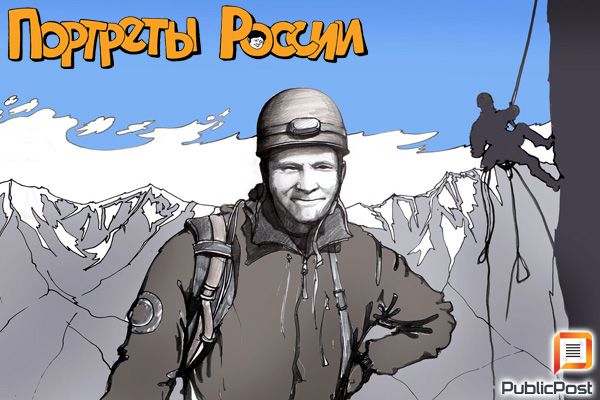 Photo: Asamaz Dzivaev/Publicpost
Dmitry Guryanov came up with the idea to build a hut on the saddle of Elbrus , which should save the lives of climbers. For the sake of this, he gathered together different people, for a year he offended the thresholds of different instances. However, he was not a professional climber, builder, engineer.
About childhood, hitchhiking and Russia
I was a completely greenhouse child. And then at the age of 16 he went from Norilsk to Moscow to go to the institute - and immediately left "stop" to the Crimea. Mom was shocked when I called Bakhchisaray. I quit counting my "collision" after 70,000 kilometers. I traveled only in Russia, and indeed I have never been abroad to the former USSR. In those days when I was chasing geography, new places and so on, I did not have a passport. And now I am already not pursuing for geography. Everything that is interesting to me is people, psychology, depth - this can be found anywhere.
About mountaineering
Climbing for me was a very new, impressive, interesting area. He seemed to me a mixture of heroism, victories over himself, mountains and other high -half things. My first acquaintance with Elbrus happened when we, a handful of completely “zero” climbers, tried to climb on him in winter, however, under the leadership of a very experienced instructor. We fell into strong weather, there were every chance to return to the camp not in the evening, but in the morning, and not the fact that whole and unharmed. We got lost in winter at an altitude of 4 kilometers. Fortunately, everything worked out. But for myself, I then understood how much everything can be hopeless: below, just 4 kilometers from you, the people are warm and good, they are there in the village, rest in the bar, everything is fine. And here you stand in a white darkness after 10 hours of wandering-and you don’t know where to go, and you can’t go.
About dangers and ambitions
In 2006, in May, many people died on Elbrus at once. Really a lot, 11 people. It went 12, returned 1. It is tragic, it does not fit in my head: not the war, how so?
Perhaps people were deceived in their understanding of this mountain. They probably thought that they were going on a pleasant walk, and at some point they realized that they were in such a ass from which there was no way out. Air temperature is -50, wind, no understanding where to go. You just gradually die - and this is in peacetime. This should not be. But how to prevent it? We all tend to make nonsense. You will not stand at the foot and exhort: "Guys, do not, let's another time." These are all human ambitions. It is very difficult to abandon the ascent, when you have been preparing for it for a year, all your friends already boasted, photographed in cool clothes. And now you arrived, you are at the peak of form, acclimatized, ready to go - there is no weather. You think: "Well, I'm not a fool, I'll wait." Waiting for a day, second, third. And you understand that you have a train home the day after tomorrow. You think: "Well, if that - I'll be back." And you do not return.
About the idea of building a hut
Then I had a horror from the understanding that people were in difficult conditions, of which there was no way out. And the hut, as it seemed to me, could save their life. And I began to flood climbers on the forums with my naive and cloudless remarks like: "Guys, why is there no hut there? And let's do something so that no one would die." I didn’t hear any hot support from anyone. Someone was silent, someone also said nothing from the height of his great experience, someone said: "Boy, who are you, in general, what are you talking about? What a hut should be climbed there."
I wrote in several publications that are somehow related to mountaineering-“risk”, “ex”, “free wind” and others. There people with serious experience, but they were very inert. The newspaper "Free Wind" responded: "Yes, come on, dude, if necessary, we will help you." But how can they help? True, my call was published. The editor -in -chief of the journal "EX" Sergey Shibaev is very serious, reinforced concrete with this text, I simply pressed me into a skirting board, such as - who are you at all? Do you understand that there are clever men without you, and they tried before you? Most normal people would answer him sharply. And I just said, they say, okay, sorry, why are you so. And some time later, he just became one of those who actively supported the whole idea.
I was 30 years old. I lost nothing. I was not a hero, did not go to the feat. Life continued to flow peacefully. I came after work, climbed onto the Internet and simply tried to understand for myself what it was at all about, what is the difficulty, why since the previous shelter was destroyed (it existed from 1938 to 1998 - approx. End,), they built nothing there. I could not do anything, but I could write a bunch of letters to different authorities. What I did, he will not lose from me. And I was moving strong enthusiasm to me mixed with strong infantilism. Well, they would send me, saying that this is impossible - I would believe and spat it in it. But the words that "kipets, guy, will not come out" I have not heard either.
About the call from the minister
In the end, I was answered from the Ministry of Economic Development of Kabardino-Balkaria, from which I was stunned by non-well. Moscow, winter, turn on a minibus, 9 in the morning, people like amoeba, I'm sleepy ... And here is a call to the mobile phone. An unfamiliar number, a pleasant female voice reports: "Hello, sorry, you are worried about the Ministry of Economic Development of Kabardino-Balkaria. Are you convenient to say now?" I, restraining emotions and counting to 10, say: "Yes, of course." She: "You know, the minister wants to meet with you next week, could you drive up?" I am: "Well, yes, probably why not." Our brief dialogue ended, and I, picked the phone, jumped on 2 meters in the middle of this whole Crowd with a scream: "Yyyyyeeeeeeeee!" It took me out at all: not a fig to himself, minister! Since the ministry, now everything will be stuck! But in the end, they did not help us with anything. I don't know what this is connected with. I went to the minister, he smiled, shook his hands, but there was no specificity.
About the idea and failures
I continued my amateur research. He sat all day on the Internet and studied what ice on Elbrus, what construction equipment can be dragged there and in what way, what category of hardness of the breed on the saddle, whether it can be drilled, what is the speed of the glaciers, how to deliver the load, how snow skidding occur. Imagine what they say to you: "You need to understand whether it is possible to make a poultry farm on Mars." And you are looking for everything that is connected with these chickens: how to feed them, how to bring them to Mars, than to protect from Martian foxes and so on, so on.
I fantastically lacked knowledge. The project for building a hut on Elbrus is an idea and implementation. And I'm not a specialist in implementation. I don't know how to build. But I had an idea.
About a year after the start of my “searches”, they called me from the mountaineering of Russia and asked: “Boy, are you mutating the water here? Come on, come here, let's see what you can do.” Well, I came. And they already officially took up the implementation of this project.
I was appointed coordinator of the whole action. They began to look for volunteers, designers. But then my role was already very small: I coordinated the expedition and was a little by its psychologist. I rose there during the construction of only two times: health problems have appeared, now I’m restoring the form.

Photo: "The Federation of Alpinism of Russia"
About projects and budget
In the first year, the Russian company from Anapa did the project, but the project turned out to be 30 tons. New - dome - the project was made to us by an American company. She has been engaged in domed houses for 40 years, the project was of high quality. The Americans did everything inexpensively: they were imbued with an idea, and for the image it was interesting for them to have a project at such a height. Our budget was extremely small, a penny in general. At the very beginning, there, in my opinion, there were 300 thousand rubles for everything about everything-including the hut, the expedition, and the provision of volunteers. Everyone understands that for such money even a project is not a fact that they will draw. But difficulties with money are not a problem, you can always find sponsors. And with the hut there was a bunch of other troubles.
About people, helicopters, crazy and limit
It was almost impossible to find a helicopter who would deliver the load to the saddle. The best of Russian helicopters for heights is the Mi-8 MTV. So he has a dynamic “ceiling” of heights - 6000 meters. And he still needs to abandon the load. And at the heights close to the ceiling, helicopters feel very unstable, in other words, they are "sausages". The car is "put" upstairs - how not to do figs. On Elbrus lies more than a dozen helicopters. In only 4 years of our expeditions, at least two turntables lay down. One - which was going to help us. For such flights, you need a helicopter skill, special skills. At that time, the only helicopter in Russia, who has access to flights above 5500 meters, was Alexander Nikolaevich Semenovich (chief state inspector of the Office of the FSNST flight activity - approx. Ed.). And he lifted the load for us for free to the top, made 26 landings in 3 days.
And from there we literally pulled it down in our hands, into the saddle. In order to lower the heavy farms of the floor along the kilometer slope, one of our guys dragged the catamaran cylinders upstairs. We pumped them up and, like on a sled, brought a load on them. Sophisticated, in general.
At an altitude of 5500 meters, it is very difficult to do anything and even just be there. If an ordinary person is sharply lifted by helicopter by these 5500, in the evening he will specifically fall with a layer, or even until the morning he will not live: mountainous disease will go into the edema of the lungs or brain, and - goodbye ... to be at 5500 - this is how to run a cross in 20 km. Only there the same load is when you just sit. Your body practically does not rest. You went to bed - and wake up tired.
In the day we did from one to three walkers. In total, the load was lowered in a few days. And every morning it began with the fact that the tent was dug. I woke up - and you are covered with the very top of the head. For a long time and persistently you are throwing it all away.
Some guys remained to spend the night on the saddle. One girl from St. Petersburg lived there for 11 days. For people rising upstairs, it was an oil picture: the people from the last forces climb, the faces are the most heroic, frequent breathing, barely alive. And our boys - who smokes, who hollows the ice with crowbar, who crushs pieces of rocks. The people, of course, were surprised - they did not know that we were already here for many days and managed to adapt.
There are no problems from the series "I don't want to, we will not succeed". The expedition originally consisted of people, to put it mildly, crazy. To spend your vacation, go to work for free, winter all summer on Elbrus is only for ideological ones. The people were charged. We were never sure of success. But there was no fear that it would not work out: we just believed in what we were doing, we walked, walked and went.
About the death of the first hut
The people immediately began to use the hut. The magazine that we left there was half written in a few days with words of gratitude. Someone spent the night there, someone drank tea and rested. And she stood a month with something. Until it collapsed, the dome touched the wind from the platform. I think the guys were simply in a hurry to complete the long -term project and did not organize the fastening well enough ... It was impossible to relax.
About fatigue and perseverance
When this hut collapsed, everyone, of course, was upset. But the federation of mountaineering and volunteers had the strength to bring the project to the end and build a new shelter, despite the fact that we made a bunch of errors.
By that time, I was no longer ready to continue to participate - not as a climber, due to a bad Fizukha, or as a construction specialist that I have never been. I have already played my best role - at the beginning of the "drama", and then the work of professionals of another plan is already going on. And I am morally tired, after all, 4 years.
In 1932, a wooden “Shelter 11” (4130 m) was built on Elbrus, in 1938 a three -story building, which stood for 60 years, was erected in its place. On August 16, 1998, the almost ownerless "shelter of 11" burned out. And on September 1, 2010 , an alpine rescue shelter appeared on Elbrus - the Red Fox 5300 station , the second in the world in terms of accommodation. The difference of 1 kilometer is not accidental: if the “shelter 11” was built for everyone - tourists, skiers, climbers - and there you could relax and spend the night, then Red Fox 5300 was already built at extreme heights and designed to save lives in extreme situations. On October 12, 2012, the Red Fox 5300 Version 2.0 station was opened, as the climbers call it. The new hut is structurally easier, less in area, but it still builds and fulfills its main function - protects climbers from wind and bad weather. |