
Translated material
Orthodoxy, Putinocracy, nationality
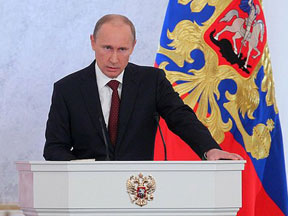
The first message to the Federal Assembly of Vladimir Putin to his third legislature inevitably was to answer one simple question - "how to continue to live and develop the country." The message is generally such a genre, but the “first message of the third term” is symbolically much more significant than other presidential performances. The status of statements is perhaps the highest, and their bureaucratic apparatus will try to somehow comprehend and even probably implement.
Putin's message turned out to be an extremely ideological performance. No, specifics like plans for the ban on officials have foreign accounts and real estate or an increase in the availability of mortgages for poor Russians, too, there were many, but ideology prevailed. And this is not the very ritual “blah blah”, but a certain claim to the designation of the country's development vector . Description of the desired future, so to speak.
And Putin supports and the path for development sees in a complicated phenomenon called “spirituality”. Here is the support on the “spiritual and moral education” and the need to restore the “ spiritual bonding of society ”, and the “millennial history” of Russia, and search units, and the monuments to the first world, and even the appearance of the Preobrazhensky regiment in the army.
The application is strong, but not quite original. Similar ideas, say, were contained in the Manifesto of Enlightened Conservatism behind the authorship of Nikita Mikhalkov two years ago. “The peoples and people who forget their history are doomed to disappearance. And we should not forget that we are aware of ourselves by the Russians, and not by the Germans, the French or the British, first of all, thanks to our past, ”writes Mikhalkov. “For the revival of national consciousness, we need to connect the historical eras and return to the understanding of the simple truth that Russia began not with 1917 and not even since 1991, that we have a single, inextricable, millennial story, based on which we have gained the internal strength and meaning of national development,” Putin practically quotes him.
Many ideas of Putin and the theses of the former “main Kremlin ideologist” Vladislav Surkov are also echoed. “The new democratic order comes from European civilization. But at the same time, from its very specific Russian version. He is viable to the extent that is natural, that is, national, ”Surkov said during a lecture on the topic“ Russian political culture. A look from the utopia. " “Russian democracy is the power of the Russian people with their own traditions of folk self -government, and not at all the realization of the standards imposed on us from the outside,” Putin echoes.
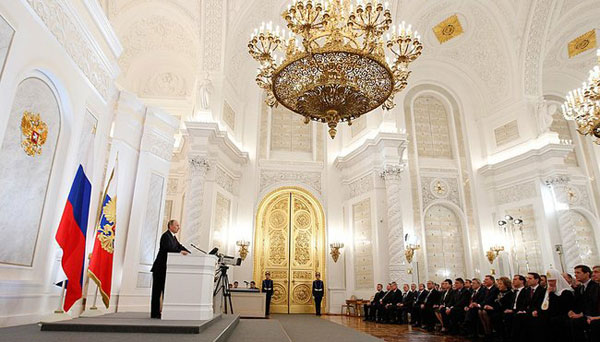 President’s message. Photo: kremlin.ru
In addition, Putin also directly quotes Solzhenitsyn (“patriotism is organic, natural feeling. And how a society cannot be preserved, where civil responsibility is not assimilated, and not to exist, especially multinational, where national responsibility is lost”) and calls him “remarkable, not in an eyebrow, but in the eye”. And speaks of the significance of studying the “basics of secular ethics and traditional religions” in the school. And the “creative class”, according to Putin, is, first of all, doctors and teachers.
It seems that for Putin the traditionalist trend of further development of the country is close. A kind of revival of the ideologist “Orthodoxy, autocracy, nationality” of Count Uvarov or in a more “folk” version “For faith, Tsar and Fatherland”. A kind of return to the era of the empire, only with a slightly changed design.
The Imperial Draff in the Putin (rather eclectic) ideology was not outlined yesterday. For strong state power, Vladimir Putin, say, spoke in the early 2000s. And his political technologists during the 2007 campaign actively promoted Putin’s theme as a “national leader” and even talked about some “civil cathedral of the Russian nation” on analogies with zemstvo cathedrals of medieval Rus'. Now this trend seems to have finally rooted in the minds of the “national leader”.
In the early 2000s, Putin came to the presidential post in the form of the president of the future, the president of hope, the president-reformer. Today he is more and more like a conservative president. If you like, “turns from a macho into a sage”, a kind of patriarch in politics. In a country where it is necessary to reform almost all spheres of life, such a president seems to be excess: either there will simply be no reforms (but everything will be reduced to the renaming of the regiments and the appearance of crazy “patriotic films”), or they will be so that not everyone will like it.
Read also the analytical article by Andrei Levkin “ 12 answers to 12 questions”