
Translated material
Mauser politician in the desk
Some call him a quick shifter Medvedev, others-Putin’s possible successor, others-a nationalist-state without special prospects. The New Times studied the career path of Deputy Prime Minister Dmitry Rogozin
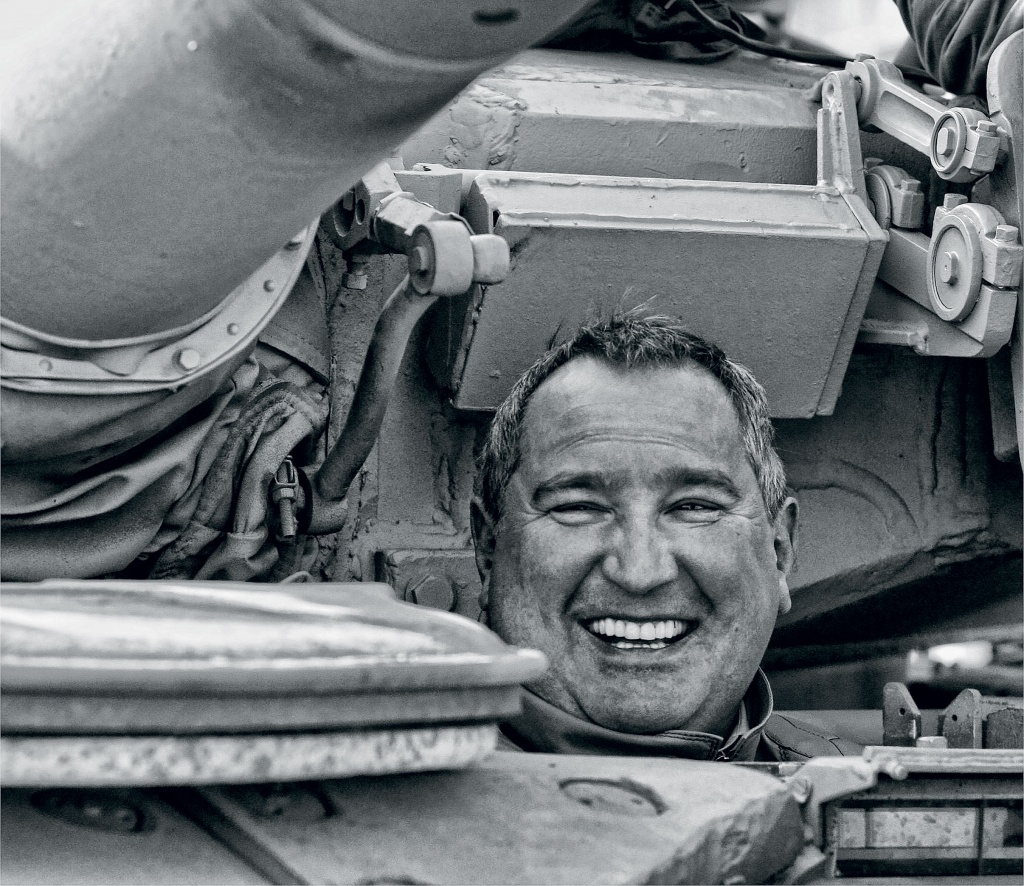
Deputy Prime Minister Dmitry Rogozin is a big fan of shooting
The first rumors that Putin had views of Rogozin appeared shortly after his appointment to the post of Deputy Prime Minister, responsible for the military-industrial complex, was too sudden the return of the diplomat from Brussels to Moscow at the very height of the protests in December 2011.
At the end of October 2012, against the backdrop of the high -profile case of Oboronservice, Rogozin read the post of Minister of Defense, but the intrigue was quickly resolved not in his favor. Nevertheless, on the sidelines, Serdyukov’s resignation was called the “victory”, including Rogozin: the confrontation of the two officials had long been public.
But experts again predict the 48-year-old Kurator of the military-industrial complex for another career take-off: the Institute of Globalization Problems issued the report “2013: the pushing of the liberal clan”, which predicts the resignation of the government of Dmitry Medvedev in the spring of 2013. “An exacerbation of the inter -clan struggle, legalized as the fight against corruption, has already acquired the character, scale and unpredictability, dangerous for the ruling class as a whole,” the report says. The authors call Dmitry Rogozin the most likely candidate for the post of prime minister.
Military bone
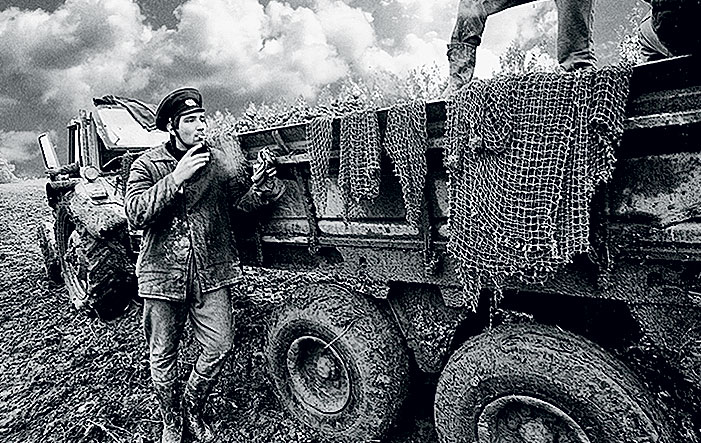 |
| Student of the journalism department of Moscow State University Rogozin on potatoes |
| ** Darpa, Defense Advanced Research Projects Agency, - Agency for advanced defense research projects under the US Department of Defense. |
“My father answered the USSR for all military science. For me, he is authority No. 1 in the reform of the Armed Forces. ” “My father proposed creating an analogue of Darpa with us* Another century ago.” "My father, being a major military scientist, has always considered a project of global about chimera and provocation." All these phrases are from Twitter Dmitry Rogozin. About the deputy head of the Armed Forces of the Ministry of Defense of the USSR (until 1989) and the scientific employee of the Russian Academy of Sciences, Lieutenant General Oleg Konstantinovich Rogozin, in a conversation with The New Times, mentioned everyone who came across Rogozin Jr. somehow: from school teachers to employees of the Presidential Administration.
When his father died in 2010, Rogozin wrote “The Baron Zholtok Baron, in which the chronicle of the last days of the life of his seriously ill father (“ Bati ”or“ Old General ”, as Rogozin calls him) is interspersed with historical sketches. The book claims that the clan Mitkevich-Zholtkov, to whom he builds his own way Rogozin, originates from the Prussian aristocracy. True or not, it is unknown, especially since the tree, according to the author, originates from the 13th century. The reconstruction of the not so distant past looks more convincing, the benefit of some archival documents on his Twitter was published by Rogozin himself. His great -great -grandfather on the paternal line is the retired police officer of Moscow, the veteran of the First World War, Denikinets and Belmigrant; The great -grandfather - a military pilot - also participated in the First World War, but after the revolution he remained in Soviet Russia and served in the Red Army. Grandfather Konstantin Rogozin in the Great Patriotic War was the chief engineer on the legendary battleship "Marat", who defended the blockade Leningrad. Given such traditions, it is not surprising that the senior (for ten years) Sister Rogozin Tatyana, having graduated from the Engineering Institute, went to work at the defense factory. By the way, the only son of Dmitry Olegovich (Rogozin is already twice grandfather) Alexei Dmitrievich in 2011 was appointed deputy general director of the Promtechnology group of companies, which was engaged in the production of small arms, and in July 2012, at the age of 28, he became the General Director of the Aleksinsky Chemical Plant of the federal treasury enterprise.
However, Rogozin itself by education is the humanitarian.
Hurricane
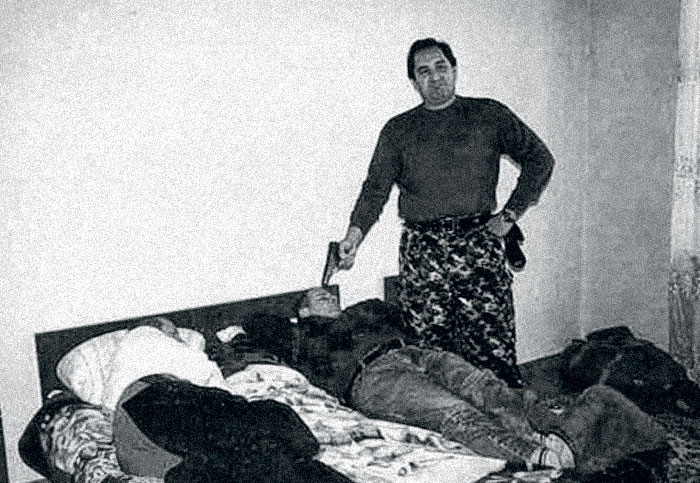 |
| Photo from the blog of banker Alexander Lebedev: "Here is such a humor in the State Duma" |
Dmitry Rogozin was born in Moscow in 1963. In 1981, he graduated from special school number 73 with in -depth study of the French language. According to his class teacher Natalya Parfenova, Dima made a dual impression: on the one hand, he was capable and even talented, and on the other, he “felt the strength to study, but did not study.” Humanitarian objects were given to him better - "he wrote magnificent poems, amazing works." Botanik Rogozin was not. “It was a storm, just a storm! - exclaims Parfenova. - When he entered the class - and he was large, tall, - so everything flew to the right and left. Energy beat over the edge. " Mom always came to parent meetings; The school knew that his father was a high -ranking military official. In high school, Rogozin became an active Komsomol member. But his successful career at school was surprised. “I always thought that he would be either a poet or a prose writer,” Parfyonova admits.
In the 9th grade, he decided to enter the journalism department of Moscow State University and enrolled in the school of a young journalist, shortly before the release he changed his mind and submitted documents to the Acting Department of VGIK, but either he did not pass the competition, or changed his mind again. As a result, in 1981, he nevertheless submitted documents to the international department of the journalism department, but fell out that it was surprising - in French and essays, he went to the evening department, but a year later he was already at the prestigious international department, for which the questionnaire and parents were of paramount importance. However, according to Rogozin himself, his father was against the journalistic career of his son. “He was always noticeable. Tall, very thin, black, with a long nose, ”Rogozin’s classmate told The New Times on anonymity. - That his dad is a general, everyone knew, but at the international, we generally studied golden youth. He was friendly, cheerful, fussy, cuttled constantly. The companies did not get drunk much. Not smoked. He married very early, in the second year. ”
The chosen one of Rogozina was the student of the philological faculty Tanya Serebryakova, the daughter of an employee of the first main department of the KGB of the USSR, Colonel Gennady Serebryakova. A year later, their son Alexei was born.
“Rogozin defended two diplomas, which no one did,” says a classmate. - He trained in Cuba: he owned not only Spanish, but also French and English. One diploma was dedicated to the French President Mitterin, the second - under the heading of "secret" - the US Psychological War against Cuba.
Referent
After the university, Rogozin went to work in the Committee of Youth Organizations, which was considered a synecure for children from the nomenclature and the “roof” of the KGB. The first position is the younger referent. Professor of the Department of World and Russian History of MGIMO, Alexei Podberzkin, remembers well that time: “I was a scientific consultant in KMO, and he was a full -time employee. The referent was engaged at once: he prepared trips, and wrote reports, and made certificates. ” Abroad, which in Soviet times was a privilege, and in capitalist countries - so it is also a form of trust in the CPSU Central Committee and KGB, Rogozin was easily released - he went to Belgium, France, to Chile. “The father’s position certainly influenced,” says Podberezkin. “But without the talent of Dmitry, nothing would have happened.” By the way, Podberezkin about the KMO ties with the KGB answered in the affirmative. Rogozin himself in an interview with different years hinted that the KGB showed interest in him in his student years during a trip to Cuba. How successful is unclear.
"
That his dad has a general, everyone knew, but at the international, we generally studied golden youth. He was friendly, cheerful, fussy, cuttled constantly. I didn't get drunk in companies
"
The current VTB-24 vice-president Mikhail Kozhokin also knows Rogozin at that time: “In the late 1980s, I was the chairman of the Association of Young Historians. We were looking for people in power structures that could help us. One of them was Rogozin. He was open to new ideas, knew how to work with people of various political views himself. The views were a statesman. ”
In KMO, Rogozin worked until August 1990: art media then published articles on repressions, the political police - the KGB - ceased to be a fashionable and promising place. However, Rogozin himself later said that he had left because he did not want to join the CPSU. And the truth: then many did not want.
He hit politics: he was a member of the board of the Russian People’s Assembly, established by Congress of civil and patriotic forces, and created the Union of Renaissance of Russia together with the now zoological anti -Semite Andrei Savelyev. In 1992, with its active participation, the formation of the congress of Russian communities began, "an interstate organization to protect the Russian -speaking population, which was after the collapse of the USSR outside Russia." It was always an ardent antelcinist. In 1993, he tried to go to the State Duma: he participated in the elections in the Northern Electoral District in Moscow, but lost to the candidate from the Gaidar “Choice of Russia” by Alla Gerber. “The voters did not like his nationalist statements,” she told The New Times. - In the Northern District, people are quite intelligent. And he said: Russia for Russians. " The enemy then seemed to Gerber “stupid” and “miserable”: “And I could not imagine that this person could make such a career.”
Where does the "homeland" begins
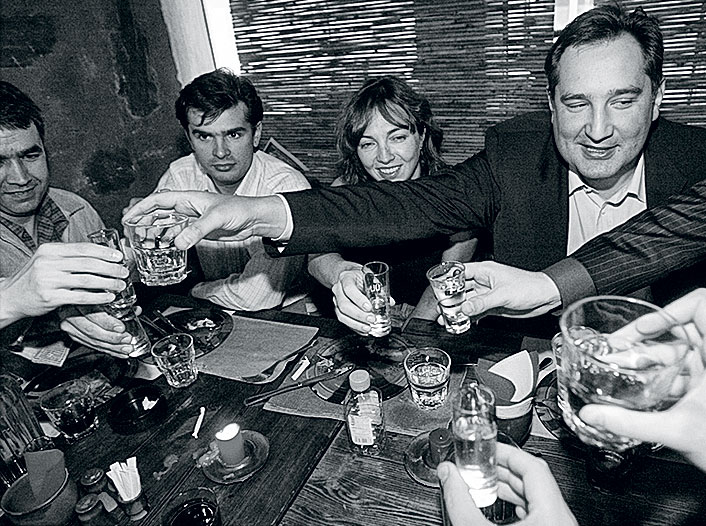 |
| MP Rogozin at the presentation of the Youth Union of the "Motherland" in the Club "Che Guevara" |
In the end, Rogozin finally got into the Duma-first in 1995, then, as an independent candidate, he re-elected in 1999, but there was no real power behind him. Everything changed with the coming to power of Vladimir Putin. No, at first he allowed two oversights: he became a supporter of General Lebed, who quickly found himself in disgrace, and then he was moved in the “Fatherland” of the Moscow Mayor Yuri Luzhkov, who declared his claims to the Kremlin and promised the fate of the hanged dictator of Romania Chausko. But the Rogozin’s God and the connections were stored: a couple of weeks before Putin became the chairman of the government and it became obvious that Yeltsin chose him in the successors, Rogozin left the Luzer movement, went to Duma-99 as a single-member and completely received the prestigious cabinet of the head of the Duma committee on international affairs. One of the sources in the close environment of the defense deputy prime minister said that Rogozin was introduced to Putin back in 1999, when he was acting president. Rogozin himself in his book “The Enemy of the People” (2006) writes: “In January 2003, at the next meeting in the Kremlin, the president asked my attitude to the United Russia party. / .../ “I understand that perhaps you don’t want to smell, but still I ask you to think about heading the General Council of United Russia,” Putin allegedly told him. The interlocutors of The New Times say that in 2003 Rogozin was really considered the candidacy of Rogozin, but Yuri Luzhkov was against, and as a result of Rogozin they pushed pushed. But here, before the parliamentary elections, the formation of the Motherland block began, which actually was the entire Rogozinsky Kro. The new block was supervised by the deputy head of the Kremlin administration Vladislav Surkov, who then decided to introduce nationalists into the game. "And what political projects were not Surkovsky then?" - says banker Alexander Lebedev, who in 2003 was a member of the Rodina block and even helped him with money.
Political scientist Stanislav Belkovsky told The New Times that at that time the Communist Party was still afraid in the Kremlin, and the new party was needed to delay the voices of the Communists. Andrei Saveliev, who worked as an adviser to Rogozin in the State Duma Committee on International Affairs, and then the deputy of the Rodina faction, confirmed The New Times that the new party was initially occupied by the niche on the left flank, but Rogozin insisted on the “national-patriotic” concept. In the party’s election videos, its leaders advocated the fight against the oligarchs that after the arrest of Mikhail Khodorkovsky in 2003 it became a topic of No. 1 on the television screens, and Rogozin himself came in to various television shows - as a defender of the oppressed Russian people and Patriot and demanded to plant Anatoly Chubais.
Populism, coupled with the support of the Kremlin, helped to gain 9.02% of the vote and triumphantly go to the State Duma, actually becoming the third faction after United Russia and the Communist Party. When, after a couple of weeks, Rogozin celebrated his birthday, at the celebration he raised a glass and Vladislav Surkov for him.
"Homeland" in danger
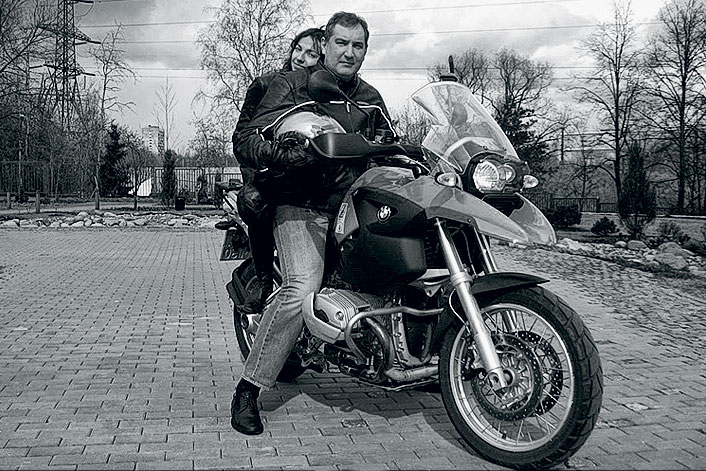 |
| With the wife of Tatyana on the BMW R1200GS Adventure: “A large, high and powerful motorcycle. I call him "trophy", - from Twitter |
The National-patriotic project had a short life: already in 2006, Rodina became part of the Just Russia, which was created under the then head of the Federation Council Sergei Mironov. The reasons for this are called different. Someone says that Rogozin then demolished the roof then and he violated some agreements with Putin, someone puts forward the opposite version: everything was fine with Putin de, Dmitry Olegovich could call him directly, but even the head ideologist of the presidential administration (and now colleague Rogozin and also Deputy Prigorer) Vladislav Surkova did not like it. However, a person from the surroundings of Rogozin claims that "Dmitry was not a man from Putin's near circle." Finally, in the fall of 2004, during the Ukrainian Orange Revolution, Rogozin was seen on the Maidan - a photograph (not of very good quality), where he stands in an orange scarf near Yushchenko, was preserved on the network. They say that Putin immediately fell on the table, after which the leader of the “Motherland” deleted from the lists of the first person admitted to the first person (Rogozin himself claims that he was not on the Maidan). Sergei Baburin, whose party was then part of the Modern block, told The New Times that Rogozin’s trip “to the Orange Revolution” also caused a crisis inside the faction - many colleagues condemned him. Finally, they say that the last straw was a hunger strike, which Rogozin declared in the Duma in the winter of 2005. “Homeland” then furiously opposed the monetization of benefits, demanding the resignation of several ministers. “Monetization” was Putin’s personal reform, which turned out to be unpopular: the protests of pensioners swept throughout the country, the president’s rating fell from 84% to 48%. And then Rogozin also strikes the back. Political scientist Marat Gelman, who worked with his homeland at one time, told The New Times that this demarche of Rogozin was probably the result of a “powerful injection of part of society, and it turned out to be intoxicated to him. Perhaps that hunger strike was pure populism, but he looked sincere. " “He was in the information blockade, on TV they were branded for this hunger strike,” said Socialist writer Sergei Shargunov, the New Times. - After he was constantly “soaked” on TV. In the program “Sunday”, for example, a hidden camera was shot by Rogozin’s meeting with Saakashvili - just like “Anatomy of Protest” is being removed now.
The media attack was not done: the Kremlin made a decision, as Belkovsky, who was still entering the cabs, “merge” the party, was afraid that she would begin to take away the electorate and voice from United Russia.
The Rogozin received a knockout in the fall of 2005, when the “homeland” was removed from the elections to the Moscow City Duma for the election video. In this 30-second video, which the TVC television channel managed to show, Dmitry Rogozin with a party’s colleague in an extremely rude form addresses the visiting from the Caucasus, and the video was married to the credits: “Clean Moscow from garbage.” And it swept: the “Rodintsev” began to be removed from the regional elections - as they say, “on the command of Surkov”.
And Rogozin surrendered: in April 2006, he announced his departure from the post of chairman of the party and the head of the Duma faction. He said that the Kremlin actually presented an ultimatum: "Homeland" can exist only in case of a leader's change. " For two whole years, a young and ambitious politician from big politics fell. Many thought - forever. Mistaken.
Nationalist
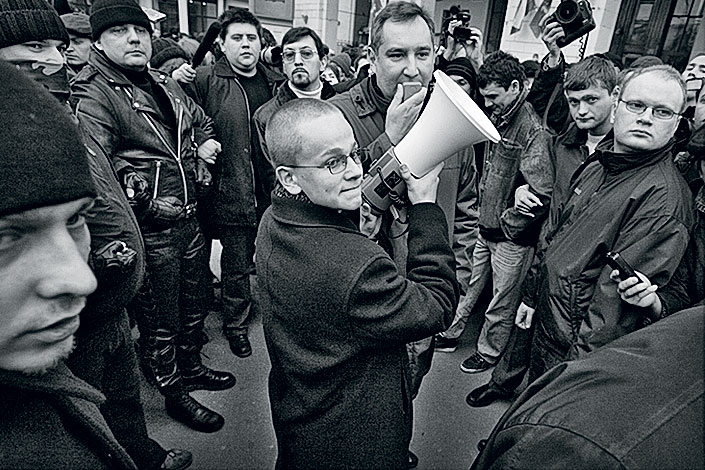 |
| Rogozin on the "Russian march" organized by DPNI in 2006 |
“He was never Nazik,” says writer Shargunov. “He was a patriot-state and before others began to say what is now considered a trend, for example, about the problems of illegal and uncontrolled emigration.” Konstantin Krylov, the leader of the National Democratic Party, who in 2006 was the editor-in-chief of the Russian March newspaper, explains that the ideology of Cro, which these two years again led Rogozin (the movement was quite marginal), lay moderate patriotism with a pro-Russian shade.
In the speeches of that time, Rogozin looks like a strange parody of Alexei Navalny. For example, at a rally of Russian nationalists on April 14, 2007, he screams into the microphone: “We will prepare a new ruling class of the country, which will ensure the prosperity of our great power! And in relation to embezzlers, crooks and traitors, we will apply the most stringent measures of social justice, up to the death penalty! ” It seems a little more and sounds: "Crooks and thieves, five minutes for fees!"
But in 2008, Opala - unexpectedly for many - ended: by decree of Vladimir Putin Rogozin, who had been organizing the Russian Marches in recent years and came to meetings in the fashionable yellow jumpsuit of a motorcyclist, was appointed a regular representative of Russia under NATO in Brussels. Источник The New Times в администрации президента говорит, что у решения Путина было две причины: во-первых, над Рогозиным просто сжалились — решили, что политик получил достаточный урок; во-вторых, держать его в Брюсселе было комфортно и безопасно. Якобы на новую должность его кандидатуру лоббировал тот же Сурков.
«Нужно понимать, что для людей его типа нет противоречий между личными убеждениями и политической деятельностью, которая требует известной гибкости, — говорит Константин Крылов. — И он, как и всякий человек этой породы, способен отложить свои убеждения на неопределенное время ради достижения своих целей. Ему было важно вернуться во власть». «Наверное, он правильно сделал, что согласился, — сказал The New Times лидер запрещенного ДПНИ Александр Белов. — Он отлично смотрится в галстуке в Брюсселе, но не с мегафоном в руках на «Русском марше». «Я в принципе удовлетворен тем, что русский националист, каковым Рогозин, безусловно, является, занимает теперь такие посты. Это хороший плацдарм для дальнейшего прыжка», — считает и другой организатор «Русских маршей» Владимир Тор.
Diplomat
«Пора завезти в аптеку НАТО пару тонн антидепрессантов», — писал дипломат Рогозин из Брюсселя в своем твиттере, представая перед читателями бойцом в тылу врага. «Американцы и их союзники вновь хотят обложить берлогу русского медведя. Медведь вылезет и надерет задницу» — это уже стало апокрифом. Однако собеседники в российском МИДе над агрессивностью риторики Рогозина только подсмеивались: «Вопросы с НАТО решаются на другом уровне и во многом урегулированы. Агрессивные заявления Рогозина нужны были для трансляции в российских СМИ, а также ему самому — чтобы сохранить статус и популярность в России». Сотрудник французского МИДа на условиях анонимности рассказал The New Times, какое впечатление производил Рогозин на иностранных коллег: «Он являл собой полную противоположность стереотипу дипломата. Резкий, эпатирующий, подчас грубый и даже вульгарный, он при своем появлении в кулуарах НАТО сначала вызвал недоумение, потом нервный смех, а после — отторжение. Многие дипломаты не просто его на дух не переносили, но даже открыто выражали это, как, к примеру, американский посол при НАТО Иво Даалдер». По словам источника, Рогозин совершенно не следил за языком — например, во время переговоров по системе ПРО в Европе выдал любимую киноцитату Сталина: «Кто с мечом к нам придет, тот от меча и погибнет». В своих выступлениях он всегда, словно в издевку, употреблял русские пословицы и поговорки, которые иностранные коллеги понять не могли: «Когда американцы сказали, что Конгресс никогда не одобрит требований России по той же противоракетной обороне, он сказал что-то типа того, что Конгресс США похож на ребенка, который хочет простудиться назло маме».
Этот демарш Рогозина, вероятно, стал следствием мощной инъекции поддержки части общества, и она оказалась для него опьяняющей. Возможно, та голодовка и была чистым популизмом, но он выглядел искренним
"
Наконец, прекрасной иллюстрацией непонимания дипломатических правил французский дипломат назвал ролик, который супруга Рогозина выложила на YouTube в качестве подарка на день рождения мужа (Татьяна Рогозина пробует свои силы как эстрадная певица; в клипе на ее песню Stay Forever снялся и Дмитрий Рогозин): «Весь Брюссель только об этом и говорил: такого вульгарного китча со стороны жены посла мы не видели никогда. А ему было, кажется, все равно — он искренне не понимал, что в этом такого». По словам источника, было заметно, что Рогозин не любит свою работу в Брюсселе — не сработался с коллегами, не находил контакта с другими послами: «Я думаю, Брюссель стал для него настоящей каторгой».
Deputy Prime Minister
В декабре 2011 года Рогозина из ссылки вернули. Тогдашний президент Дмитрий Медведев внезапно назначил его заместителем председателя правительства РФ, курирующим вопросы ВПК и оборонзаказа. СМИ писали, что главной задачей Рогозина будет сглаживание конфликтов между отечественными оборонными предприятиями и военными. «(Глава «Ростехнологий») Чемезов довольно уныл, Рогозин был нужен ему в качестве хорошего спикера», — говорит политолог Белковский. Источник The New Times в Министерстве обороны не столь критичен: «Путин заложил такой бюджет на оборонку, что фактически развернул в эту сторону всю программу социально-экономического развития. В оборонку реально деньги пошли. Нужно было назначить человека, который бы за этим следил. И тут хорошо, что Рогозин не военный».
Тот же источник перечисляет достижения Рогозина на новой должности: «Вступил в конфликт с Минобороны по поводу банкротства ряда оборонных предприятий — у МО был большой соблазн их обанкротить и перепрофилировать, Рогозин их отстоял. Во-вторых, он добился того, чтобы Минобороны осуществляло предоплату, когда делает заказ у отечественных предприятий. Наконец, он сейчас пытается создавать Фонд перспективных исследований, аналог американского DARPA, которое занимается разработкой инновационных проектов для армии. Летом этот проект уже одобрили Дума и Путин».
Successor?
Все без исключения собеседники The New Times отмечают: Рогозин харизматик, что для публичного политика важно. Рост — 190 см, крепко сбитый, красивый профиль. Хобби: мотоцикл, гандбол (мастер спорта), подводная охота и стрельба. Коллекционирует старые утюги. Любит и умеет выпить, но знает меру. Кажется грубоватым, но подкупает простотой общения. Знает множество анекдотов, правда, юмор его бывает весьма специфическим. Банкир Александр Лебедев в своих воспоминаниях о Рогозине описывает такой эпизод: он зашел к Рогозину в думский кабинет, тот налил ему чаю, а потом вдруг достал из ящика стола маузер и протянул Лебедеву — мол, посмотри, подарок министра обороны Сергея Иванова. После этого Рогозин аккуратно, тряпицей, забрал пистолет. «Ну вот, теперь у меня есть и твои, и Серегины отпечатки. Так что вы, штирлицы, теперь у меня в кармане — ежели кого потребуется в расход пустить, на вас свалим». В своем блоге Лебедев выложил и фотографию: два мужика лежат на кровати, ко лбу одного из них смеющийся Рогозин приставил пистолет.
Подчиненные Рогозина любят: дает высказаться, пристраивает по специальности разжалованных. Неплохо относятся к нему и в армии — особенно старые генералы, которые помнят его отца. В последние месяцы Рогозин постоянно мелькает на госканалах. Кто-то полагает, что это привычка публичного политика, который всегда думает о будущих избирателях. Кто-то, напротив, полагает, что это признак того, что у него нет постоянного доступа к «уху». Третьи говорят, что он по должности «к Путину вхож, но своим — не питерский, не служил в органах — так и не стал». Михаил Делягин, директор Института проблем глобализации, который в своем докладе пророчит Рогозину новый карьерный взлет, этот прогноз аргументирует так: «Он абсолютно управляемый, договороспособный, в состоянии симулировать независимость, хорошо известен Западу». Сам Дмитрий Рогозин в ноябре в интервью Владимиру Познеру на Первом канале заявил, что президентских амбиций не имеет. Но люди, хорошо его знавшие, уверены, что это не так. «Он мечтает быть преемником на посту президента», — уверен банкир и совладелец «Новой газеты» Александр Лебедев.
The New Times направил свои вопросы секретарю вице-премьера Дмитрия Рогозина. There was no answer.
фотографии: Алексей Куденко/Коммерсант, Игорь Флис/ Коммерсан, Александр Миридонов/Коммерсант, Сергей Мамонтов/РИА Новости, Motonews.ru, фотографии: т