
Translated material
Learning is cheaper abroad than in Russia
As investments in education, the depressive cities of America were raised, why more than 50% of universities graduates cannot find work in a specialty where to find refuge for those who filled up the session, and why is it very good too.
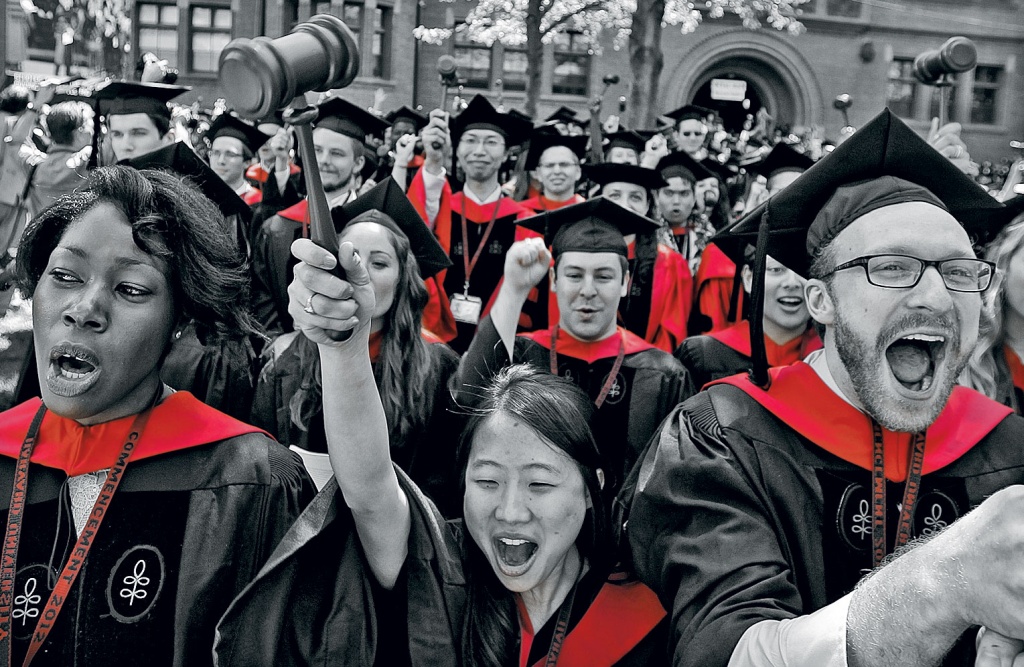 |
| Graduates of the Faculty of Law of Harvard University celebrate the receipt of a degree |
Stronger steel
We all know from history textbooks that the cities were formed around factories and factories. These times have sunk into the past: in the post -industrial economy, universities and medical centers took the place of industrial giants. A good example of this is the American Pittsburgh, Pennsylvania. Once it was a city of steel, but in the early 70s it turned out that it was cheaper to import metals, and it is more profitable to contain production outside America, say, in Asia. The city, like many other industrial centers of the United States (and this is how well known to Russian single -industry towns) survived difficult times and a sharp increase in poverty among the population. And then Pittsburgh relied on investments in education and healthcare. And today the largest employer of the city was the Medical Center at the University of Pittsburgh (UPMC): about 60 thousand people are working there, and its revenue is more than $ 9.5 billion. Every year, the center invests in new medical technologies $ 450–700 million, spends about $ 250 million on research. This is a real business of hospitals in the country, several subsidiaries abroad (Italy, Japan, China), a transplant center in Singapore and the National Center for the Treatment and Study of Cancer in Kazakhstan. The second pillar of the city economy was the University of Carnegie-Mellon, notes the urbanist and creator of the Telestrian information and analytical resource Aaron Renn. And Pittsburgh is by no means an exception. And in Chicago, the largest city in the Middle West, education has become one of the main segments of the economy. A similar story in Dutch Rotterdam and German Berlin, where there are 133.6 thousand students. Moreover, 54% of students studying in the city is not Berliners, but more than 10% - foreigners: cheapness and super popular clubs attract youth from around the world to the capital of the former communist GDR.

Blessed barrel
Over the years, education expenses in developed countries have only grown. Education has become one of the most investmently capacious spheres of the economy, it presents a giant and practically unsaturated demand for investment.
Here are just a few examples of recent days. The British Council for Natural Sciences allocated £ 800 million ($ 1 billion 291 million) of budget funds for research and development only this year. The Government allocated $ 26 million to the University of Kanberra (Australia) to prepare new courses, new educational technologies, etc. In total, the country allocates 377 million Australian dollars (397 million 960 thousand - in US dollars), and a special fund allocates these funds between universities this year. Nottingham University invests £ 20 million in research in the field of biotechnology and synthetic biology - so that Britain becomes a world leader in this area.
The University of Nepobra is increasing the power of its student campus from 25 thousand to 30 thousand students and plans to double the costs of research and development in five years. Last year, this university opened the innovation campus - a space of 185 thousand square meters. m for research, where 7 thousand people work simultaneously, there is a space for laboratories, conferences, etc. This required $ 80 million state and private investment. The University of Georgetown invests $ 8 million in a fund that distributes funds to new educational technologies on a competitive basis between the faculties.
Scientific and educational pleasures are very expensive. In the United States, higher education costs have almost reached 3% of GDP; The mark of 2.5% of GDP, according to the OECR, exceeded Canada and Korea.
Educational inflation
 |
But to what limit can education and medicine costs grow? Until recently, economists did not ask such a question, believing that "the more, the better." The studies of James Rauch from the University of California, made by him back in the 90s, showed that in large cities every additional year that a person spent on education increases his labor productivity by 2-3.6%.
Studying for several years at universities, people spend money (and do not use the opportunity to earn it immediately) in exchange for the future. They count on a more interesting work, a decent salary, the opportunity to try themselves in various fields of activity.
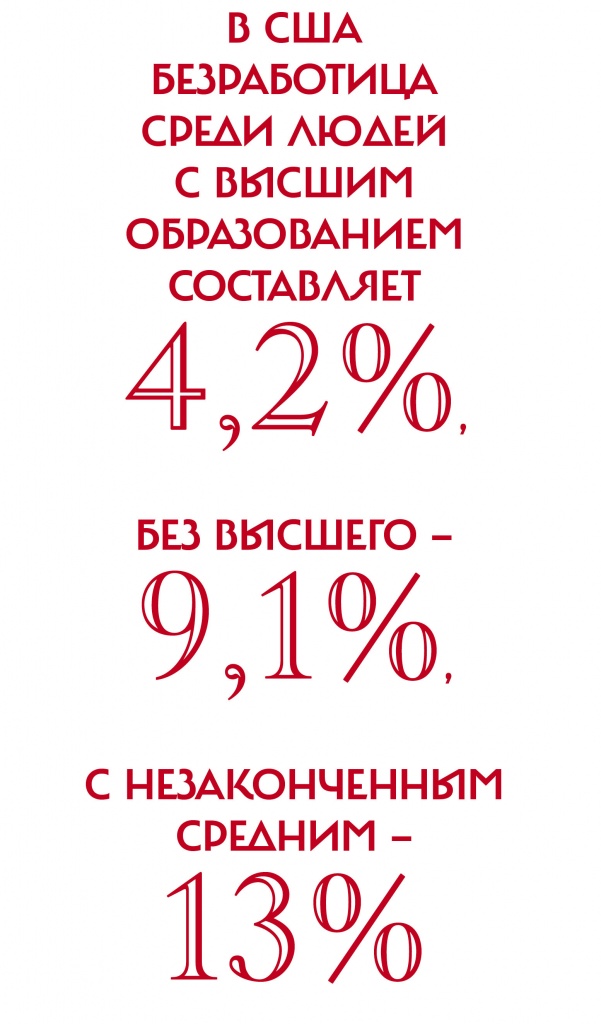
In the United States, for example, unemployment among people with higher education is only 4.2%, without a higher one - 9.1%, and with an unfinished average - 13%. But among very recent graduates, unemployment is higher: 53% of them work not in their specialty or do not work, the cost of education is growing much faster than inflation. In the United States, average inflation since 1978 amounted to 3.9% per year, and the cost of higher education has grown twice as fast - by 7.4% per year. The cost of medical services is also a little behind them - they value 6% per year. The total volume of educational loans exceeded $ 1 trillion (ten years ago it was four times less), and many analysts believe that the crisis in it can be comparable to what happened on the secondary mortgage market, which has become a trigger of the full -scale crisis of 2008, which is still stretched. At the same time, educational loans, unlike ordinary ones, cannot be repaid through bankruptcy. If the bubble of educational loans really bursts, this market can be reformed. For example, regulators can force universities to be jointly liability to banks for their students.
This global, global world
The result is a decrease in the demand for education. If last year in the United States only 21% of students and parents believed that an educational loan over $ 20 thousand is too much, now this figure has grown to 42%. And the proportion of adults who consider the formation of a good investment fell from 81% to 57%. The problem, of course, is not in the expediency of education itself, but in its price.
In the 1980s and even the 90s, when there was a decline in industry, higher education was almost a guarantee of success in the labor market. But now the world has turned over: the “white collars” have encountered unexpected competition of consonants on the significantly smaller earnings of colleagues from India and other English -speaking countries. It has become more difficult for programmers and accountants to find work in the same United States: their work can be outsourced abroad.
Finally, education is lags behind technological progress. University knowledge may be outdated by the time of end of education. In addition, even a teenager can launch an Internet startup-a good idea here is more important than education, and implementation may be inexpensive. Peter Til, President of Clarium Capital and the first external investor on Facebook (he bought 10.2% of this company for $ 500 thousand in 2004), even pays students who quit his studies to open their business. After all, Bill Gates and Mark Zuckerberg did exactly so at one time.
Perhaps education and medicine are gradually approaching the line, beyond which, such as recently, financiers, will have to cut expenses and reduce employment. Until now, these sectors, protected by the budget, have not passed through such crises. It will be very difficult to reduce expenses: over the past 70 years, employment in the education and medicine of the United States has grown by an order of magnitude - from 2 million to 20 million people. Comparable (but much less) was only an increase in employment in the sector of business services and retail: over the past ten years, almost half of the new jobs have been created in sectors depending on the budget - education, medicine and government.
Forecast for Russia
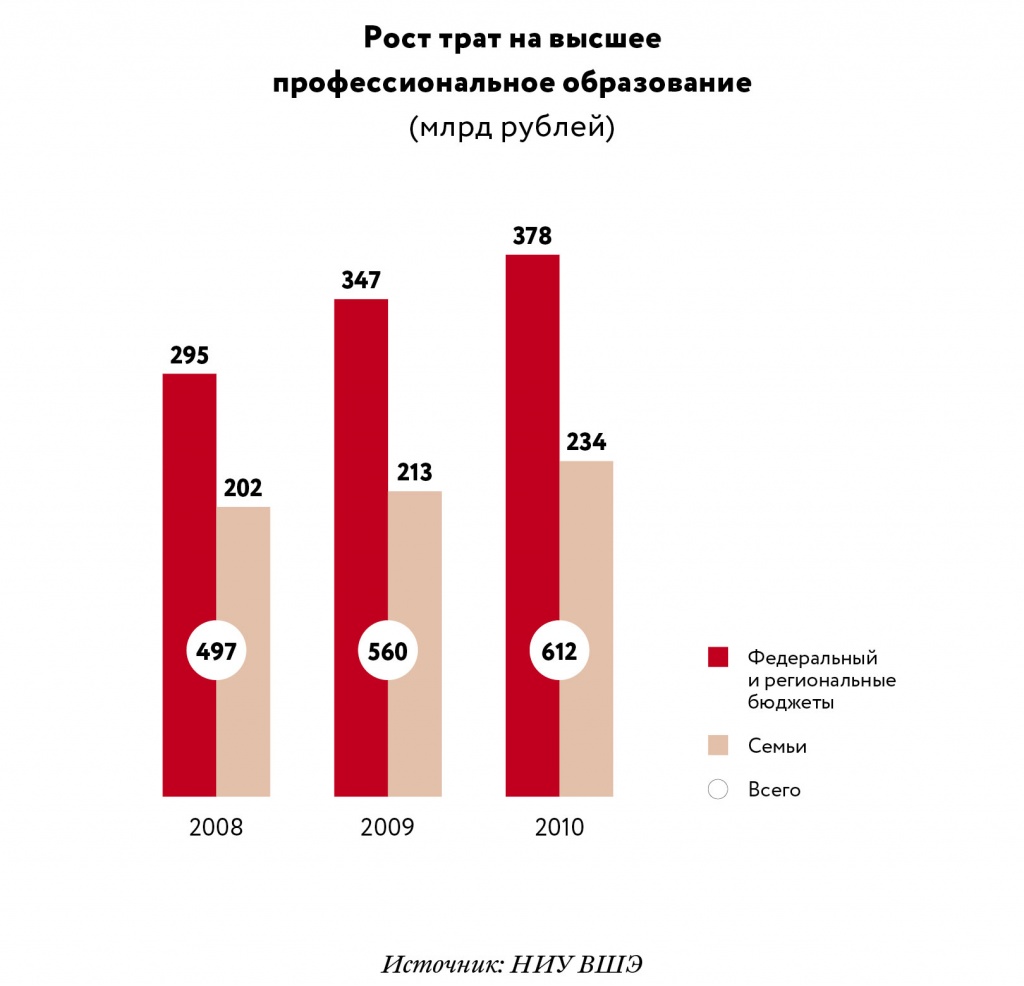
It seems that all these conversations should not touch us: we have too small expenses for education and medicine, too large after the difficult 90s, the scale of their underfunding. At the same time, the cost of education continues to grow. The money of the population is 38–40% in the total income of higher education (see schedule).
The cost of education is rested on the ceiling of the solvency of families, which spurred the development of the market of educational loans. For example, the cost of annual training at the journalism faculty of Moscow State University reached 287.2 thousand rubles. The salaries of journalists, as you know, are very small, so it will be difficult to return this amount even to those who are going to work in Moscow and St. Petersburg.
At the RSU - a university, due to a misunderstanding of the Ministry of Education dysfunctional according to the version of the Ministry of Education - training at the Faculty of Economics and Management costs 116.6 thousand rubles in one semester, that is, 233 thousand per year. But this is the non -core faculty for the university, where humanitarian disciplines are taught at a much stronger level than the economy! Education of the Humanities at the RSUSU, however, will cost about two times cheaper. Hence it is obvious that the price of education is determined not so much by its quality as with solvent demand.
The cost of education in Russia is approaching its value in decent Western universities. For example, one semester of training for a lawyer in the City University of New York costs a state of $ 6900 (for non-residents, that is, for those whose families did not pay taxes on the state, $ 10,900). And the year of study at the bachelor at the Bokkoni University of Milan costs $ 6050–13 500. As a result, families with medium and high income have to think: pay Russian universities or send a child to the university abroad - education at the second row there is no worse there, and the prices are lower. Although, of course, Harvard, like other universities of the first thirty, so far on the absolute majority is too tough: a year along with expenses for textbooks and life there will cost $ 50 thousand.
Meanwhile, competition in education is already becoming global. American and British universities can afford large costs - they know that even in case of falling demand among young Americans, universities will be able to compensate for the hole in the budget due to students from other continents. And what will Russian universities do, which are also connected by numerous “education standards”, programs from “United Russia”, and now the Russian Orthodox Church? The loser in the global market pays much more than twice.
Photo: Reuters