
Translated material
Battles around Heraclitus
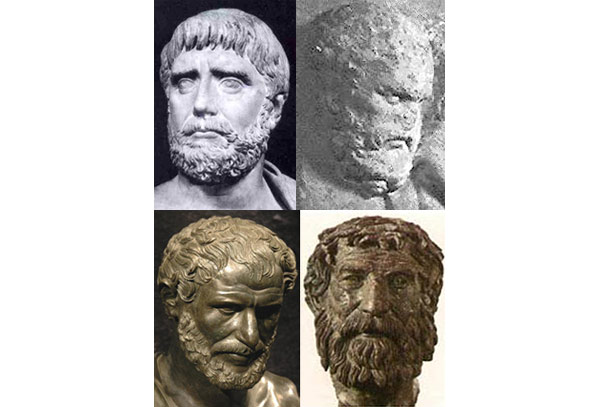
Suddenly, a sharp replica of the famous scientist was caused by his colleague’s publication about the ancient philosopher. The historian of ancient philosophy Andrei Lebedev, among other things, the father of the famous media designer Artemia Lebedev and the spouse of the writer Tatyana Tolstoy) in a public letter, S.N. Muravyov, also a historian of ancient philosophy, who recently published a book about one of the most mysterious representatives of the pre -Osocratic philosophy of Hercity of Ephesus. The book was published in Vienna in French, and then in Moscow (ed. Ad Marginem) in Russian: Herciting Ephesus. The whole legacy. In the languages of the original and in Russian translation: a brief edition. / Prepared by S.N. Muravyov. - M.: LLC “Hell Margin Press”, 2012. - 416 p., Ill [16 p. vn.]. - 2000 copies.
For the work of S.N. Muravyov, who worked on the translation since 1968, Lebedev promises Muravyov the “heavy paw of the bear” for the fact that, according to Lebedev, “without knowledge of the Greek” dared to publish Heracles. The examples given by Lebedev at first glance make a terrifying impression.
But, unfortunately, Lebedev picked up examples somewhat tendentially and without taking into account the special translation method of Muravyov. In a completely different way, he looked at the work of Muravyov A. Markov in a review of the “Russian magazine”: “At the same time, Herclite Muravyov should be read-not only because this work was highly appreciated by Ml. Gasparov and V.V. Bibikhin. Muravyov re-introduces the disciplinary division of ancient philosophy-he watches how little the Heraclitus of“ Biology ”and how many“ ethics ”and politics. This immediately suddenly revives the picture of antiquity - in the place of the philosophical cyborg, the native world of meanings turns out to be. ”
Both in the review of Markov, and in an angry letter of the angry Lebedev Sr. from the Retimino ( published on the Blog by A. Zhmudi), in essence, an important question is raised about philosophical hermeneutics, about the boundaries of the antique philosophical texts that are permissible when translating. Lebedev advocates philological severity, ants (and, coupled with him, and the late specialists M. Gasparov and V. Bibikhin) - for relative freedom within the framework of a large hermeneutic task. Without such freedom, the text of Heraclitus, according to S. Muravyov, will remain incomprehensible. It is not for nothing that Heraclitus was called “dark” (σκοτεινός) during his lifetime.
The public letter ends with the phrase: “If I were asked to compile a rating of Heraclitites from the time of the Renaissance, I would not hesitate to put you in the very last place and miserable senile. Farewell and do not dare to bother me anymore.” But it seems that the dialogue about the translation of ancient philosophy is just beginning. No wonder M. Hidegger said that without a deep knowledge of ancient philosophy, it is impossible to understand either the crisis of European thought in our time or European civilization in general.