
Translated material
"Chronic pain changes a person"
What are the consequences for the country to have a disease of the head of state
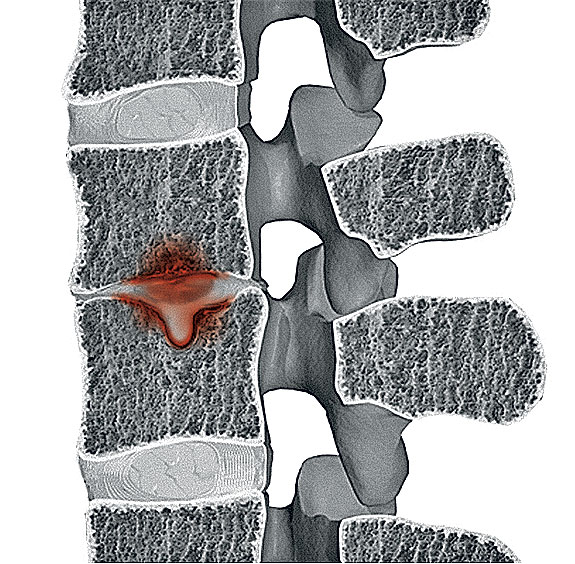
Damaged vertebra (bone tissue is sealing around a hernia)
The conversations and rumors about the disease of President Vladimir Putin have long gone beyond the Kremlin: the world press endlessly writes about this, reminding about the abolished visits and meetings with the heads of state and governments.
Information flowing from the Kremlin corridors: Putin damaged his back, with which he already had problems, as a result of a strict landing on a motor -plaplan on September 6, which led to the formation of a hernia of the intervertebral space. However, his spokeswoman Dmitry Peskov assures that the president "pulled the muscle in training." "Do you need to know this?" -Putin harshly asked the NTV correspondent, who asked the question of the president’s daughters during a recent press conference that lasted 4.5 hours. The subtext was obvious: my personal life does not concern you. Meanwhile, concerns. Once, in July 1996, during the second round of the presidential election, the country chose the head of state, who on this day could neither walk nor say: Boris Yeltsin had a heart attack and a stroke. And the next four years, the country endlessly observed the president, who “worked with documents” and was angry that “they didn’t sit down”, but led others.
Disease
The appearance of intervertebral hernia is often associated with inappropriate physical exertion - especially in middle -aged people, says Alla Strutsenko, associate professor of the Department of Nervous Diseases and Rudn neurosurgery. “A person between the bodies of the vertebrae has intervertebral discs that perform the shock -absorbing function and are designed to ensure the mobility of the spine. These discs consist of a dense external fibrous ring covering the inner core, which contains a lot of moisture, ”she explains. With age, the discs wear out, lose their liquid, become less elastic and can crack, for example, from a sharp lift of weights or as a result of sports injuries.
“Such cracks are ruptures of fiber fiber rings. These fibers are quite elastic, and if a fragment of the nucleus falls into the gap site, they can lean together. This is the intervertebral hernia, ”says Strutsenko. According to her, even a small hernia of 2-4 mm can cause severe pains. A large hernia, compressing the roots of the spinal cord, can lead to loss of sensitivity, to paralysis in certain muscle groups.
“The pains are severe and burning, gradually they begin to give in the leg, at the far -goed stages a person literally puts his leg. He cannot walk a lot, sit for a long time-he needs to either lie or stand, ”adds Alexei Mashinsky, a surgeon from the regional center of preventive medicine.
Treatment
According to the candidate of medical sciences, Mark Leontyev, in cases where there are no signs of compression of the cerebrospinal spine or other nerve formations, conservative treatment of a hernia is quite possible - without surgery: “It includes, among other things, drug improvement of blood circulation, and physical education - strengthening the muscles of the back, improving control over the muscles of the spine”.
“Immobilization of the spine, that is, an elastic comfortable bed with a fairly hard mattress, local heat and non -steroidal analgesics are the main triad of therapeutic techniques, which in many cases allow to stop exacerbation of pain. Explosion, massage, physiotherapy exercises, physiotherapeutic procedures, blockade are widely used, ”Alla Strutsenko transfers treatment methods.
According to her, if for three or six months, the doctors have no consensus - conservative methods do not help, you need to proceed to surgical intervention.
Microsurgical operations
“If a diagnosis of intervertebral hernia is diagnosed and this is accompanied by damage to the spinal cord, then treatment is definitely surgical,” said Mark Leontyev. According to him, conservative treatment in this case is permissible only with serious contraindications to the operation. “Or when a person categorically refuses, is afraid of surgical intervention,” he adds.
As Alla Strutsenko says, there are quite a lot of neurosurgical treatment methods and they are diverse. “Currently, surgeons are increasingly resorting to an operation that is carried out using special microscopes. Such a technique allows you to remove the intervertebral disc through a small incision without causing trauma to the surrounding fabrics, ”she says.
According to Mashinsky surgeon, after surgery the patient is restored quickly enough: “If earlier a person was in a horizontal position for a month, now after three to five days you can write out home. But physical labor to these people is still contraindicated, they are prohibited from skiing, equestrian sport, motorcycle walks. ”
The intervertebral hernia is operated on under general anesthesia. This means that if the rumors of the president’s illness are true, then he will have to temporarily transfer his authority to Prime Minister Dmitry Medvedev, Boris Yeltsin did exactly this on November 5, 1996, when Viktor Chernomyrdin transferred powers and “nuclear suitcase” before his heart operation. Obviously, Kremlin sources are speculated, it is for this reason that Putin is afraid to go for the operation.
"See a catch in everything"
“Any chronic pain changes a person,” says Igor Klimov, the main neurologist of the hospital. N.N. Burdenko.
This pain affects the perception of the world, affects the behavior of a person and on the decisions that he makes. “Those patients who focus on their pains see only evil in the surrounding world, see a catch, problem, hostility in everything,” says Alexey Danilov, professor of the Department of Nervous Diseases of the 1st MGMU to them. Sechenov.
It is difficult to say to what extent this can be attributed to Putin - the president has always been distinguished by the rigidity of the statements.
The situation when the president’s disease must be hidden - the direct product of the political system that has prevailed in Russia, which is closed to one person, says political scientist Igor Klyamkin: “The stability of the entire system is associated with his condition. In the eyes of society, he should look healthy and capable - therefore, he hides diseases. In another system in which society is included in politics, and institutions do not depend on the state of one person, this would be abnormal. ”
“You can’t hide such things. What else can you say? " - adds Klyamkin.
Photo: PhotoxPress.ru